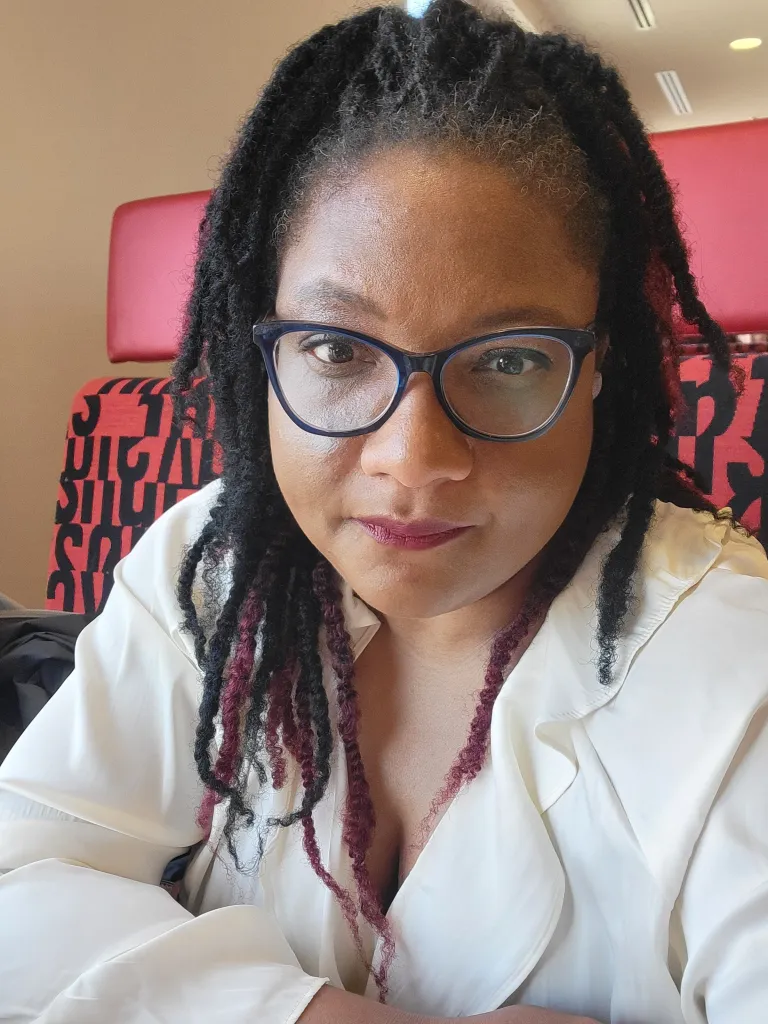
Your Digital and Analog Life with Jo Davis

Coloring book designer, writer, and creative, faculty member, Jo Davis shares her story with you. Faculty, do you use paper and pen? This interview touches on life offline too.
As a writer, Jo Davis is used to sharing through her online presence. In this episode of The Social Academic, we talk about her life online such as her digital portfolio. And, offline through the coloring books she designed, the Starseed Panic Pages, and journaling. What does it mean to be intentional about your digital and analog life as an academic? We talk about focus and what it can do for your brain to be on paper.
I’ve admired Jo Davis’ writing for years. I followed her on X after reading one of her movie critiques. When she shared a recent podcast appearance on the Moments that Define Us, I thought she was perfect to come on The Social Academic to talk about her life online and on paper. And, what it means to be her authentic self.
P.S. Jo’s workshop, Writing Through The Noise: Letters to the Inner Child is coming up. There’s 2 session to choose from: August 8 and 9. You may find it helpful, here’s info about her workshops for you.
In this interview
Meet Jo Davis
[Jennifer van Alstyne:] I’m Jennifer van Alstyne, thank you so much for joining me here on The Social Academic. This interview series is about online presence for faculty, for researchers, and I’m so excited because today I’m going to be talking with Jo Davis. Jo is a writer, she’s a faculty member, and she has this rich digital and analog life. I thought this interview would be fun because you have this practice of doing things on the page. And I think that’s different for some people. Would you introduce yourself, Jo?
[Jonita ‘Jo’ Davis:] Hi, I’m Jo. I am everything you said. I am a writer. I’m an author. I call myself a creative because I’m little of everything. I do photography, art, and the coloring books. I’m also a film critic. Find me on Rotten Tomatoes. I teach, mostly composition and rhetoric. I’m really, really big on that. Yeah, I’m all over the place, but there’s a point to it. I enjoy my career. Thank you for having me on.
[Jennifer:] Thank you. I am curious, when you do all of these things, it’s probably kind of hard to bring all of those identities together. I know you have a website. You’re on social media. What do you do to kind of balance things in terms of your digital portfolio?
[Jo:] I don’t. I tried to in the beginning. I really, really tried to in the beginning because there were people that were telling me, my colleagues that, “You need to have a niche, a focus, so that people know when they’re recommending you, when they’re thinking about using your work.”
I’m freelance writer as well, freelance journalist. So they know what to recommend you for. To me, that’s like putting myself in a box because I’m all over. I like so many things. I find so many ways to put ’em all together. Teaching, the writing, and rhetoric. I use rhetorical analysis in my film reviews, and also in my journalism, and cultural criticism. A lot of my articles, I’m picking apart either some new story or a movie using the same thing that I teach in a classroom. With my photography, when I explain the photos, the rhetorical analysis is there.
Then with the coloring books, those are just sort of, just my way of calming down, coming down from it all. That’s where I kind of put that in there. It’s almost like having this very busy, vivid world with rhetoric and exploring it, and teaching it, and writing about it. And then coming down by using the coloring books. The coloring books are for neurodivergent people. So people who have a lot going on anyway. My people understand me, you know?
Brain-hand connection and life on paper
[Jennifer:] Oh, I really like that. What is it about being on the paper and doing something in that coloring book? Or, I believe you have a journaling practice as well. What is it about doing something on the paper that’s different than, say, creating something in the digital space? Like your writing?
[Jo:] I’m really old fashioned. I found an article, there’s actually been studies done that kind of explore the brain-to-hand thing and handwriting. It’s been known that there is a connection. There is a connection. And, journaling I know from personal experience, I know from teaching writing prompts that are like journaling prompts, and from feedback from my students, and in my workshops that journaling, when you’re writing by hand, it causes almost this trance-like effect, almost like meditation, and it lets you get into your brain underneath what you’re conscious of. It gets you into all those things that you’re kind of pushed back, but you’re not really wanting to think about, that you’re not trying to think about. But it does it in a way that’s kind of guided, especially with the guided journaling. The page for me, there’s kind of this brain-hand type of connection that unlocks a lot in the brain that I don’t think you’re going to get digitally because there’s so much going on on the screen.
[Jennifer:] I really feel that. I’m a writer. I’m a poet, but so much of the work that I do is through, The Social Academic, The Academic Designer. I’m working on websites, I’m working on social media. And that digital life puts me in a very different creative space than if I am like actually sitting down and taking notes, actually sitting down, working on the paper. And so I actually try to intentionally create spaces in my work where I can do this activity, outside, in the garden on paper, and how different that is for me, how generative it can be in just like this different space and different mode of thinking through things. Why coloring books?
[Jo:] Because I use coloring books.
[Jennifer:] Yeah, you use them.
[Jo:] I mean, that’s, that’s the start of it. I actually started these coloring books to help me because I was going through a divorce and needed to like, stop the noise in my brain. The anxiety. I have anxiety, I in, my separation at the time was so chaotic. There’s so much going on that my panic attacks that I used to have when I was younger came back. So having to calm the panic, calm the, the noise in my brain. I also was going through a lot. I had my two youngest kids in a new state. We were, we were unhoused. We didn’t, we were living in a hotel and I needed, I didn’t have a job, so I needed to find work, find housing. I needed to, well get the kids established in school and everything, which I did pretty quickly. But, that’s a lot of paperwork. I don’t know if you’ve never been in that situation, it’s a pile of paperwork. It’s really hard. Your brain is so enmeshed in emotion to where you can’t think. And my ADHD was on, I say 10 is the highest? My ADHD was like on 50, so I really needed to like stop the noise.
Calming down was not even the point at that point. It was stopping the noise. Coloring did it, but not for a long time. And, it didn’t do it all the way. Then I ran out of coloring books. Coloring books are expensive…
Designing coloring books
[Jo:] I had moved to Colorado and didn’t realize how expensive everything else is in Colorado. It’s like everything is more expensive, in Colorado vs. Indiana. So I grabbed my kid’s sketch pad and started doodling out coloring pages and started putting the numbers in as a way to kind of finding the numbers as a way to kind of hyper-focus on the page. Turn away from whatever you were thinking about before, whatever you were obsessing about before, whatever puts you in that emotional state.
It forces your brain to turn away from that and focus on the page. There’s coloring, which is soothing. Counting is a calming technique. I bury the numbers where you have to cross your nose several times, and then look up and down. It’s called crossing the midline. It’s a calming technique. I think of it as self hypnosis in a way, not totally, so I don’t want anybody to freak out. But it’s almost like it gets you into that trance-like state to where you are now focusing on this coloring page. And you will calm down.
There are people on TikTok who have actually posted reviews saying they calmed down when they’re doing my coloring pages. There’s a woman who used my coloring book. Her sister brought the coloring book for her to use during her treatment. She has an illness and she said she has to have nine hour treatments. And she used the coloring book during her treatment session. It just flew by. So I get it.
There’s a lady with social anxiety. She didn’t put anything on TikTok, but she reached out in Instagram. Not social anxiety, but with an anxiety disorder. She said, just doing a page calmed her down. So putting all those things together into one page.
I also did it because if you have ADHD like me, you have to trick your brain. So it’s almost like having to study with music on. You have to have something there for your brain to like focus on in the background while you’re doing. That’s why there’s so many things to do on the page.
Sometimes people who aren’t neurodivergent kind of find the coloring book to be a bit much. But it has to be a lot for the neurodivergent brain to really focus on and to, quiet everything that’s going on. And so I found doing all that in those pages. And yes, surprisingly, even though I bury the numbers in the page, I still have trouble finding them, which is the point. That’s the point. They help me to calm down.
I was able to find a job at a local newsroom and was able to get a place. We were only in the hotel for like six months. They [the coloring books] really helped.
[Jennifer:] Oh, it sounds like the coloring books saved you in terms of your brain space and being able to move forward. I’ve been in a place of trauma and grief and dealing with mounds of paperwork at the same time when I needed to get divorced after leaving a domestic violence situation. And I, I couldn’t move forward. Like, if I had something like this that could really have snapped my brain into focus on anything, any, like, anything, it would have been, I mean, life changing for me.
[Jennifer:] What does it feel like when you’re in that mode, when you, when you are able to focus on the page, on the coloring that you’re doing?
[Jo:] Well, I can show you, I have a book here. So one of the pages, this is panic pages for Pride. So this is a book I did for Pride month and also because there’s, I wanted a space for my L-G-B-T-Q, siblings, cousins, whatever you want to call it, community to kind of use, because neurodivergence is everywhere. Let me find a page.
My designs are kind of weird sometimes, but they’re designed to be, let me try one, okay? This is one that I’ve used a lot. So this is not anything that’s going to be, yes, there’s hearts, you kind of know what those colors are, but you’re really going to have to be able to, to concentrate on the designs, the color, the, the color of everything. Let me show you. So I think one is right there. So you’re coloring this piece of this larger heart. So you’re going to be thinking about, “Okay, I got to keep my design together. What, what color scheme do I want for this heart? What color?” This is the flag. And if you’re not, if you’re like me, I don’t remember how the flag goes. I mean, not the flag, the rainbow. Sorry, rainbow. So I don’t remember the colors of a rainbow and how they go. So I have to remember those and keep that straight and then figure out the, the scheme for every, everywhere else. But the numbers are where you’re not, this one here, two is not in this heart, it’s not two is somewhere else on the page. So when you leave this heart, you’ve got to remember and then go to two.
I call it meditation because after a while, the only thing you’re focused on is finding numbers and keeping your colors together and figuring out, “Okay, do I want these hearts to be red? Okay, but they’re going to be touching part of the red rainbow here. So do I want these hearts to be maybe pink? Okay, if they’re pink, what’s the background going to be? Is this a bush, is it a cloud? What is this happening here?” So that’s what you’re thinking about as you’re doing all this. Is this like maybe a rainbow coming up from the ground, or is it in the sky? And these are all clouds with stuff in ’em, you know, what are you doing? And when you find two, three, you’re hopping from here to here. I can’t see where the numbers are. Oh, two, right, two is right here actually. And then three is over here. You’re hopping all over the page. So much to where that’s all you’re thinking about. Nothing else. There’s nothing else going.
I recommend putting on music in the background. If you do, it’s like you’re in another world for the, however long this page takes, which is about 30 minutes to an hour, depending on how good your number hunting skills are. So, yeah.
[Jennifer:] Oh, that is so fun. Where can people find your coloring books, The Panic Pages?
[Jo:] I have a TikTok shop if you’re on there. So just go to Starseed Panic Pages. That’s my account there. And then I have a Shopify account, a Shopify shop called the Panic Pages Book Shop. You can find ’em there. They’re also, I have a few on Amazon, I move distributors so that they’re not there anymore. The rest of them are not there. But there’s a series of 10 so far. I even have Panic Pages for Resistance. So that one, if you’re just, that one’s for people who are frustrated with what’s happening in politics right now. There’s a lot there to get your, your everything out.
I do want to point out that my Panic Pages, especially one for resistance, also has journaling pages in, in them. So, they’re line pages, so you can just write. There are also journal prompts in here. Like one picture is the word calm, and then you’re writing about calmness. The prompt tells you to basically to write about calm stuff right here. And then there’s a prompt in the corner and then pages, because it all works to calm the noise. And so sometimes after writing a page, there’s still some stuff in there you maybe want to jot down. That’s what that’s for.
While I’m still tooting my own horn, I just came out with what I call the calm kit, which actually has 10 journal prompts, three panic pages, and then an essay by me, well, by me and about me. It’s called How Do You Get Out Of Your Head Touch Grass? And it’s about how I discovered that going to nature helped me to get out of my head when I had postpartum depression. So, and it’s interactive. So I filled out, I figured out the PDFs, how to get the PDFs to work. And so it works on any device. There’s also a, a coloring book that works with any device that’s fillable and they’re both like $7 each, I think. Yeah. So they’re, they’re digital interactive books. I’m going to quit talking, I’m rambling now.
[Jennifer:] No, that is so exciting. ’cause I didn’t know about that one. And so I think that that is a really good opportunity for people to explore. So wait, where can they find that link? Is that on the Shopify or is that elsewhere?
[Jo:] So that’s in Shopify. So the interactive, the digital ones are in Shopify.
[Jennifer:] Perfect.
[Jo:] You can look for the Panic Pages Book Shop.
Expressing creativity through different mediums
[Jennifer:] I love it. Now you’re someone who creates many things. I mean, you’re a journalist, you’re working in the media, you’re working in digital video, all of these things.
I know that you love that creative ability to do all of those different things, but how does your brain decide, “Oh, this idea, this goes with video or this idea, this goes with writing.” Like how does your brain choose?
[Jo:] I don’t know. I don’t know. It just, I, maybe I know neurodivergents are good at pattern recognition, and so I kind of recognize that, oh, there’s a pattern here. There’s a, this connects to this almost like, the Scooby-Doo kids. It’s, this thing connects to that thing. And maybe if I put those two things together with the third thing, then it will work. I couldn’t tell you how it all goes because it’s, I don’t know if you know anybody with ADHD, that we kind of jump all over the place and the thing that triggers the next topic doesn’t always make sense. So I could be talking about a shark and then suddenly something about talking about a shark links me to cell phones, and then something about the cell phone links me to books. Then next thing I know, I’m talking about journaling.
I don’t know how it works. I just, there’s a lot of inspiration I guess. I’m, I don’t know how it works. It just does. And as I, I’m in this space now where I am fortunate enough by working in academia and teaching, that kind of allots me a lot of time to be able to work on these extra things. And I do a lot more just kind of following that ADHD, topic exploration is what, if you, what you’re going to call it. It’s chaos really. It really is. But I know that once I follow that train, it leads back to the station somehow at some point. So that’s the best I can describe that.
Share your writing on social media
[Jennifer:] I have one more question that’s kind of social media related, and that’s, I first came across of you because you had shared an article that you had written about, a movie that you went to watch. I can’t even quite recall which one it was, but it was so poignant when I read the article, I was like, I have to follow Jo on, this is back on Twitter. So this is, this is a while ago. And I really, I think so many faculty, even if they’re writers or journalists in another area of their life, they struggle with that idea of, I want to share my writing or, I need to share my writing, or I should share my writing.
How you feel about sharing your writing on social media or the things that you create. Do you ever feel like you should or shouldn’t? I’m curious what your thoughts are about that.
[Jo:] Oh, I’m all about sharing. What use is it if it stays in my head?
I mean, it’s not going to work. I mean, it’s not going to do anything, anybody, any good staying in there. And it’s like, I tell my students you have to share your work to find out, basically one, if it’s, if it actually makes sense, because sometimes in our brain, something, it seems like the next thing, the very, very next best invention since sliced bread. But when you put it on paper, it doesn’t work. You also share your writing because that’s how people connect. You tell a story, and then I’m like, “Oh, I had an experience like that.” And I tell a story and then all of a sudden we found similarities and we can like connect with one another. People also love personal essays because they find, they have that, “I thought I was the only one type” of recognition.
Even with my film criticism, a lot of times I find myself pointing out little pieces and bits in a film and putting those parts together in ways that people may not think about the first time they watch through. So they’ll go back, have to go back. So it’s a lot of different reasons why I found that I share my writing. And I share everything because, and as a writer, I don’t know, there’s something about having your writing and not sharing it that’s like almost an itch that grows and grows and grows until you put it out. Does that make sense?
[Jennifer:] It does make sense. ’cause I felt that at times, but I don’t feel that way about all of my writing. Honestly, I have a stack of poetry that I have not submitted for publication. I haven’t shared like, anywhere probably. It’s been years since I’ve done that. And so when I think about that itch, when I think about what I want to share, like I really appreciate the value of needing to share that you bring into what you post on social media. Because I really don’t think everyone has that. And some people are afraid of that because that maybe they’re like your students and they are like, “Well, does this work or does this not work?” And there’s this fear or hesitation that might stop them. So I love that you share everything.
[Jo:] Well, that’s not everything. I do have a series of short stories that I may put out, I’m not sure. But I wrote them while I had postpartum depression and they’re actually horror stories. This is my therapist idea. I had really bad anxiety during, when I had postpartum depression with my youngest daughter. She happens to be a Scorpio, for those of you who are into horoscopes. So you all prob, you all know. Anyway, from the moment she got here, she was a great baby. It’s just that my postpartum depression with her was, it was just “Grr.”
My now ex-husband asked me how did it feel? And I told him that it’s like I’m on Twilight Zone and the the with the clock that’s like winding backwards and it, the dial keeps going, going faster, faster, faster, and it get keeps getting darker. And you know how the clock just sort of goes in The Twilight Zone? It just goes, keeps going and spreading and getting weirder and weirder.
[Jennifer:] Yeah.
[Jo:] That’s how it felt. So my therapist is like, “Channel that into, into a story, tell a story, what kind of story can you tell using some of the components of your PPD?” And so I wrote about five horror stories and they’re on the level of maybe The Hills Have Eyes and Saw. They’re, they’re pretty, yeah. The, the tamest one is the prisoner, and it’s a woman who’s trapped in, she’s in her body, but she’s in a cage in her brain, there’s this figure of a man who’s almost like a circus, one of those old fashioned circus tamers, lion tamers in a circus. And he’s taunting her as she watches her body and someone controlling her voice, someone controlling her limbs, someone acting on her behalf with her family, and she’s not doing it. So she has to watch this happening and this guy’s taunting her. And yeah, it turns out, I’m not going to give away the end, but that’s, that’s the story. And it’s horrifying to think about it. But with postpartum depression, you kind of feel like there’s a separation between your mind and body and you’re on autopilot a lot. It was a way to kind of describe that.
[Jennifer:] Oh, I want to read that collection of stories, that sounds really interesting. And what a interesting spark for horror. I think that makes so much sense. Ah, I’m fascinated by that. Oh, Jo, this has been such an interesting conversation. Is there anything you want to chat about before we wrap up?
[Jo:] Hmm. I mean, I’m pretty open to anything, but I just wanted to say too about the sharing everything, that itch comes only when there’s something that I, I wrote that I was inspired to write by something else.
[Jennifer:] Ooh.
[Jo:] And if I sit on it for too long, it just sort of, kind of gets at me, but not, it doesn’t happen for everything.
It’s not going to happen for everybody. So some people who are out there is like, “Well, I wish I could share everything.” Well, I mean, if you don’t have that urge, you don’t have that urge, and that’s okay.
[Jennifer:] Yeah.
[Jo:] That is okay. It’s okay not to share everything out there. It is so okay. It is so okay. If you’re the type of person, well, there’s some things I feel prepared to share and sometimes not. That’s okay too. So, yeah. And it’s, I, if anything, I would like to kind of inspire people to be their authentic selves.
I guess that would be the final topic is talking about that authenticity.
Being who you are as an academic, authenticity
[Jennifer:] Is there, I’m curious, is there a way that maybe you felt like, maybe you weren’t your most authentic self in the past and that you’ve really, embraced and done more of recently?
[Jo:] Oh, yeah. There were times, and I wrote about it. So I, when I first started teaching at universities, I taught at Purdue. I wrote about this, there’s an article on Zora and Zora Magazine that says that the English professor teaching MAGA babies is not all right. And I wrote about teaching in central Indiana, at a satellite campus. And I was always the first black teacher these students had, and they were predominantly white. And I had a scripted way of going about things. I was really, really hesitant about being my authentic self. And turns out, my department wasn’t, wasn’t okay with my authentic self. And I wasn’t really giving them everything I’m giving now, with the purple hair and everything else. I wasn’t giving them all that. And I still, that it still did not go well for me. That was still around the time where I was like still listening to things I heard growing up, which most neurodivergents will tell you. They hear the same thing. You’re too much, you’re too wild. You got to be a certain, you got to look a certain way. You got to dress a certain way, you got to talk a certain way. No, you can’t talk about certain things at certain places. And, that all came down to I couldn’t be me. And that whole point in my life, I think just taught me that even when I’m following the rules, I still cannot win. During that time, those, I, had a group of students who did not like my policies, who went to my department head and told her that I was unapproachable as a professor, and they used a couple other that were dog whistle-y type terms, to basically have my department head tell me that I needed to change my hair, my dress, the way it talked, I need to make myself more approachable to.
And I told her, you’re telling a black teacher/ instructor that she had, needs to change herself to make herself more approachable to white students. Didn’t, she didn’t get it. She didn’t get it. And so I ended up saying that again to another, to her boss. And the look on his eyes just went wide. And he’s like, okay, let’s stop and talk about this. I ended up not going back, not teaching again.
They wanted me to take a training or something, and I’m like, “What?” I, at that point, I’d published steadily in the Washington Post. I think I was publishing there. I’d published all over and in places where they hadn’t, couldn’t even break in. So I’m just like, “I’m more experienced as a writer. You all trained me as a professor, so I don’t need this. And I moved over to a couple colleges in Illinois and just sort of decided I was going to be me. So, and that’s the, that was the start of me just kind of slowly letting myself just kind of unravel and be who I wanted to be. And now these days I show up as myself and it’s shocking how much that it, that people just kind of relate to it and love it.
I mean, at the University of Denver, my first, we call it evaluation. My department had came to my classroom and my students knew that I had, they knew, I tell them I’m neurodivergent my first day. I mean, I introduced him to my fidget dragon and no joking. I tell ’em about that, about it. And so they knew that I get off on tangents and they, we had a warm-up exercise. We were sharing our writing, and somebody wrote about Bumblebee bats, and she’s like, “I got to show you this bat. You’ll love it.” Knowing that was going to get, so we were derailed for 10 minutes about Bumblebee bats, and my department head’s in the back of the room, and I’m just like, “Oh man, I’m going to fail this.” So I get everybody back on track. We keep going with the lesson. He talks to me about my evaluation later on.
He goes, “No, I loved it. It was fun. I loved the way-” And so I’m like, okay, okay. And he said that it was the way I related to the students, and just kind of went with the flow with what they were doing. I still got my lesson out, but he liked how I just kind of, I wasn’t so rigid with the students, you know? So that was great. It was great hearing that but, but it was shocking at first. It was like, really? You thought it was, okay, all right. Okay. I’m not going to push that too much.
Yeah. So I’m finding out being authentically me is fine. It’s perfectly fine. It’s great. And I, I’m now trying to help inspire people to be themselves as much as they possibly can.
[Jennifer:] Oh, I love that so much. I feel like, so I was adopted and I feel I grew up with a lot of, kind of similar constraints on how I showed up, what I did with my time. Even my thinking process was very constrained. And so I feel it wasn’t really until I was an adult that I was like, what is my authentic self even?
Many of the professors that I work with, they come to me and they say authenticity is something that they want for themselves and they value, but that also comes with being intentional and thinking about ourselves, which is sometimes uncomfortable.
A letter to yourself
[Jennifer:] Is there maybe a prompt or something that like you might journal on to help you be more authentically yourself?
[Jo:] Yes. Actually, great segue, because I have a, a journaling workshop I’m doing on August the eighth and the ninth, and it’s about writing a letter to your child self, your inner, and connecting, reconnecting. Going back to a time when you were kind of questioning, you were kind of wondering or just any time that people just because I at some, when you get to be my age, I’m 45, you’re all the time thinking about way back, you’re nostalgia is all around us. Think of a time, of a memory.
- How old were you then?
- Who were you then
- What did you want for yourself then?
Through the workshop, the letter to yourself is kind of the last journal prompt. But I have a couple of different prompts before that, they kind of get us working toward that letter. And at the end, that letter is usually, and I’ve done this prompt like twice now in workshops, first with the Dress for Success ladies here in Denver. And then with Point Creative Supplies.
The workshop both times tears all around, men and women because by that time, you, you’re people are thinking about, “Hey, what did I, what did I stay true to when it comes to myself at 14, 9, 16, even 21? “Am I being, am I staying true to that person? What do I need to do to get back to whatever that person had goals for, plans for, goals for?” And what are some of the things that maybe were, just a little bit of, farfetched then that probably are not going to happen,” But just a little bit of that. I don’t dwell on that, but it’s like, “What is it about me now that my person that I would be proud of if I could see myself, my 14-year-old self could see me. And then kind of writing to that kid and telling that, giving that kid instructions on how to find their own authenticity in their own way. So yeah, it’s about an hour and a half. Usually stretches to two hours. Yeah.
[Jennifer:] Is that workshop like open to the public? Like can people listening to this register?
[Jo:] You can register in the Panic Pages Book Shop. There’s a sign up there.
Perfect. I’m going to share the link to that under the video if you’re watching this later. And in the blog post, so August 8th and 9th, probably one and a half to two hour workshop, and at the end you’ll have written this letter to yourself. Oh, I love it. I’m so glad that came up.
[Jennifer:] Is there anything else you want to add before we wrap up?
[Jo:] No, that’s it. Well, yes I do. So the workshops on the 8th and 9th, that’s because I let you choose. Friday night or Saturday morning.
[Jennifer:] Okay, perfect. That will work for more people’s schedules that way. I love that. Okay. So everyone, thank you so much for joining us for this episode of The Social Academic. I’ve been talking with Jo Davis about your analog and digital life. Jo, where can people connect with you after this?
[Jo:] Social media? I’m all over the place. So if you type in Jo, my full name and put it l in the middle of the, the Jon l Davis, you’ll find me on Instagram and Facebook. On TikTok, I am Starseed Panic Pages, and then the Panic Pages Book Shop on Shopify. I also have a website. It’s my name.com, jonitadavis.com There’s also a panicpages.com But if you find me on any platform, there’s a list, what did you call it? Linktree, there’s a Linktree that’ll take you everywhere. Find me one place, you’ll you’ll find me everywhere.
[Jennifer:] I love that.
[Jo:] Yeah. You can also Google my name. I’m Google certified, so you can Google my name. Though, you’ll get tons of articles and everything else.
[Jennifer:] Perfect. Jo, thank you so much for coming on The Social Academic!
Subscribe to The Social Academic blog.
The form above subscribes you to new posts published on The Social Academic blog.
Want emails from Jennifer on building your online presence? Subscribe to her email list.
Looking for the podcast? Subscribe on Spotify.
Prefer to watch videos? Subscribe on YouTube.
Bio
Jo Davis is a professor, author, freelance writer, film critic, artist, and a beacon of creativity. She teaches writing and rhetoric at the University of Denver.
Here’s her episode of the Moments That Define Us podcast, “You need to find calm in the noise”.