SMS + Email Nudges That Work
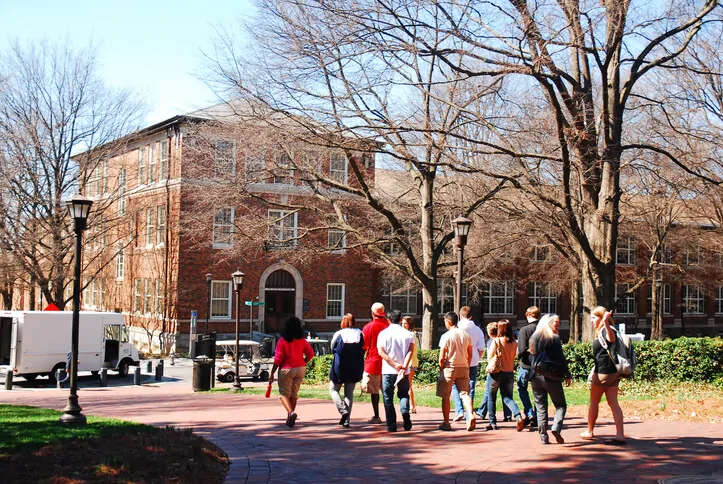
“No-shows” are one of the most preventable leaks in the student recruitment funnel. Institutions already invest heavily to generate registrations through paid media, landing pages, and outreach. When a prospective student misses a campus tour or information session, the impact goes beyond an empty seat. Staff time, event capacity, and an important moment of engagement are lost.
Many institutions treat attendance as a simple reminder issue. In reality, reducing no-show rates requires removing friction, reinforcing the value of attending, and making participation easy. Prospective students often miss events because the next step feels unclear, scheduling conflicts arise, or the event’s value was never reinforced after registration.
The solution is not more communication, but a structured system. Effective institutions combine confirmation emails, calendar integration, SMS nudges, and clear rebooking pathways to keep prospects engaged between registration and the event itself.
When SMS and email are coordinated strategically, they guide the prospect through the final stage of commitment. The result is higher attendance, better use of recruitment resources, and stronger engagement with students already showing intent.
Start by Measuring the Right Thing: No-Show Rate vs Attendance Rate
Before adjusting reminder cadence or communication frequency, institutions must define what they are actually optimizing. Two metrics matter: no-show rate and event attendance rate, and each reveals a different performance issue within the recruitment funnel.
The no-show rate measures the proportion of registrants who did not attend the event, calculated as registrations who did not attend divided by total registrations. The admissions event attendance rate measures the proportion of registrants who actually attended, calculated as attendees divided by total registrations.
These metrics should be interpreted together. If the attendance rate remains flat while registration volume increases, the issue may be weak follow-up or insufficient pre-event engagement. If registration volume stays consistent but the no-show rate declines, operational efficiency and conversion performance are improving.
Institutions should also separate hard no-shows from soft no-shows. Hard no-shows involve no check-in, no virtual join, and no response. Soft no-shows include late cancellations, rescheduling, or “couldn’t make it” responses. These soft no-shows are the segment where automated rebooking workflows deliver the greatest recovery opportunity.
Why Does a No-Show Occur: It’s Usually Friction, Not Disinterest
Most prospective students do not skip campus tours or information sessions because they have lost interest. In many cases, they still intend to attend. The real barrier is usually the friction introduced between registration and the event.
Common sources of friction include:
- The event was never anchored to a calendar. Students register but forget because the session was not automatically added to their schedule.
- Logistics are unclear. Questions about parking, check-in, location, or what to bring can create hesitation.
- Anxiety about fit or expectations. Some prospects worry about the formality of the interaction or whether they will feel comfortable attending.
- Registration happened too early. Plans change between registration and the event date.
- Virtual access issues. The event link may be difficult to locate, or it may be buried in spam or promotions folders.
This is why an effective SMS and email nudge system should focus on three operational goals:
- Confirm the registration and anchor logistics early, ideally with calendar integration and clear directions.
- Reduce uncertainty shortly before the event, reinforcing where to go, how to join, and what to expect.
- Provide an immediate rebooking option if the student cannot attend.
Example: Wellesley College, after a campus visit registration, Wellesley reduces logistical friction by sending visit-specific parking instructions and publishing clear directions/parking guidance. Wellesley’s approach centers on friction removal: it sets expectations about travel time and provides exact arrival routing and parking options. Critically, it states that after a visitor registers, the institution will email specific parking instructions, helping ensure registrants don’t have to hunt for logistics before arrival.
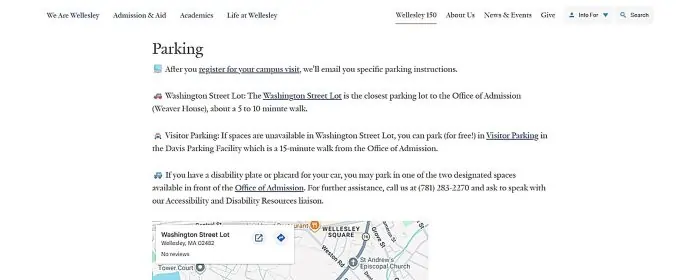
Source: Wellesley College
Email vs SMS Reminders: Which One Reduces No-Shows More?
The most effective answer is not choosing between email and SMS. It is sequencing them intentionally so each channel performs the task it handles best.
Email remains the channel for context and reassurance. It provides space to explain logistics, outline the event agenda, clarify who the session is for, and reinforce the value of attending. For campus visits and information sessions, email also supports practical details such as parking instructions, check-in locations, accessibility information, and what prospective students should expect during the event.
SMS, by contrast, works best as an action-oriented prompt. It delivers quick confirmations, real-time reminders, and simple links that guide students toward the next step. A short message reminding a registrant that their event starts soon, or providing a direct join link for a virtual session, often removes the final barrier to attendance.
For Canadian institutions in particular, SMS should function as a supplementary channel rather than the only communication method. Guidance from institutions such as Johns Hopkins emphasizes that text messaging should complement email communications and avoid transmitting sensitive information.
Example: Johns Hopkins’ Registrar policy states that texting must be supplemental and refer students back to official channels like Hopkins email or web alerts. It also prohibits including personally identifiable information (including education records) in texts, and recommends using institution-managed/reviewed platforms, constraining risk while still enabling operational nudges.
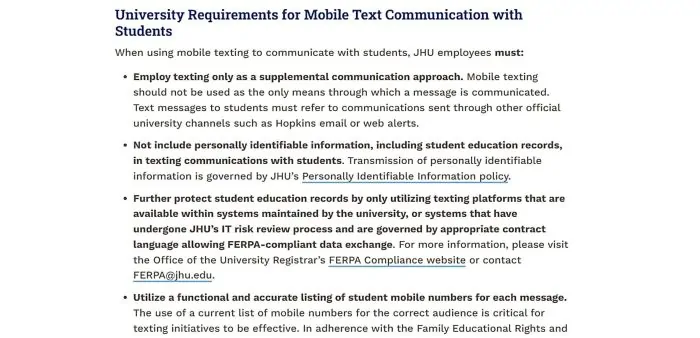
Source: Johns Hopkins University
A practical system, therefore, looks like this:
- Email carries detail and reassurance
- SMS carries timing and “do the thing now” prompts
- Both point to the same next step
The Reminder Cadence That Actually Works
You do not need ten reminders to reduce event no-shows. What matters is delivering the right three to five touches at the right moments, aligned with registration timing and event type.
Example: A useful reference comes from Stanford University’s Tour Guide Information Sessions. After registering, attendees receive a confirmation email immediately, followed by a 24-hour reminder, and a final reminder approximately two hours before the session. This multi-touch structure works because each message supports a different stage of commitment.
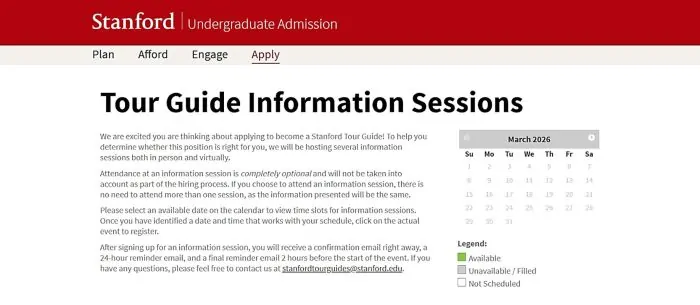
Source: Stanford University
The cadence typically covers three behavioural checkpoints:
- Immediate confirmation (commitment): reinforces the registration and anchors the event in the student’s mind
- Day-before reminder (planning): helps the registrant prepare logistics such as travel, schedule adjustments, or virtual access
- Two-hour prompt (action): provides the final cue to attend or join the session
Example: For virtual events, the University of Edinburgh uses a similar logic. Registrants receive a confirmation email containing an e-ticket and joining instructions, followed by a reminder email on the day of the event to ensure the access link is easy to find.
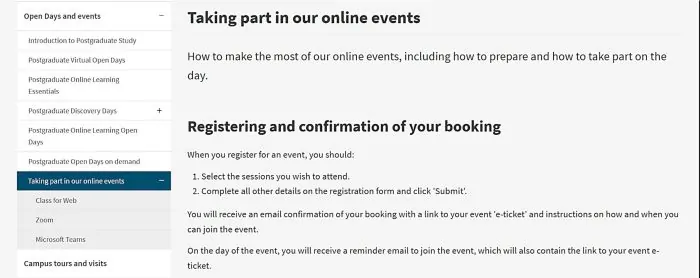
Source: The University of Edinburgh
Institutions can use these patterns as the behavioural framework, then adjust the exact timing depending on event type, lead time, and audience segment.
SMS Reminders for Events: Rules That Prevent “Spam” and Protect Deliverability
SMS reminders can significantly reduce event no-show rates, but only when they are managed with clear governance. Text messaging is a high-attention channel, which means poor practices can quickly erode trust or trigger opt-outs. Institutions that scale SMS successfully treat it as a structured communications program, not a casual reminder tool.
Effective SMS governance typically includes the following principles:
- Consent-first approach: collect explicit opt-in wherever possible, often through inquiry forms, registration pages, or admissions portals.
- Easy opt-out controls: every SMS program should support standard STOP and HELP commands so students can manage communication preferences.
- Message discipline: fewer, well-timed reminders perform better than frequent or repetitive texts.
- No sensitive details: avoid including personal data, application status updates, or confidential information in SMS messages.
Several institutions publish transparent SMS policies that illustrate these practices.
University of Michigan–Dearborn documents a consent-first SMS program: prospective students opt in via a form checkbox or by texting a JOIN keyword, and admissions texting is explicitly used for “event reminders” and deadlines. The published terms also document opt-out via texting STOP (and that a confirmation message follows), which supports list hygiene and trust while keeping SMS viable as a nudge channel.
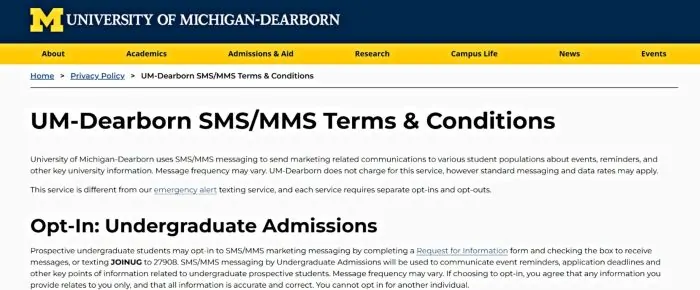
Source: University of Michigan–Dearborn
Similarly, Penn State Undergraduate Admissions outlines its SMS communications policy. Students opt in through the MyPennState portal, texts are positioned for time-sensitive operational updates (including event reminders), and recipients can opt out via STOP or request help via HELP. Penn State also explicitly warns that students should not provide personally identifiable or confidential/sensitive info via SMS.
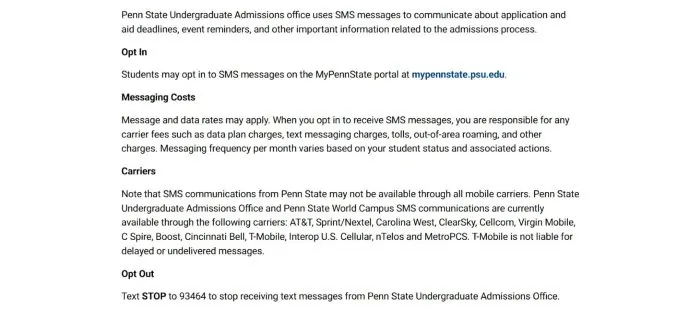
Source: Penn State University
For institutions aiming to reduce no-show rates without compromising trust, these governance standards represent the baseline for responsible SMS use.
Tour Confirmation SMS: The Message That Prevents the First No-Show
A tour confirmation SMS should be short, clear, and operational. Its purpose is not to persuade or promote. Instead, it ensures that the registrant knows exactly when and where the event takes place and what to do next. When structured properly, this message anchors the commitment immediately after registration and reduces the likelihood of early drop-off.
Unlike email confirmations, which often contain detailed logistics and supporting information, SMS works best when it focuses on essential details and a single action. Prospective students should be able to read the message in seconds and immediately understand the next step. In most cases, this means confirming attendance, saving the event information, or accessing directions and logistics.
Because text messages operate in a high-attention channel, clarity matters more than tone or branding. Institutions should prioritize operational details such as the event date, start time, meeting location, or virtual link, and one practical logistics cue. A simple instruction, such as arriving early or reviewing directions, can significantly reduce confusion on the day of the event.
Below are practical, copy-ready examples that illustrate this approach. Institutions can adapt these messages to their voice and policies.
- Tour confirmation SMS
“Confirmed: your campus tour is booked for [Day, Date] at [Time]. Start point: [Building]. Details: https://www.higher-education-marketing.com/email-marketing/reducing-campus-tour-info-session-no-shows-sms-email-reminders. Reply C to confirm, R to reschedule.” - Tour confirmation SMS
“You’re booked for a campus tour at [School] on [Date] [Time]. Parking + check-in info: https://www.higher-education-marketing.com/email-marketing/reducing-campus-tour-info-session-no-shows-sms-email-reminders. Can’t make it? Reply R to rebook.” - Tour confirmation SMS
“Thanks for registering. Campus tour: [Date] at [Time]. Save this link for directions: https://www.higher-education-marketing.com/email-marketing/reducing-campus-tour-info-session-no-shows-sms-email-reminders. Reply STOP to opt out.”
Campus Tour Reminder Text: Templates That Reduce The No-Show Rate
A campus tour reminder text works best when it removes the final barrier to attendance. The most effective reminders focus on logistics, timing, and simple actions. When the message answers “Where do I go?” or “What do I do now?” the likelihood of attendance increases significantly.
A structured reminder sequence typically includes messages sent 24 hours before the event and again shortly before the start time. These messages should reinforce logistics and provide a quick path to reschedule if plans change.
24 hours before the event
- Campus tour reminder text
“Reminder: campus tour tomorrow at [Time]. Parking + check-in details: https://www.higher-education-marketing.com/email-marketing/reducing-campus-tour-info-session-no-shows-sms-email-reminders. Reply R to rebook.” - Campus tour reminder text
“See you tomorrow at [School]. Tour starts at [Time]. Please arrive 10 minutes early. Map: https://www.higher-education-marketing.com/email-marketing/reducing-campus-tour-info-session-no-shows-sms-email-reminders.”
2 hours before the event
- Campus tour reminder text
“Today’s campus tour starts in 2 hours ([Time]). Start point: [Building]. Directions: https://www.higher-education-marketing.com/email-marketing/reducing-campus-tour-info-session-no-shows-sms-email-reminders.” - Campus tour reminder text
“Quick check: still on for your campus tour at [Time]? Reply Y to confirm or R to reschedule.”
Optional operational messages
- Running late option (useful for commuter-heavy markets)
“If you’re running late for the tour, reply L, and we’ll send updated join/check-in info.” - Weather or disruption notice (used sparingly)
“Update: campus tour check-in location moved to [New Location]. Same time. Details: https://www.higher-education-marketing.com/email-marketing/reducing-campus-tour-info-session-no-shows-sms-email-reminders.”
What’s the best SMS reminder schedule for events? A reliable schedule is: confirmation (immediate), reminder (24 hours before), and final reminder (2 hours before). Stanford publicly describes this exact confirmation + 24-hour + 2-hour cadence for registered sessions.
Event Reminder Text Message: Focus on One Clear Action
An effective event reminder text message should always guide the recipient toward a single, immediate action. Text messages are not the place for long explanations or “learn more” prompts. Instead, they should make it easy for the student to attend, join the session, or reschedule if plans have changed.
Because SMS is a high-attention channel, simplicity improves response rates. A reminder message should include the event timing and a direct pathway to the next step, such as joining the session or confirming attendance. The goal is to remove any hesitation in the final moments before the event begins.
Below are practical examples that follow this principle:
- Event reminder text message
“Your info session starts in 2 hours. Join link: https://www.higher-education-marketing.com/email-marketing/reducing-campus-tour-info-session-no-shows-sms-email-reminders. Reply R to rebook.” - Event reminder text message
“Starting soon: [Program] info session at [Time]. Add to calendar: https://www.higher-education-marketing.com/email-marketing/reducing-campus-tour-info-session-no-shows-sms-email-reminders.” - Event reminder text message
“Last reminder: you’re registered for today’s session. Tap to join: https://www.higher-education-marketing.com/email-marketing/reducing-campus-tour-info-session-no-shows-sms-email-reminders.” - Event reminder text message
“Can’t attend today? Reply R, and we’ll send the next available dates.”
College Tour Confirmation Email: The Structure That Prevents Confusion
A college tour confirmation email should function as the prospect’s single source of information for the visit. If students need to search multiple emails to find directions, parking information, or timing details, the likelihood of a no-show increases. The confirmation email should consolidate everything needed to attend the event smoothly.
The most effective structure prioritizes logistics and immediate actions.
Recommended structure
- Subject line
Confirmed: [School] Campus Tour on [Date] at [Time] - Above-the-fold essentials
Clearly display the tour time, start location, check-in instructions, and parking guidance immediately at the top of the message. - Primary action button
Add to Calendar so students can anchor the event in their schedule. - Secondary action button
Reschedule the tour for prospects whose plans have changed. - Brief experience overview
A short section explaining what attendees will see during the tour, such as academic buildings, student spaces, and opportunities to ask questions. - FAQ block
Address common concerns: accessibility support, weather considerations, late arrival instructions, and whether guests are allowed. - Contact details
Include a phone number and email address for quick assistance.
A simple copy framework helps keep the message clear:
- “You’re confirmed.”
- “Here’s where to go.”
- “Here’s what to expect.”
- “Here’s how to reschedule.”
Example: The University of Alabama provides detailed visit preparation guidance, including confirmation emails that deliver parking passes and allow registrants to edit their visit details.
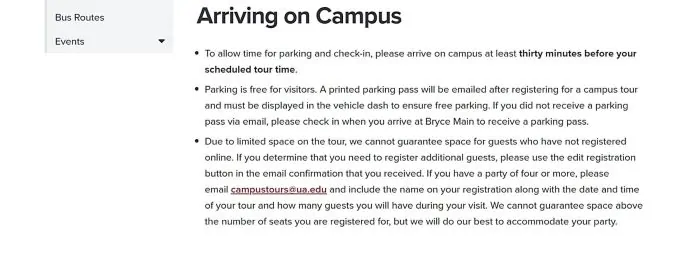
Source: The University of Alabama
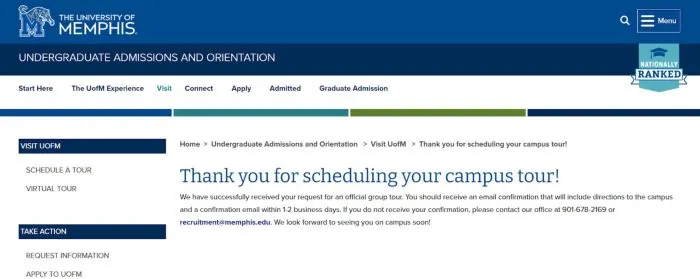
Similarly, the University of Memphis informs visitors that they will receive a confirmation email with directions and event logistics after scheduling a tour.
Source: The University of Memphis
Info Session Reminder Email: What to Include So People Actually Show Up
An info session reminder email should function as a quick checklist rather than a promotional brochure. The goal is to make attendance easy by confirming logistics and setting expectations.
Recommended structure
- Subject line
Tomorrow: [Program] Info Session: Link + Agenda - Event access details
Include the join link, start time, and relevant time zones for virtual sessions. - Brief agenda
Provide a three-point outline, so attendees know what they will gain from attending. - Participation prompt
Encourage engagement with a short note such as “Bring your questions for the admissions team.” - Single action step
Include one clear CTA: Join the session or Rebook if you cannot attend.
The University of Michigan–Dearborn reinforces this coordinated approach by collecting SMS consent during event registration, allowing admissions teams to combine reminder emails with SMS nudges without uncertainty about texting permissions.
Reduce Event No-Shows by Segmenting Reminders
If every registrant receives the same reminder sequence, the messaging is unlikely to match individual circumstances. Effective reminder systems adjust timing and content based on who the prospect is and how they registered.
Start by segmenting reminder workflows using key variables:
- Event type: campus tours, virtual info sessions, and open houses require different reminder details and logistics.
- Lead time: someone who registered two days before the event needs fewer reminders than someone who signed up three weeks earlier.
- Student type: domestic, international, transfer, and graduate prospects often have different concerns and planning timelines.
- Engagement signals: whether the registrant opened the last email, clicked the join link, or ignored prior messages, can guide follow-up.
Segmentation ensures reminders feel timely and relevant rather than repetitive.
This is also where your broader enrolment marketing system should connect. If a registrant ultimately misses the event, that record should not disappear from the funnel. Instead, route the contact into your student lead re-engagement campaigns, allowing admissions teams to offer a rebook option, alternative event, or follow-up resource rather than treating the lead as lost.
In summary, how do you reduce no-shows for campus tours? You reduce no-show rates by combining confirmation, friction removal, and rebooking. Send an immediate confirmation, a day-before reminder with parking and check-in, and a two-hour “action” reminder. If they miss, send one respectful rebook link. Wellesley’s confirmation plus day-before reminder model is a strong reference.
Student Recruitment Event Follow-Up: What Happens After the Event Matters Too
Many admissions teams treat attendance as the finish line. In practice, what happens after the event often determines whether interest turns into action. A structured follow-up system supports application conversion, encourages undecided prospects to take the next step, recaptures no-shows through rebooking, and helps maintain strong email deliverability and list hygiene.
A practical student recruitment event follow-up framework usually includes two tracks.
Track A: Attended
- Email within 2–24 hours: share a recap of the session, links to relevant resources, and clear next steps such as applying, booking a one-on-one meeting, or exploring program pages.
- Optional SMS the same day: if the student has opted in, send a short message prompting the next action, such as registering for another event or beginning an application.
Track B: No-show
- One follow-up message: assume positive intent and provide an easy path to rebook another session or tour.
- Second attempt only if needed: if there is still no engagement, suppress the contact from further event reminders to protect list health.
Rebooking Text Message Template: Turn No-Shows Into Reschedules
When a student misses an event, the objective is not to assign blame or pressure them to respond. The goal is to make rescheduling effortless. A well-designed rebooking message acknowledges that schedules change and provides a simple pathway to select another date.
The most effective rebooking texts are short, neutral in tone, and focused on a single action: choosing a new time. By removing friction at this moment, institutions can recover a significant portion of missed registrations that would otherwise disappear from the recruitment funnel.
Rebooking text message template examples
- Rebooking text message template
“Looks like we missed you today. Want to rebook your tour? Next dates: https://www.higher-education-marketing.com/email-marketing/reducing-campus-tour-info-session-no-shows-sms-email-reminders. Reply 1, 2, or 3.” - Rebooking text message template
“No problem if today didn’t work. Rebook in 20 seconds here: https://www.higher-education-marketing.com/email-marketing/reducing-campus-tour-info-session-no-shows-sms-email-reminders.” - Rebooking text message template
“If you’re still exploring [School], we can hold a new tour spot. Choose a time: https://www.higher-education-marketing.com/email-marketing/reducing-campus-tour-info-session-no-shows-sms-email-reminders.” - Rebooking text message template
“Prefer a virtual option instead? Pick a virtual info session date: https://www.higher-education-marketing.com/email-marketing/reducing-campus-tour-info-session-no-shows-sms-email-reminders.”
When implemented consistently, this rebooking layer becomes one of the fastest ways to reduce long-term no-show rates. Instead of losing momentum, missed events become opportunities to restart engagement and move prospects back into the recruitment journey.
Operational Guardrails (Canada)
For Canadian institutions using SMS in recruitment communications, governance matters as much as messaging. Texting is a high-attention channel, so operational discipline protects both trust and deliverability.
Recommended operational guardrails include:
- Treat SMS as a high-trust channel. Only send messages to students who have explicitly opted in to receive texts.
- Build preference management into your system. If a student opts out of SMS, retain them in email communication where consent exists, but reduce overall messaging frequency.
- Use texting as a supplement, not the primary communication channel. Avoid including sensitive personal information, application details, or other protected data in text messages.
- Follow clear governance models. The Johns Hopkins registrar guidance is a widely referenced example of institutional texting policy, emphasizing consent, appropriate use cases, and privacy safeguards.
- Align with U.S. carrier expectations when recruiting cross-border. Institutions targeting U.S. prospects should ensure their messaging practices reflect U.S. consent language and carrier standards.
For example, Penn State’s SMS terms clearly outline opt-in methods, STOP/HELP commands, and privacy references. This approach enables event reminders and operational messaging while reducing compliance and deliverability risks.
Where This Fits in the Broader Higher Education Marketing System
Reducing no-shows is not an isolated tactic. It is part of a broader, full-funnel approach to student recruitment and enrolment conversion. Event registrations represent high-intent signals, and the way institutions manage attendance, follow-up, and rebooking directly influences downstream application behavior.
Within a coordinated recruitment system, event registrants should be integrated into ongoing nurture workflows rather than treated as one-off contacts. Tour attendees, webinar participants, and open house registrants can move into targeted follow-up streams that reinforce program information, admissions guidance, and next steps.
No-show behavior should also function as a segmentation signal within the admissions CRM. When a prospect misses an event, that data point helps identify friction or scheduling barriers. Instead of sending repeated generic reminders, institutions can route persistent no-shows into structured reactivation workflows. These campaigns can offer alternative event formats, new dates, or additional information that addresses the reason for disengagement.
Handled strategically, event attendance and no-show behavior become valuable behavioral data that strengthens the entire recruitment funnel rather than a simple operational metric.
FAQs
How do you reduce no-shows for campus tours?
You reduce the no-show rate by combining confirmation, friction removal, and rebooking. Send an immediate confirmation, a day-before reminder with parking and check-in, and a two-hour “action” reminder. If they miss, send one respectful rebook link. Wellesley’s confirmation plus day-before reminder model is a strong reference.
What’s the best SMS reminder schedule for events?
A reliable schedule is: confirmation (immediate), reminder (24 hours before), and final reminder (2 hours before). Stanford publicly describes this exact confirmation + 24-hour + 2-hour cadence for registered sessions.
Email vs SMS reminders: which reduces no-shows more?
Email reduces confusion and answers logistics. SMS drives action close to start time. The best performance comes from using both: email for detail, SMS for last-mile prompts. Governance matters too, since texting should be supplemental and not contain sensitive details.