‘We will hold institutions accountable,’ top US education official vows
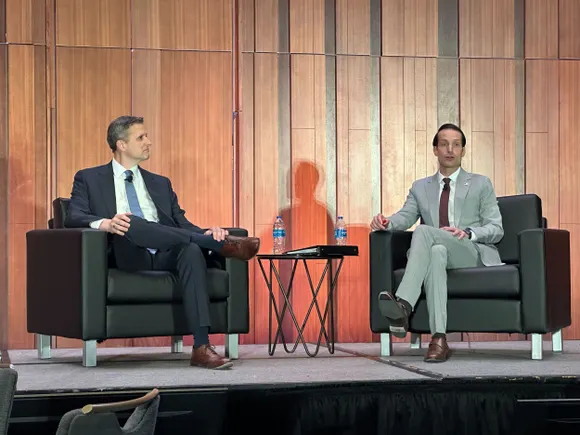
WASHINGTON — U.S. Department of Education Under Secretary Nicholas Kent issued a stark warning to a room full of college leaders Friday during the American Council on Education’s annual conference.
“Too often, institutions have been eager to accept billions of dollars in federal funds while resisting any meaningful accountability for results,” Kent said. “Let me be clear, those days are over.”
Kent outlined President Donald Trump’s higher education policy priorities, including an overhaul of the accreditation system, more civil rights investigations against colleges, and continued efforts to stamp out diversity, equity and inclusion initiatives.
He also said the Education Department continues to work on the Trump administration’s higher education compact, which promises priority for federal research funding in exchange for colleges making sweeping policy changes in line with the federal government’s goals.
Kent’s speech suggests that the massive disruption the higher education system has faced over the past year won’t relent anytime soon.
A new arena for accreditation
Kent described a system that shields “low-performing legacy institutions,” and has fueled “skyrocketing costs.”
“Worse still, the focus has shifted away from measurable student outcomes and towards ideological mandates, including so-called DEI requirements that are unlawful, divisive and inconsistent with our federal civil rights laws,” he said.
Now, the Education Department intends to make good on Trump’s campaign promise to use accreditors as his “secret weapon” to force changes in the higher education sector. Last year, Trump signed an executive order that attacked the diversity standards at some accreditors, prompting some agencies — including those overseeing law and medical schools — to drop or suspend their diversity policies.
The Education Department plans to overhaul the regulations governing the accreditation system this spring. And just this week, the agency released an interpretative rule that aims to speed up the process for recognizing new accrediting agencies — a major policy priority for the Trump administration.
“This isn’t about a race to the bottom,” Kent said. “It’s about breaking up a stagnant and sleepy system while maintaining necessary quality indicators that ultimately lead to student success, like stronger graduation rates, better workforce alignment and higher wages.”
But he also suggested that accreditation would be used to police more than just student outcomes.
“For years, the American public has watched in horror as the most elite campuses were overrun by anti-Western teachings and radical far left groupthink that restricts speech and debate,” he said, adding that the Trump administration has taken “swift, immediate action” against some institutions.
He praised the $221 million deal struck with Columbia University. The Ivy League institution signed the agreement after federal officials suspended hundreds of millions of dollars of its federal research funding and formally accused it of not doing enough to address antisemitism on campus.
Along with the payment to the federal government, the university also agreed to a sweeping set of policies, such as tightening protest rules and reviewing some academic programming focused on regional areas, starting with the Middle East.
“We will not allow accreditors or institutions to continue to turn a blind eye to blatant civil rights abuses and, unapologetically, we will take action,” Kent said. “We will hold institutions accountable, and if you violate the law, we will hold you to the fullest extent of it.”
Massive changes coming to student lending
Jon Fansmith, ACE’s senior vice president for government relations and national engagement, suggested the Education Department is scaling up some of its policy tactics.
“The Department of Education is going to be doing more and more and more to implement systemic change, not targeting one school at a time, not withholding money from one school at a time, but putting the things in place that will impact 4,000 institutions rather than 50 institutions,” said Fansmith, addressing conference attendees Friday following Kent’s remarks.
This spring, the Education Department will bring together different stakeholders in higher education to hash out new regulatory language governing accreditors through a process called negotiated rulemaking.
The Education Department has said it wants to curb diversity standards and explore easier pathways for new accreditors to gain federal recognition. It also intends to pursue regulations governing accreditor standards on faculty and intellectual diversity.
That area is what concerns ACE most, according to Fansmith. He noted that the Trump administration has also asked colleges to prioritize intellectual diversity via its proposed higher education compact, which contains enforcement mechanisms such as faculty surveys.
“Their goal is to force the accreditors to make those changes as well, to become the agents of that policy,” Fansmith said.
Kent also described the Education Department’s efforts thus far to implement the policy changes in the major tax and spending bill signed into law last summer. Among other changes, that bill is overhauling the student lending landscape, including by eliminating Grad PLUS loans and capping borrowing to $100,000 for graduate students and $200,000 for professional students.
Additionally, programs whose graduates fail to meet certain earnings thresholds will lose access to federal student loans and could also be cut off from Pell Grants via a separate test, under a policy proposal the Education Department reached with stakeholders during negotiated rulemaking.
Those policies take effect July 1, though some existing students with Grad PLUS loans will be able to continue to access these loans for three more years or until they graduate — whichever comes first.
“I hope that you all are ready, having made it through the five stages of grief and, most importantly, reaching this final stage of acceptance,” Kent said.
Kent argued that the bill’s policies would put “downward pressure on colleges to lower costs, increase efficiencies and prioritize high-quality programs.”
However, Fansmith voiced concerns that the new limits and the end of Grad PLUS would force some students into an expensive private loan market and leave some unable to pursue a higher education altogether.
He pointed to a recent paper put out by the Federal Reserve Bank of Philadelphia that found about 28% of graduate students who took out loans in recent years borrowed above the caps set to take effect in July.
However, 40% of those borrowers likely wouldn’t be able to get private loans without a cosigner. And those students could also face much higher interest rates in the private market than what the federal government offers.
“It’s nice to hear the department’s commitment to affordability, but when the process in law is pushing students into loans that are at times almost triple the cost of what they’re currently paying, it’s not an effective solution,” Fansmith said.