Universities have a responsibility for the high street too

“Any country that cannot keep its high streets alive, its bills down, and its people feeling respected, will struggle to meet the test of our times.” So said Keir Starmer in Hastings earlier this month, linking the boarded-up shopfront to the broader condition of the nation.
The public mood suggests he has a point. Our polling finds a nation in despair, with public mood at its lowest. When we ask people about issues in their local area, high street shop closures rank as the second most significant issue people identify in their local area, beaten only by potholes.
High streets then have become shorthand for something larger than retail. They are where questions of economic vitality, civic pride and state capacity become visible.
Shops, pride and polls
In a recent focus group we ran in a university town, a 24-year-old woman summed up the view: “The local shops and the high street shops are shutting down. I think we’re doing okay, but the same as everywhere, really, it’s not what it used to be.” This sense of erosion and a lack of local and national pride is politically potent. It cuts across age and party, and is in a large part driving the momentum behind Reform’s current lead in the polls. It speaks to pride and belonging as much as to spending power.
Against that backdrop, the question for higher education is awkward but unavoidable. In towns and small cities where the university is often the largest employer and most stable institution, does it also bear responsibility for high street regeneration, as well as a myriad of other duties?
Centre for Cities research shows that in university towns and big cities, nearly 60 per cent of city centre residents are aged between 18 and 29. In cities without universities, that figure falls to just 20 per cent.
Universities – and the choices they make about their wider estates and spending – shape pedestrian flows and patterns of consumption. They control where people go, and what routes they might take. They influence where high-density accommodation is built. They often – proudly and correctly – claim to be the anchor institution in otherwise fragile local economies. When a university expands, a coffee shop opens. When it contracts, the pub, bar and sandwich shop closes.
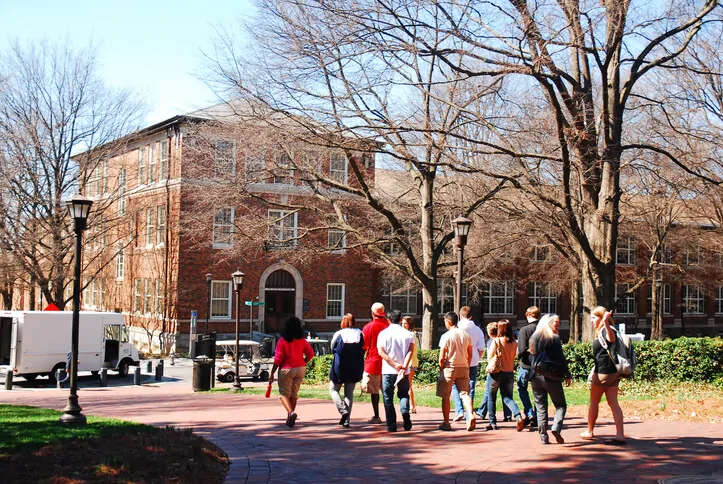
Yet there is a jarring contrast in many places. The walk to a university campus can take you along a high street marked by vacancy signs and betting shops. Turn a corner, and things change: the paving is even and the litter disappears. Someone’s put up some hanging baskets. Marketing banners proclaiming the latest league table success adorn the lampposts. The investment and care is visible.
Hard hats
The notion that vice chancellors should double as town centre developers would strike some as imaginative, others as implausible. Universities are not planning authorities nor commercial landlords in the conventional sense. They are facing their own financial pressure and estate management challenges.
But higher education institutions do not operate in a vacuum. Indeed, many trade on narratives of local impact and partnership, proud of their role in regional and national renewal. This impact often comes on the universities’ own terms – GVA measured, economic impact analysed in pound signs, a new report launched hundreds of miles away in Parliament.
The hard truth is that if the university is the most visible symbol of prosperity in a town, while the high street struggles, that dissonance will be noticed. The university is visibly leaving the rest of the town behind. Residents we speak to in university towns are often in awe of the success of their local institutions – and also feel totally at a distance from it.
There are practical levers available. Universities can choose to locate new facilities in town centres rather than on out-of-town campuses, driving footfall past existing retailers. They can support independent businesses through procurement choices and incubation schemes. They can work with local authorities on public realm improvements that blur the boundary between campus and community.
Hey big spenders
None of this is to suggest that universities alone can reverse decades of structural change in retail. Online shopping, business rates, and shifts in consumer behaviour have reshaped town centres across the country. Yet higher education institutions are among the few actors with the scale, permanence and convening power to influence direction of travel. In places where almost 60 per cent of city centre residents are aged 18 to 29, students are not a niche demographic; they shape the local economy. How and where they live, walk and spend is crucial.
High street regeneration may not sit neatly within the job description of a vice chancellor. But if keeping places alive is, as Starmer suggests, a test of our times, then universities cannot plausibly argue that the test ends at their gates. And in an era when public support for higher education cannot be taken for granted, putting the resource and problem solving power of universities behind tackling the problems that matter to people most, can only do good.