Understanding Models vs. Patterns in Course Design
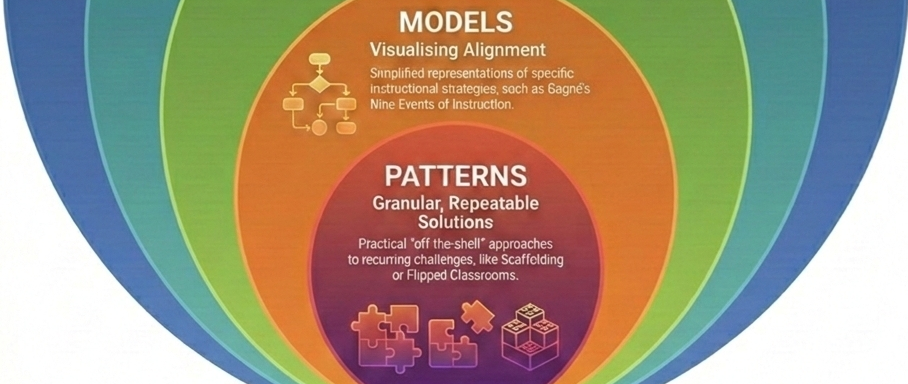
For university course designers, the distinction between Models and Patterns is essentially the difference between the alignment of the course to its programme and its internal logic (models) and the structure of learning used to support learners (patterns).
In a higher education context, here is how those two levels differ:
1. Models: Visualising Alignment
Models at the course and programme level act as “blueprints” for how a specific course or module is structured. They provide a mental map for the flow of information. Models should incorporate the concept of constructive alignments.
- The Focus: Sequencing and constructive alignment.
- The Language: Strategic, systemic, and pedagogical.
- Examples for Designers:
- Gagné’s Nine Events: Ensuring a lecture series begins by “gaining attention” and ends with “enhancing retention.” Or better still, my 9S derivative.
- The 5E Model (Engage, Explore, Explain, Elaborate, Evaluate): Often used in STEM courses to move students through inquiry-based learning.
Key takeaway: Models answer the question: “What is the overarching logical flow of this learning experience?”
2. Patterns: Granular, Repeatable Solutions
Patterns are the “off-the-shelf” tactics used to solve specific, recurring problems within those models. In a university setting, these are the practical activities that fill the slots created by the model.
- The Focus: Engagement, interaction, and specific task completion.
- The Language: Practical, actionable, and tool-oriented.
- Examples for Designers:
- Conceptualising: Running POE experiments using digital media (Predict, Observe, Explain)
- Scaffolding: Providing a rubric and a template for a complex thesis paper.
- The Flipped Classroom: Moving the “information transfer” to pre-work so that “active learning” happens during the seminar.
- Think-Pair-Share: A specific pattern used to break up a lecture and increase peer-to-peer engagement.
- Gamification Elements: Using leaderboards or badges for a specific lab module.
Key takeaway: Patterns answer the question: “What specific activity or technique will solve this particular learning hurdle?”
Comparison for Course Designers
| Feature | Models (Logical Structure) | Patterns (Learning and Teaching Activities ) |
|---|---|---|
| Scope | Global (The whole course or module) | Local (A specific lesson or activity) |
| Goal | Cognitive alignment | Student engagement & problem-solving |
| Design Step | Mapping the “Skeleton” | Fleshing out the “Interactions” |
| Changeability | Hard to change mid-semester | Easy to swap or adjust based on feedback |
This Friday, the Simon’s Educational Architects Substack will illustrate the relationship between models and patterns.