Seize the Moment: Higher Ed Must Improve, Innovate, and Inspire
This is a condensed version of a speech on higher education that Ted Mitchell, president of the American Council on Education, gave at ACE’s annual meeting on Feb. 26.
We’ve been insulted, demeaned, and punished, for no good reason. But we’re still standing. Now it’s time for higher education to seize the initiative.
We must improve, innovate, and inspire.
The past year was a hard one for colleges and universities. Unjustified political attacks disrupted our work and threatened our ability to serve students and America.
I made two promises a year ago. First, we would work with the administration on policies to make higher education more affordable, to connect students to careers, and to promote transparency and accountability for results. Second, when we faced attacks, we would not cower.
We kept those promises.
On policy, there have been bright spots. Pell grants for short-term workforce programs finally made it into law after years of our collective advocacy. We also are seeking to work with the administration to improve a new federal accountability initiative centered on the worthy premise that when students go to college, they should reap an economic benefit. And fortunately, Congress has taken steps recently to protect higher education programs and important scientific research.
Over the past year, the American Council on Education has also stood up to outrageous assaults, aimed at a few colleges and universities, but intended to hurt all of them. We defended the rights of institutions, faculty, and students. We opposed measures that would cripple our research enterprise. And we defended the rule of law. We will continue to do that.
As we think about the year ahead, we should be proud of our achievements and protective of the freedoms that enable us to thrive. But we also should acknowledge our critics when they’re right and push ourselves to do better. To do otherwise would be to brand ourselves as hypocrites and to rob us of the moral standing to which we aspire.
Let’s resolve now to move higher education forward to a new future through improvement, innovation, and inspiration.
Think of improvement as holding ourselves accountable for student success. We know student success doesn’t stop with the diploma. It continues to be defined by the economic and social mobility of our students and their contribution to communities and societies.
Think of innovation as fearless experimentation. Nothing should be off the table, from the ways we teach, to the courses and degrees we offer, to the services we provide students and the community.
Think of inspiration as engaging the public, so that all Americans can see themselves in our work. For too long, too many groups have seen higher education as out of reach, and not for them. It’s time to change that. Everyone should understand our contributions to students, to communities, and to the nation. We want everyone to know that higher education builds America.
There are painful chapters in the history of higher education, when colleges and universities excluded or discriminated against students who were black, brown, female, Jewish, or members of some other group that was not the elite or powerful.
But the civil rights, women’s rights, and disability rights movements led us to a better place. So has the growing presence of international students and scholars. They bring diverse viewpoints and enrich our cultural and intellectual lives.
Today, our campuses are diverse in so many ways — diversity of identity, diversity of thought, diversity of economic background. We will not reverse the progress that we’ve made. We will support students of all racial and ethnic backgrounds, of all gender identities, all faiths, all countries of origin, all economic classes. We will support historically Black colleges and universities, Tribal colleges, and minority-serving institutions. That’s the way we improve. That’s the way we build America.
But problems remain. Let’s be honest, the scourge of anti-Semitism is unfortunately alive on many of our campuses. Student success is still unequally distributed among our student population. And we clearly have more work to do to ensure that all Americans feel welcome in our classrooms and on our campuses.
We need to improve on free speech and viewpoint diversity. Cancel culture is wrong, whether it comes from the left or the right. Some new survey data suggests that students are feeling comfortable on our campuses, regardless of their political affiliation. That’s great. But we should build on that.
To thrive, higher education requires essential freedoms that have made us the envy of the world. They are the freedom to decide who teaches, what they will teach, whom they will teach, and what research questions they will pursue. Those freedoms define our independence.
Higher education is not an instrument of this administration, nor any other administration. We are not, and never will be, an agent of government propaganda, or an enforcer of ideological hegemony. And we do not seek federal funding through appeasement.
But with freedom comes responsibility.
It’s on us, for example, to offer educational opportunities to all Americans. It’s on us to deliver a high-quality education to every student, whether they’re 18, 28, or 38, whether they live on campus or connect online.
It’s on us to raise graduation rates so that those who start college reap the benefits of finishing. It’s on us to ensure that transfer students receive all the credits they deserve.
It’s on us to show students pathways to meaningful careers. That means creating opportunities for students to engage in the real world of work while they’re in school.
None of that will happen automatically. That’s where innovation comes in. AI will provide new challenges and opportunities. New governance models and collaborations will likely make us more efficient. I won’t try to pick winners and losers. But we need to innovate.
Finally, we need to inspire. We all know that we’re doing vital work, and we all know that we can do it better. What we haven’t done is bring America along on our journey of improvement. We must think creatively about how to ensure that the public hears our stories, understands our work, and is inspired by the opportunity it represents.
Higher education has faced plenty of skepticism in recent times. But if you look closely, there’s evidence that public opinion is turning in a more positive direction. That gives us an opening. But as we think about how to tell our story, we must remember this is not just about messaging. It’s about substance. To rebuild trust, credibility matters above all.
In October 2024, ACE launched our Higher Education Builds America campaign, with full-page ads in the New York Times. Now, we are expanding that message. Take a look.
ACE wants this campaign to represent contributions of all colleges and universities. We want their perspectives, and we want their help. We will celebrate all that they do for America.
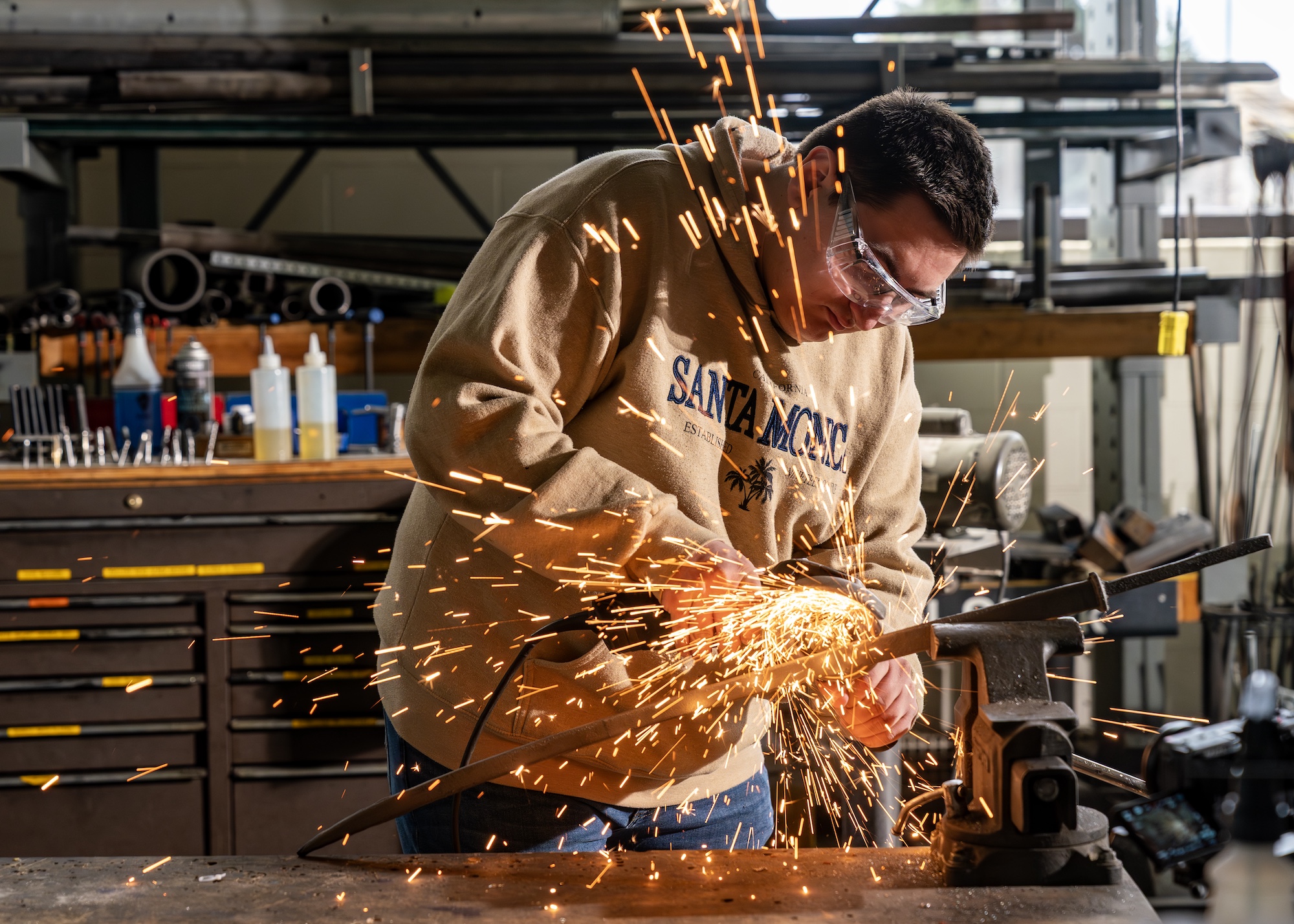
Image: Grand Valley State University mechanical engineering student Scott Strayer grinds a sword for the 2025 Cast in Steel competition, where students used modern casting tools to design and produce a functional sword for George Washington.
If you have any questions or comments about this blog post, please contact us.