With a new vision, clear goals and full buy-in, reinventing high school can happen
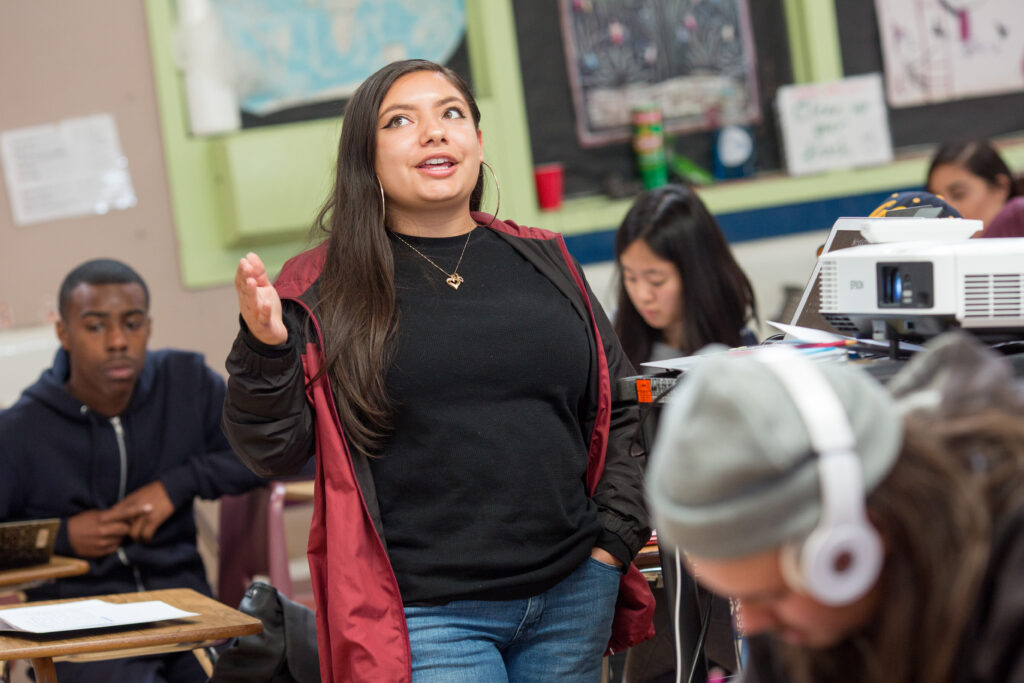
A student shares her research results during a class presentation.
Credit: Photo by Allison Shelley/The Verbatim Agency for EDUimages
For decades, we’ve watched and studied our public schools and education system struggle, caught in a cycle of incomplete and often frustrating school reforms. The big, top-down initiatives and the small, isolated bottom-up projects and programs have consistently fallen short as achievement gaps persist. As policymakers create more programs to solve more problems, we’ve seen a disconnect between what students learn in school and what they need to thrive in the real world. Schools and districts have become less and less relevant in society for the vast majority of students, and sadly, for their teachers.
We must, therefore, develop a new system. This new system, already being adopted by some districts, shifts the center of reform gravity — with the school district and its communities leading the way, inspiring new local and state policies that will sustain their efforts over time. The transformation begins with students and teachers working together, supported by administrators, community, and business leaders, who unleash them to develop and demonstrate new competencies — such as the five Cs of compassion, communication, collaboration, creativity, and critical thinking — as they learn and apply the content knowledge. In doing so, these schools have embraced a new purpose — not the standardized test scores of the past — but rather new abilities to become effective in and for society.
What does the future of public education look like for a student and a school?
Imagine a high school where a student’s day isn’t just about moving from algebra to history to biology. Instead, they might be part of a project-based learning team tackling a real-world problem, learning as they go to harness the powerful tools of artificial intelligence to create new solutions and, possibly, whole new jobs. For instance, they might be working with one of many career-pathways teachers and AI mentors to design a sustainable community park, applying their math skills to analyze the budget, their science knowledge to understand environmental impact and their communication skills to present their proposals to city officials.
We have been learning more about this approach from California communities such as Anaheim, Oakland, Fresno, Lindsay, Monterey, Shasta, which are in the midst of adopting and spreading some of these systemic changes. We have dug deeper into the specifics of the roadmap in one of those districts, Anaheim Union High, where every school and student focuses on real-world skills necessary to thrive in career, college and civic life.
Influenced by the promise of new developments at the school level, opportunities — like California’s Secondary School Redesign Pilot Program — are now being created. Administered by the California Collaborative for Educational Excellence (CCEE) in cooperation with other state agencies, this initiative will fund a network of participating districts to build capacity, identify promising models and share best practices statewide.
Through this effort, the collaborative and its partners will demonstrate how a network of schools can:
- Ensure every student is known and supported through structures that support small learning communities, that personalize learning, as in the best kindergartens and graduate schools.
- Redesign learning for deeper knowledge and skills that place a premium on students demonstrating what they know and can do in community projects and internships.
- Advance pupil success and equitable outcomes through co-teaching, embedding wellness with academic learning and technologies that customize support (such as new AI tools that offer every student a tutor) and creating space for adults and young people to connect on a deeper level.
- Promote measurable growth in student engagement and learning that is demonstrated in multiple contexts (such as portfolio/capstone projects) and captures with innovative tools what students know and can do through durable skills like collaboration and creativity.
- Design sustainable structures to maintain impact over time, such as reinventing master school schedules, crafting local policies, and creating serious time for teachers and allied professionals to collaborate in a reimagined system of professional learning and leadership.
This very specific, on-the-ground, collaborative approach means that a lot can be accomplished in a short period of time, say two to three years. Districts will be able to demonstrate the “what and how” of school and system change, and show how educators and their partners can collaborate more effectively. The pilots can also make progress in measuring engagement and learning using indicators such as agency; attendance; course progress; college, career, and civic readiness; and graduation. Together, they can drive continuous improvement within and across schools.
The themes portrayed here are also being jump-started with investments from a coalition of 10 philanthropic entities chaired by the Stuart Foundation, in a major initiative called the Youth Thriving Through Learning Fund (YTL).
Make no mistake about it. This is a different strategy in the history of secondary system reform in the state. It started at schools, communities, and districts, with support from above. System transformation requires “system energy” at all levels.
It is time for schools and districts to become strong system partners and drivers in transforming the future of adolescents.
•••
Michael Fullan is professor emeritus of the Ontario Institute for Studies in Education at the University of Toronto, and a leading scholar of applied system change in education.
Barnett Berry is a consultant on teacher leadership and system change in education. He currently serves as a senior research fellow at the Learning Policy Institute and a senior advisor for the Center for Reimagining Education at the University of Kansas.
The opinions expressed in this commentary represent those of the authors. EdSource welcomes commentaries representing diverse points of view. If you would like to submit a commentary, please review our guidelines and contact us.