WIOA Funds Explained: Your Complete 2026 Guide to Workforce Training Money
The federal government allocated $2.919 billion for job training grants in Program Year 2026. Not secretive — the Federal Register published the allotments in April. Just invisible to most of the people the money was designed to help.
The Workforce Innovation and Opportunity Act has governed federal workforce spending since Congress passed it in 2014. It replaced the Workforce Investment Act and reorganized how federal dollars flow from Washington to local workforce boards and American Job Centers. The basic premise: connect workers who need training to programs that lead to real jobs, and fund it with federal money.
The execution is where things get complicated.
What WIOA Is and How the Money Is Organized
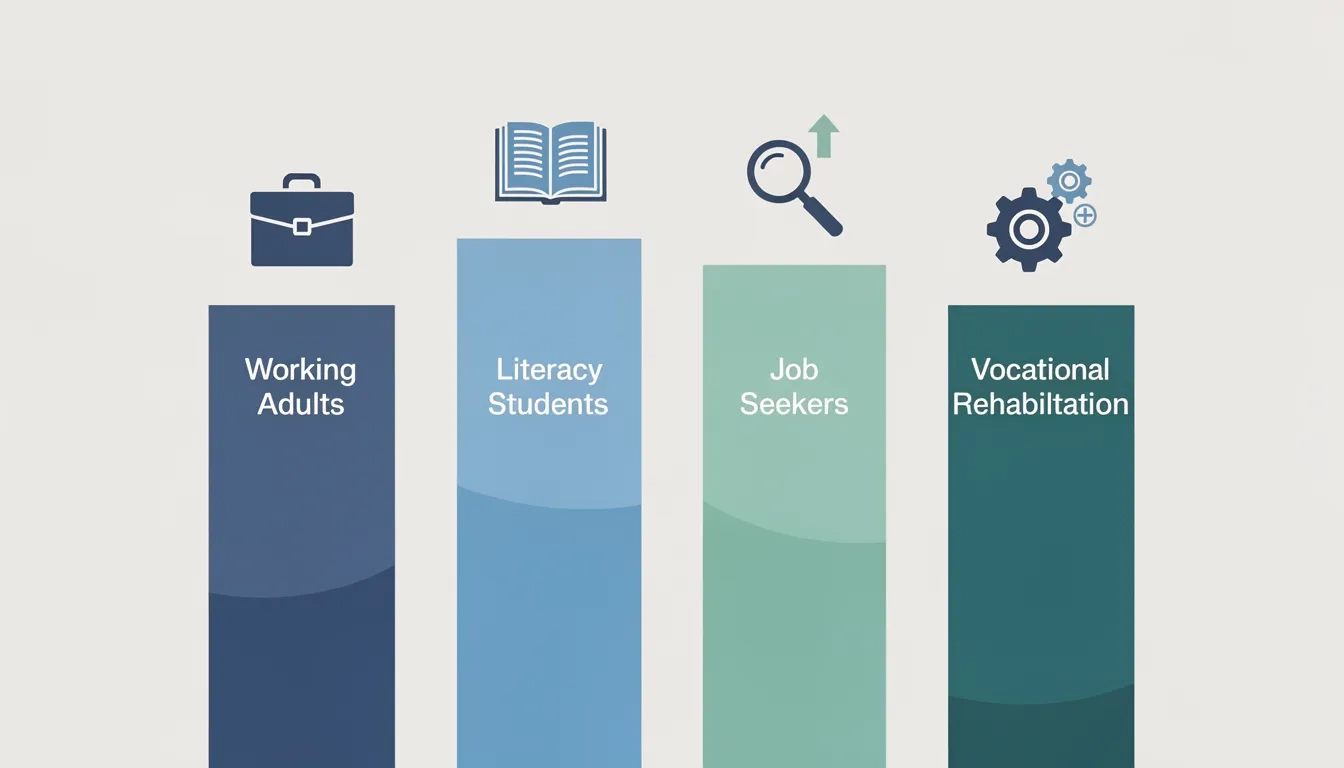
WIOA channels funding through four distinct programs, called Titles. Each funds a different population and sits within a different federal agency.
| Title | What It Funds | Agency |
|---|---|---|
| Title I | Adults, dislocated workers, youth ages 14–24 | Dept. of Labor |
| Title II | Adult education and literacy | Dept. of Education |
| Title III | Employment services at job centers | Dept. of Labor |
| Title IV | Vocational rehabilitation for people with disabilities | Dept. of Education |
Title I is where most of the training money sits. For Program Year 2026, that breaks down to $875.6 million for adult activities, $948,130,000 for youth activities, and $1.396 billion for dislocated worker activities. Title III Wagner-Peyser funds cover the career counselors and job-search services that staff American Job Centers.
None of this money goes directly from Washington to individuals. It flows: federal government → state workforce agencies → local Workforce Development Boards → American Job Centers. By the time it reaches you, it has passed through at least three layers of bureaucracy, each with its own rules and priorities.
Who Actually Qualifies for WIOA Funding
Eligibility depends on which Title I program you're applying under. The three main pathways work differently.
Adults (age 18+) typically qualify if they:
- Receive public assistance (SNAP, TANF, or SSI)
- Have household income at or below 250% of the Federal Poverty Level
- Are basic skills deficient (reading below roughly an 8th-grade level)
- Face other documented barriers to stable employment
Dislocated workers qualify if they:
- Were laid off or received a formal layoff notice
- Lost work due to a plant closure or company downsizing
- Are a military spouse who relocated and lost a job as a result
- Were self-employed and became unemployed due to economic conditions
Youth (ages 14–24) qualify if they:
- Come from low-income households
- Are out of school or at risk of dropping out
- Face barriers including involvement with the justice system, homelessness, or foster care history
The dislocated worker pathway is the most accessible. Prior income doesn't disqualify you. If you lost your job involuntarily, you almost certainly qualify regardless of what you were earning before.
Here's the misconception that costs people real money: you don't need to be unemployed to access WIOA services. Working adults who are underemployed or earning below 250% of the poverty level may be fully eligible. A warehouse worker making $14 an hour trying to earn an HVAC certification could be a textbook WIOA candidate.
How to Get an Individual Training Account
If you meet eligibility requirements, the main tool for paying your training is the Individual Training Account (ITA) — a voucher issued on your behalf and paid directly to an approved training provider. You don't see a check. The money moves from the workforce system to the school or program you chose.
Here's the process at most American Job Centers:
- Find your local American Job Center at careeronestop.org or by calling 1-877-872-5627
- Complete an intake appointment with an employment counselor, who reviews your work history, income, and any barriers
- Build a career plan focused on occupations with real local demand
- Select a program from your state's Eligible Training Provider List — not every school or course qualifies, and this step trips people up
- Receive your ITA, which pays directly to the training provider
How much is the ITA worth? The honest answer is: it depends where you live. A commonly cited figure is up to $4,000, which holds roughly true for many local boards. But some authorize significantly more for high-demand fields, while others set lower caps.
The variation between counties in the same state can be striking. Two people with identical eligibility and the same career goal might receive different funding levels based entirely on geography. This local flexibility is both WIOA's design feature and its biggest flaw.
What WIOA Funds Cover (and What They Don't)
ITAs aren't blank checks, and understanding the limits upfront prevents wasted time.
WIOA funds typically cover:
- Tuition and enrollment fees at approved programs
- Required textbooks and course materials
- Licensing and certification exam fees (CDL, nursing board exams, CompTIA certifications)
- Short-term occupational training leading to industry credentials
What they generally won't cover:
- Living expenses or rent
- Transportation costs
- Training at unapproved providers
- Programs that don't lead to employment in a locally in-demand occupation
There's a real gap between what some longer credential programs cost and what a standard ITA covers. A certified nursing assistant program might run $1,200 — well within most ITA limits. A licensed practical nursing program can run $10,000 to $15,000, which requires combining WIOA funds with community college financial aid or other sources.
Ask about supportive services early. Local workforce boards can connect eligible participants to separate funding for childcare, transportation, and work-related supplies. These services don't get advertised prominently, but they're often what determines whether someone finishes training or drops out halfway through. Results for America, which studies evidence-based workforce programs, has flagged that participants who access supportive services alongside training show meaningfully better completion rates.
What's Changing in 2026
The elephant in the room: WIOA hasn't been fully reauthorized since it passed in 2014. Congress has been trying to update it for years. The results have been mixed.
The House passed "A Stronger Workforce for America Act" (H.R. 6655) in 2024, but the Senate never acted on it. A revised version cleared the House Education and Workforce Committee on April 21, 2026. Shannon Meade of Littler's Workplace Policy Institute has noted that "the legislation has lost bipartisan support," making full passage unlikely given the narrow House majority and Senate dynamics.
The proposed reauthorization would require 50% of adult and dislocated worker funding to go directly toward training activities — a direct push to move money away from administrative costs and into actual skill-building.
A few concrete things that did happen in early 2026:
- The Consolidated Appropriations Act (signed February 3, 2026) rejected the "Make America Skilled Again" block grant proposal, which would have consolidated multiple workforce programs. Separate Title I, II, III, and IV funding streams remain intact.
- Job Corps — which faced serious closure threats — was preserved under FY 2026 appropriations and a federal court injunction.
- Starting July 1, 2026, short-term Pell Grants become available for programs between 150 and 600 clock hours. This doesn't replace WIOA, but it opens a new parallel funding channel for workers in shorter credential programs.
Without full reauthorization, states are using federal waivers as their primary tool for flexibility. The Department of Labor's Training and Employment Guidance Letter (TEGL) 05-25 lets states request permission to increase on-the-job training reimbursement rates to 90%, adjust out-of-school youth spending requirements, and modify incumbent worker training caps. For workers in states actively pursuing these waivers, the practical effect can be meaningful — more OJT options, more local flexibility.
One thing worth watching: President Trump's FY27 budget request proposes cutting overall workforce development spending by approximately $1.23 billion. If that passes, funding availability at the local level would tighten.
Mistakes That Cost People Time and Money
Starting the process too late. Some local workforce boards run low on ITA funds before the end of a program year (July through June). Applying in the fall for training you want in the spring is not excessive. Early applicants get funded; late applicants sometimes get waitlisted.
Picking a school before verifying it's on the list. Programs get removed from state Eligible Training Provider Lists. Someone who falls in love with a school based on a website, attends an orientation, and then finds out the program doesn't qualify for WIOA is in a painful spot. Always confirm with your workforce counselor before making any commitments.
Expecting a quick turnaround. From first visit to ITA approval, plan for three to six weeks at minimum. Bringing documentation upfront — tax returns, prior employer records, proof of public benefits received — cuts this significantly.
Not asking what the outcomes data looks like. Before you commit to a program, ask your workforce counselor for employment rate and median wage data for graduates. Results for America has pointed out that inconsistent evidence standards mean some local boards are funding training programs with weak job placement records. One question about outcomes data separates informed participants from everyone else.
Bottom Line
Over $2.9 billion in workforce training grants moves through WIOA each year. For displaced workers, low-income adults, and young people navigating real barriers, it can fund training that would otherwise be completely out of reach. My read: the program works when workers know it exists and use it strategically. The system is cumbersome, but it's not broken — it's just poorly marketed and undersupported.
Here's what to actually do:
- Start at careeronestop.org to find your American Job Center. Bring income documentation, work history, and anything that documents barriers you're facing.
- Ask about both ITAs and supportive services. The ITA gets the press; supportive services (childcare, transportation, supplies) are often what makes the difference between completing training and dropping out.
- Verify your program is on the Eligible Training Provider List before falling in love with a school. Check first, then commit.
- Request outcome data on any training you're considering — employment rates and wages six months after graduation. Workforce counselors have this; most just don't volunteer it.
- Track short-term Pell Grants launching July 1, 2026. If your target program is 150 to 600 clock hours, you may be able to layer that federal aid on top of WIOA funding to close any gap.
The money is there. Go get it.
Frequently Asked Questions
Is WIOA funding a loan or a grant?
It's a grant with no repayment obligation. Individual Training Accounts are paid directly to approved training providers, not to you. There's no debt created, though participants are generally expected to complete their programs and pursue work in the field they trained for.
Can I apply for WIOA funding if I'm currently employed?
Yes. Being employed doesn't disqualify you. Adults who are underemployed or whose income falls at or below 250% of the Federal Poverty Level can still meet eligibility requirements. WIOA was explicitly designed to serve working adults who are stuck in low-wage jobs and need skills to move up.
What's the difference between a WIOA ITA and a Pell Grant?
Pell Grants come from the Department of Education and fund academic programs, historically requiring at least 600 clock hours. WIOA ITAs are more flexible on program length and can cover shorter occupational training that Pell has traditionally excluded. Starting July 1, 2026, short-term Pell Grants extend to programs between 150 and 600 clock hours — creating overlap with many WIOA-eligible programs and making it possible, in some cases, to stack both funding sources.
Do WIOA funds cover online training programs?
Some do. The program must appear on your state's Eligible Training Provider List and must lead to employment in a locally in-demand occupation. Remote learning options have expanded significantly since 2020, but approval still varies by state and local workforce board. Confirm with your employment counselor before enrolling anywhere.
What happens if I can't finish my WIOA-funded training?
You won't owe money back, but withdrawing can limit your future access to WIOA services. Some local boards track completion rates and restrict funding for participants who've previously exited without finishing. If you're struggling, talk to your employment counselor before withdrawing — program switches, reduced course loads, or leaves of absence are often available and keep your eligibility intact.
How much notice will I get if WIOA funding gets cut?
Federal budget proposals and appropriations work on an annual cycle. If the FY27 proposed $1.23 billion cut to workforce development moves forward, it would affect Program Year 2027 (starting July 2027). For workers considering training now, current PY 2026 funding is in place. The practical advice: don't wait if you're eligible — funding availability at the local level tends to tighten when federal dollars shrink.
Sources
- WIOA Reauthorization & Funding Update: 2026 Status Report – MyOneFlow
- Program Year 2026 WIOA Title I Allotments – Federal Register
- Am I Eligible for WIOA Funding? – WhereWeGo Insights
- Bill Seeks to Align Workforce Development with Employer Needs – SHRM
- Recommendations for WIOA Reauthorization – Results for America
- April 2026 Policy Spotlight: WIOA Reauthorization Bill Released – National Youth Employment Coalition