What happens in Israel impacts my life at UCLA and everywhere else
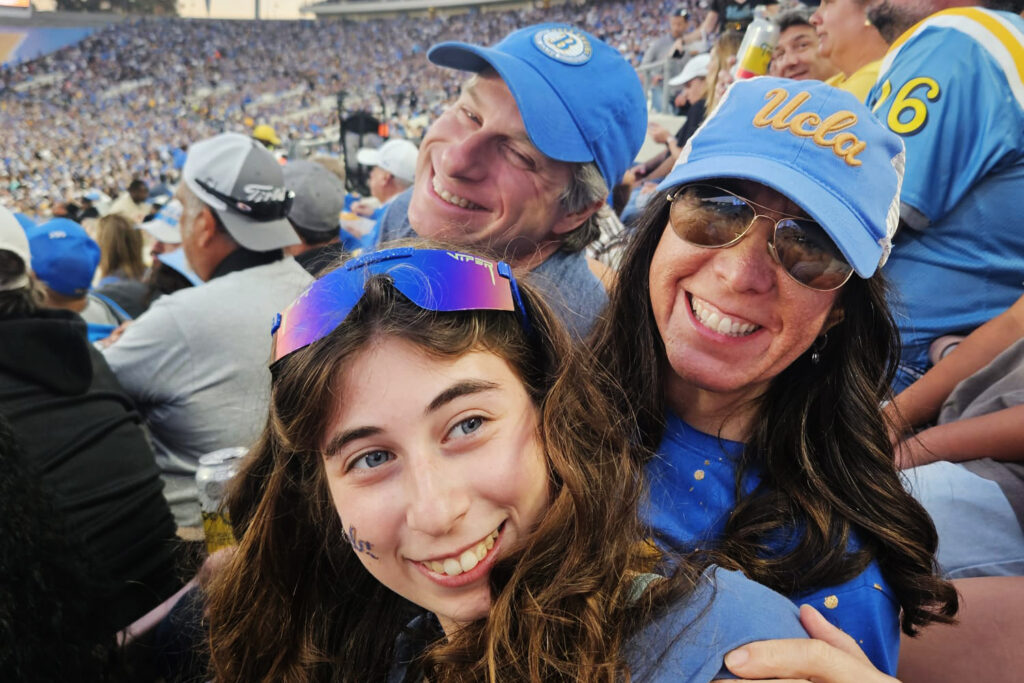
Mollie Grange Issacson is pictured with her parents at a UCLA football game.
June 21 arrived on a Saturday this year.
For Jewish people, Saturdays are meant to be days of rest. We turn off our phones and shut out the outside world to concentrate on what’s most important in the present.
On June 21, my simple plan was to focus on family; play board games with my parents and kick the ball around with my cousins. But a sense of peace was not possible because that’s the Saturday the United States dropped three bombs on Iran.
Suddenly, I was pulled right back into the real world — my phone flooded with texts from family and news alerts, and I couldn’t help but feel panic and grief. I couldn’t play a game of catch without feeling the weight of what was happening thousands of miles away.
On every screen, in every conversation, I see the effects of war. Bombs fall. So do the prayers for the dead, the missing and those people having to fight a war.
Yes, I am safe. Physically. What is happening in Israel punches a hole in my life, my education at UCLA, and my comfort wherever I am.
Recently, I made it back out to Camp Interlaken in Wisconsin, where I have been a member since I was 7 and where my dad went when he was a child. I have made the trek to Camp Interlaken dozens of times, but this time I went to celebrate the camp’s 60th reunion. Part of me was sad because I knew this would be my last time at camp. A bigger part of me was overjoyed to join my whole family, friends and former counselors who hadn’t been back for years.
We all looked forward to the big Shabbat dance on Friday night. We put on our nicest outfits and ran onto the dance floor. I remember the drums pounding along with my heart. My feet stomped. And I sang.
I looked around and saw my mom to my right, my brother behind me and my best friends all around, but someone was missing. I so badly wanted to share one last dance with my dad to thank him for introducing me to camp life and the community. I wanted to thank him for passing the torch to me and to officially let him know that I, too, have reached the point where life is taking me to new places and would need to pass the torch on to others.
I kept waiting for him to join us, but he never did.
He had been drawn into a conversation with the Israeli staff, listening to their stories of loss and hardships. He couldn’t bring himself to dance because he was instead standing in grief with them. Later, my brother quipped that the moment I missed on the dance floor with my father “was another casualty of the war.”
The war doesn’t just steal lives; it steals moments. It reached into our joy and dimmed it. It followed us even to the places meant to be untouched.
When I come home from school now, the first question my relatives ask isn’t about classes or college life, but rather, “How’s campus? Are there protests?” The war has become the frame for everything.
Even in my college classes, conversations are deeply political. When professors or classmates express anti-Israel views, I sometimes feel like there’s no space for me. I’m not against anyone having a different opinion; I want dialogue, but it makes me feel like my identity and my community’s right to exist are up for debate. So, I’ve found myself staying quiet, even when I want to contribute, worried that speaking up will change how others see me.
During the spring of my freshman year, protests in response to the war led to the cancellation of the classes I had been most excited to take. These were courses I had dreamt about: deep, rigorous, inspiring. After years of craving that kind of learning — the learning I came to UCLA for — they were canceled abruptly. I support activism and the right to protest, but when demonstrations escalated and disrupted campus operations, UCLA canceled classes. It was devastating to lose the chance to learn.
But far from the front lines, this war has changed the way I learn, speak, connect and think about my school. Before the protests, I loved UCLA with pure affection. But when classes were canceled and I saw how deeply the conflict affected campus life and divided the students, that innocence was shattered. Once you see the darker sides, you can’t unsee them; the gates open, and they never close.
Bombs don’t just destroy buildings. They shake the ground beneath the things we thought were safe. And that kind of pain doesn’t go away.
•••
Mollie Grange Isaacson is a second-year student at UCLA majoring in education and social transformation with a minor in public affairs and a member of the EdSource California Student Journalism Corps.
The opinions expressed in this commentary represent those of the author. EdSource welcomes commentaries representing diverse points of view. If you would like to submit a commentary, please review our guidelines and contact us.