West Contra Costa Unified faces deep cuts to staff and programs to remain solvent
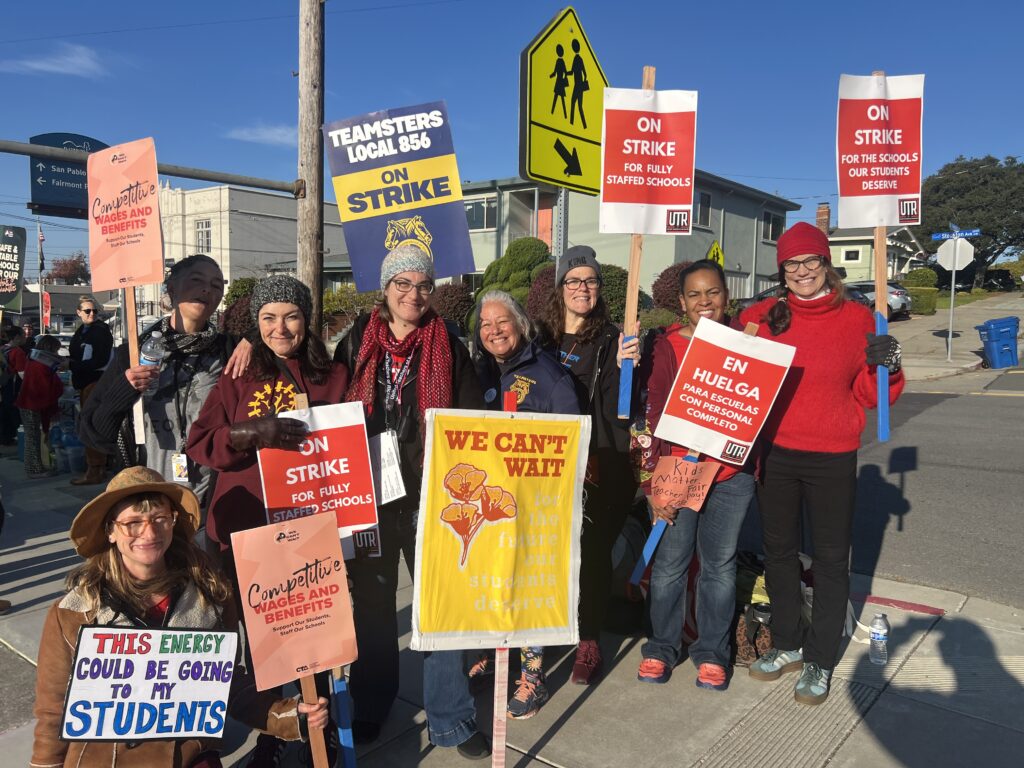
Striking teachers on the picket line in El Cerrito, California on Dec. 5, 2025.
Louis Freedberg
Now for the really hard part.
After agreeing to raises and other increases in compensation to settle the first teachers strike in its history last December, the West Contra Costa Unified School District is grappling with how to fund the $105 million it estimates the settlement will cost. That’s in addition to an already significant budget deficit.
School administrators this week revealed a possible but painful pathway forward that will require making deep cuts to many aspects of its operations.
“This is not pleasant, and it is hard,” Superintendent Cheryl Cotton shared at a community meeting in Pinole, one of several East Bay communities the district serves, including Richmond, San Pablo, Hercules, El Cerrito and Kensington.
All told, the district estimates it will need to come up with $127 million over the next three years to stay solvent. The district projects its total expenditures this year to be about half a billion dollars.
How the district manages this extraordinarily difficult challenge offers lessons for several other California school districts facing similar financial and labor challenges.
At least a dozen other school districts in California have declared an impasse in labor negotiations, including several, such as San Francisco and Oakland, that face similarly perilous financial conditions.
Many of them are part of the “We Can’t Wait” campaign launched by the California Teachers Association. They may have in mind achieving gains similar to those achieved at the bargaining table by the United Teachers of Richmond, the union representing West Contra Costa teachers. That includes an 8% pay increase over the next two years, and substantial increases in health benefits.
The district’s budget reduction plan, presented to the elected board of trustees last week and to several community meetings this week, is now in the hands of Contra Costa County Superintendent of Schools Lynn Mackey. Under state law, she has until Tuesday to assess whether the district’s spending plans are “affordable” and “sustainable.”
In an interview with EdSource, Mackey described the cuts and other proposed actions as “substantial” and “Draconian.”
The measures being proposed include laying off some non-teaching staff, increasing class sizes while remaining within the state-mandated caps, and eliminating programs that are not “impactful” or that do not demonstrably improve student learning. The district’s overall staffing levels would shrink by about 10% over the next three years.
The plan also calls for borrowing $13 million a year from a health retirement fund that offers lifetime health benefits to employees who retired before 2008.
Although the district’s board of trustees pledged last week to make significant budget reductions, it still has to approve how exactly they would be achieved.
“There are other options that would be more painful,” Cotton told parents at the community meeting in Pinole.
Francisco Ortiz, president of the United Teachers of Richmond, downplayed the severity of the problem in an email to union members on Friday. “We are already hearing the same old narratives about ‘tight budgets,’ ‘hard choices’ and ‘doing more with less,’” he wrote. He called on his members to be “ready to organize and fight back against any cuts to programs and services that harm students.”
The most immediate goal, he said, is to ensure the board approves the tentative bargaining agreement at Tuesday’s board meeting.
If Mackey rejects the plan, the district will have to go back to the drawing board. If she approves it, the board presumably will have to begin to implement the reductions.