West Contra Costa scrambles to cut payroll by 10% or face insolvency
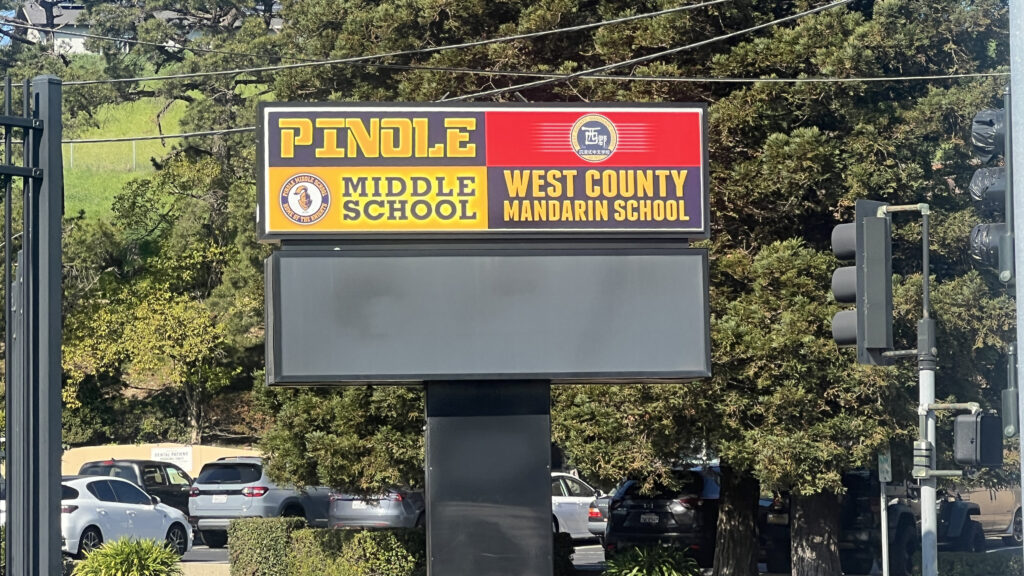
Under the West Contra Costa Unified redesign plan, elementary school students at West County Mandarin School, a public school now housed at Pinole Middle School, would attend Betty Reid Soskin Middle School next fall. The Soskin Middle School would be merged with PInole Middle School.
Credit: Louis Freedberg / EdSource
Top Takeaways
- The compensation package after the first-ever teachers strike in December has substantially increased the district’s projected deficit.
- The board of trustees is to consider a complex budget reduction and redesign plan at Wednesday’s meeting in order to stay solvent.
- The plan includes merging two middle schools and changing five K-8 schools to elementary grades only.
With its first-ever teachers strike behind it, West Contra Costa Unified School District is now racing against the clock to come up with a package of budget reductions and austerity measures in order to keep the 25,000-student Bay Area district solvent.
The district’s elected board of trustees meets Wednesday to vote on a budget plan drawn up by Superintendent Cheryl Cotton to meet state deadlines for its 2026-27 budget. By law, the district must send out layoff notices, if necessary, by March 15.
How the board closes the district’s budget gap is being closely watched by California school districts facing similar budgetary challenges. Some are within driving distance of West Contra Costa Unified, like Oakland Unified and San Francisco Unified, where teachers went on strike on Monday.
In settling the four-day strike in December, the West Contra Costa district and the teachers union agreed upon a compensation package widely viewed as a victory for employees. It will cost the district $105 million over the next three years on top of a preexisting operating deficit of $13.9 million, according to district calculations.
The district says it now needs to come up with $127 million over the next three years in savings and budget cuts to stay solvent.
According to a fiscal solvency plan presented by Cotton to the board last month, the district, which encompasses the city of Richmond and several smaller East Bay communities, plans to reduce the district’s overall staffing levels by 10% by July 1, the start of the next fiscal year.
That’s in addition to considering cuts in other areas — contracts, supplies and transportation. The district is also looking at borrowing $13 million for each of the next three years from an employee health retirement fund, combining two middle schools and eliminating five K-8 schools by enrolling their 7th and 8th graders in separate middle schools.
Over the past week, the district’s leadership has held eight in-person and eight Zoom “listening sessions” as well as a district-wide online “town hall” to hear from parents and staff at school sites that will be most directly affected by the budget.
Each listening session has been attended by Cotton, who became superintendent a little over six months ago, and other senior district administrators.
Cotton is framing her budget reduction plan as a “redesign” that offers the district a chance to introduce reforms that have been discussed for years, such as being able to offer a broader course of study and electives at middle schools. It would also “right size” the district by reducing staff and costs, something it has needed to do given declining enrollment.
Under the plan, she says, the district will also begin to reduce its use of outside contractors for special education services, a major issue in the strike and an issue at other school districts.
One recent listening session was held at the K-8 West County Mandarin School, a highly sought-after Mandarin dual immersion public school for which there is a long waiting list.
The school, however, has been on multiple sites since its founding 10 years ago, and is currently split in two. For space reasons, its TK-5 students attend school on the Pinole Middle School campus, and its 6-8 grade students are on the Betty Reid Soskin Middle School campus a mile and half away. It has been a dream of parents and teachers to have all students under one roof — which Cotton’s redesign plan would accomplish. The school’s elementary students would go to Soskin Middle School, which in turn would be merged with Pinole Middle School.
Still, these proposals have triggered anxiety among parents on multiple issues, such as transportation and traffic control, and the adequacy of playground equipment and toilet facilities for elementary school students at the middle school site. “It is uprooting for everyone,” one Mandarin School parent told Cotton. “I’m hoping it doesn’t create more division.”
The consolidation of the two middle schools would save about $900,000. As the district trustees consider the entirety of the proposed cuts, the stakes are high. West Contra Costa Unified was the first district in California to get a state bailout loan to fend off insolvency in 1990. It took 22 years to pay off $29 million in loans, and during that period it was overseen by a state trustee.
“We don’t want to be the first district in California to go into bankruptcy twice,” Jamela Smith-Folds, an elected board member who attended the listening session, told parents and teachers. She was one of two of the five board members to vote against the contract settlement with teachers earlier this month because she did not believe the district could afford it.
Francisco Ortiz, president of the United Teachers of Richmond, which represents teachers, is himself a graduate of district schools and taught in the district for over a decade. He rejects the notion that the strike settlement contributes to the district’s financial woes — or that the district’s financial health is anywhere as dire as the district makes it out to be.
He says that the labor settlement has laid the foundation for the district to better attract teachers and other staff and to make sure there is a fully qualified teacher in every classroom.
“It’s an easy bait and switch to say ‘Well, now the teachers got a raise, so now we have to do all these cuts.’ It’s an easy out to blame teachers and to say that is what’s going to bankrupt the district,” he said.
“People who have been in the district for decades have heard the same narrative over and over again, and we believe they are going to be able to right the ship,” he said.