Understanding the California School Dashboard: What parents need to know
Credit: Pexels
The California Department of Education on Thursday released the annual California School Dashboard, which means it’s time for a refresher course in the state’s multidimensional, multicolored look at student, school and district achievement.
The dashboard was designed to offer parents a quick look at student results, as well as to provide data for guiding school improvement and for holding districts accountable. Trying to serve these different purposes has created a data system that’s complex and comprehensive, often useful, but daunting for first-time parent users.
“Pick someone off the street and present it to them, and I don’t think most people would be able to understand what it is,” said Morgan Polikoff, associate professor of education at USC’s Rossier School of Education and lead author of a 2024 study of states’ dashboards and school report cards. “I’ve said this many times: It’s not the worst — probably in the middle of the pack (of states) in terms of functionality and usability.”
The California Department of Education has translated the dashboard into multiple languages and produced dozens of flyers, videos, and an annually updated Dashboard Communications Toolkit. This is a good place to start.
Here are some answers and tips to help navigate the dashboard experience.
What’s the purpose of the state dashboard?
The dashboard gives an extensive look at every school, charter school and school district’s yearly performance as measured by ratings on eight state indicators. They are standardized test scores, of course — English Language Arts and math in grades three through eight and grade 11, English learners’ progress, plus, for the first time this year, science in grades five and eight.
Other indicators are high school graduation rates and a measure of how well high schools prepare students for college and careers. Ratings for chronic absences, though only through grade eight, and suspension rates underscore the importance of engagement and school climate to student success.
What’s the point of colors?
Rating performance by color serves a double purpose. There are five: blue signaling the highest achievement, green, yellow, orange, and red signaling the lowest performance. Each color reflects a blend of two factors, evenly weighted: the current year’s test score or rate, and the change from the preceding year to credit improvement or signal a decline deserving attention.
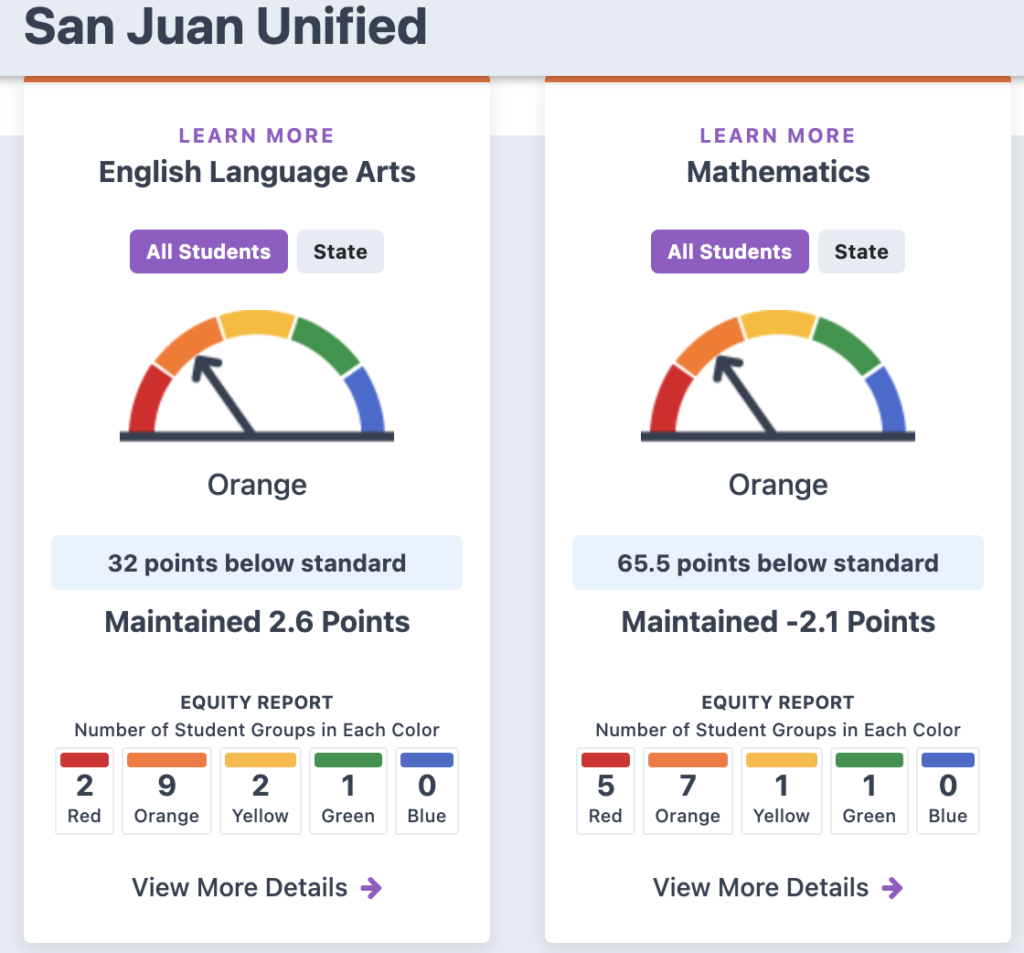
A school’s goal is to achieve green for any indicator, but a sharp change from the results of students the year before can elevate an otherwise yellow score to green or lower it to orange.
Clicking any indicator on a district or school’s overview page will lead to additional details.
For example, clicking the math score “odometer” for San Juan Unified reveals that students averaged 65.5 scale points below the threshold for proficiency or “meeting standard” in math in 2024-25 — a sizable gap. Its students also declined 2.1 points from the year before. The combination is rated orange, two levels below green. The same template applies to other indicators.
Why is there no summative or top-level rating for a school’s or district’s performance?
In designing the state dashboard, former Gov. Jerry Brown and the State Board of Education he appointed insisted on ditching a single number or rating, such as the three-digit Academic Performance Index assigned to schools and districts. They said the API rating overemphasized test scores, oversimplified a district’s performance, and distracted the public’s focus from confronting achievement gaps. Eliminating a top-level rating, they reasoned, would shift the focus to other equally important factors and to the range in performance of student groups, which are hidden by the average scores for all students.
“Paying attention to multiple measures has been the greatest accomplishment of the dashboard,” said Rob Manwaring, senior adviser to the advocacy group Children Now, who has monitored changes in the dashboard for the past decade.
How do student groups factor into the dashboard?
Tracking achievement gaps among 14 different student groups, including eight racial and ethnic groups, drives the dashboard. Every student group with a statistically valid number (usually a minimum of 30) receives a color rating on every indicator in every school and district.
While most of San Juan Unified’s student groups scored in the orange range, African Americans, Pacific Islanders, Homeless students, English Learners, Long-term English Learners and Students with Disabilities scored in the red band. American Indian students scored orange, and Filipino students achieved green.
Every district’s dashboard includes grids — the 5×5 Placement Reports — that lay out the color rating for every school in the district on every indicator. Here’s the math 5×5 grid for San Juan Unified. It showed that of the district’s 60 schools on the grid, 27 rated orange, 14 were yellow, 10 were green, eight were red, and one, Winston Churchill Middle School, was blue.
As with all districts with student groups receiving a red rating on an indicator, San Juan Unified must then address low achievement in its Local Control and Accountability Plan, better known as the LCAP. That’s the three-year improvement plan in which districts must list, among other requirements, an action item, including funding, for every student group with a red rating.
Can you compare schools’ and districts’ ratings on the state dashboard?
No, and that’s been a major point of contention.
“From a parent’s perspective, some of my frustrations are that you cannot compare one school to another school, or one district to another district,” said Manwaring, the Children Now adviser.
Added Polikoff, the USC professor: “Potential users and parents could use it to make choices. It seems really difficult to use for that purpose. Unlike a lot of other state report card systems, there’s no comparison tool.”
Here again, the state dashboard reflects Brown’s philosophy that the primary purpose, consistent with local control, was self-improvement, not a new list of district and school rankings.
Other organizations have included an easy-to-use comparison tool in modifying the state dashboard, including EdSource, which has a version with 2025 data. Go here to see it.
What are local indicators?
The dashboard includes priorities for which there are no statistically valid comparable statewide data or assessments, but nonetheless are vital for successful schools. These include family engagement, school climate and access to a broad course of study. The State Board of Education requires that districts analyze each local priority and report back to the public annually. Examples are the results of local school climate surveys and the district’s actions to improve public engagement. For example, county offices of education must report on how well they are coordinating services for foster youths and expelled students.
How does dashboard information drive improvement?
Districts in which at least one student group is rated red on two or more priority areas, such as low reading scores and high chronic absenteeism, are designated eligible for “Differentiated Assistance.” They are encouraged to seek guidance from county offices of education or the California Collaborative for Educational Excellence, a small state agency, on how to improve. Differentiated Assistance is voluntary and applies only to districts.
Since the dashboard’s first year, in 2017-18, 752 districts and county offices have qualified, with more than 80% of those identified two or more times. In 2025, 418 districts will qualify for help, compared with 436 last year. That large number raises questions about whether the state has the capacity to work with many districts. Most of those qualified because of the low ratings for students with disabilities and long-term English learners, according to an analysis of the Nov. 5 State Board of Education meeting.
In the coming months, the State Board of Education will reexamine whether the current criteria for differentiated assistance should be modified, perhaps to target higher priority districts and other overlooked, chronically underperforming students.
Has the dashboard changed since it was introduced in 2017?
Each spring, the State Board of Education decides whether to modify or expand the dashboard. There have been technical fixes, a new approach to long-term English learners, and substantial development of the college and career readiness indicator. That indicator rates schools and districts based on the percentage of graduates who complete one of several courses and study options. They include satisfying the A-G course requirements for admissions to UC and CSU, passing multiple AP and International Baccalaureate courses, successfully completing two semesters of credit-bearing college or CTE courses, attaining the seal of biliteracy, and completing a CTE pathway or pre-apprenticeship program.
In 2025, only 51.7% of graduates qualified statewide as prepared, compared with 44.1%, when the indicator was first introduced.
What are some ideas for improving the dashboard?
Polikoff recommends creating different portals of the dashboard for different audiences — one for data-driven researchers, another for parents who want simple comparisons for choosing a district or charter school.
Manwaring is convinced that essential data answering the question “How is this school doing?” could be placed on one page.
Sierra Abukins, vice president of development and communications for the Los Angeles nonprofit Families in Schools, agrees that information is spread over too many pages. “It reminds me of a Public Records Act request, and they send you 20 boxes, and you’re, ‘Oh, there’s gotta be something in here.’”
Manwaring says that having identified subgroup performance, the dashboard should explicitly highlight progress — or the lack of it — in closing achievement gaps. Reporting yearly changes in scores isn’t enough, he said. There’s one reference to achievement gaps in the California Department of Education’s lengthy press release Thursday on the posting of the 2025 dashboard.
A growth model
Polikoff and children’s advocates say one technical change in how the state measures academic improvement could make a difference in tracking student learning. California determines yearly growth in student groups by comparing the current year’s test scores with similar students in the same grade the year before. Nearly every other state has a student growth model tracking individual students’ yearly scores throughout elementary and middle school.
Polikoff has argued for integrating a student growth model for a decade. The California Department of Education first reported students’ growth scores in last year’s dashboard, although it will release the latest results next month. The State Board of Education hasn’t decided how to use the growth model. For now, districts’ growth data reports stand apart, buried in the dashboard.
Natalie Tovani-Walchuk, chief development officer with GO Public Schools, which works with parents in Oakland, West Contra Costa County and Fresno, sees great potential in using growth scores to help determine what works to raise achievement.
“Most of our districts are facing budget cuts. And so in these moments, growth indicators should be an easy way to spotlight exciting practices at school sites and then think about what should be scaled or replicated,” she said.