Tracking student parents: A challenge for educators
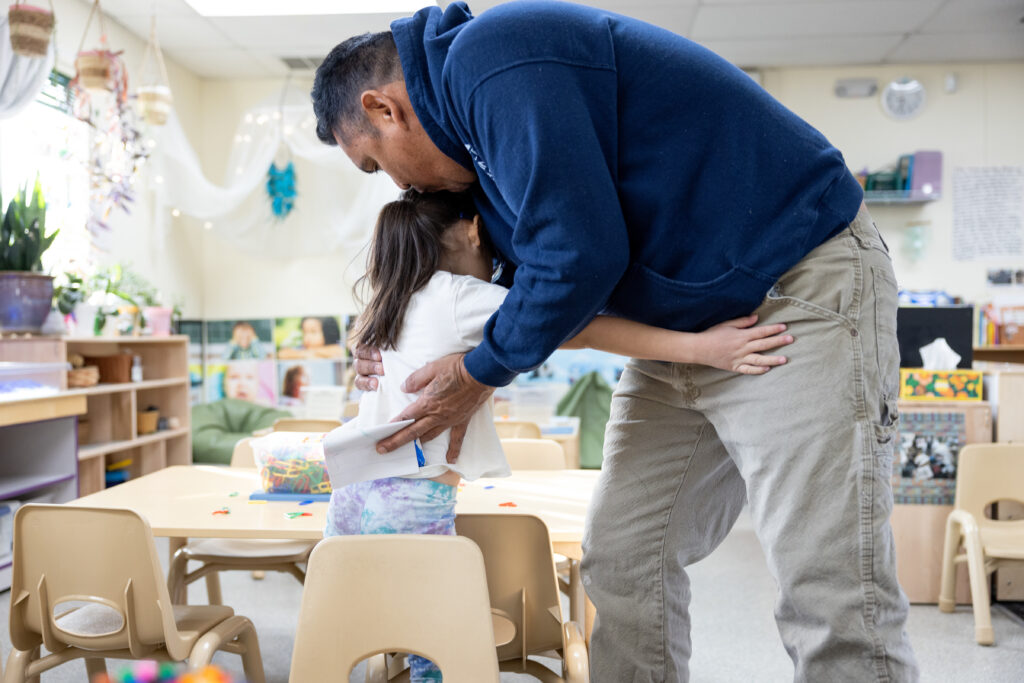
A father hugs his daughter goodbye after dropping her off at a child care center on a college campus.
Credit: Allison Shelley/Complete College Photo Library
Earlier this year, the Trump administration slashed the staff at the National Center for Education Statistics (NCES), the statistical arm of the Department of Education. With so few people remaining at NCES, educators face significant challenges in tracking educational outcomes across the United States, making it more difficult to identify trends in areas such as achievement gaps and funding for low-income students.
One population at risk of falling through the cracks without better data is student parents. Though there are more than 4 million student parents in the country — 1 in 5 undergraduate students and 1 in 4 graduate students in the United States are parents — NCES has been one of the few sources of insight on this group. The center’s data has informed national profiles of this large and important student parent population, and without adequate data, student parents risk becoming invisible. If colleges and universities are serious about student success, it will be up to them to fill in the data-collection gaps. For example, a 2021 UC Davis Wheelhouse research brief found that 13.4% of California’s financial aid applicants in 2018-19 were parents, with the majority (72%) intending to enroll in community colleges.
Colleges and universities routinely collect student demographic data, including age, gender, race and veteran status. However, they rarely track parenting status. That’s a missed opportunity: Undergraduate student parents are less than half as likely as non-parents to complete any degree in six years, even though they receive comparable grades. Accurately identifying these students is a crucial step in supporting their success, which benefits not only the individual students but also their children. And when student parents succeed, we all benefit: An analysis of a comprehensive student parent support system in Virginia showed that the program would yield positive net taxpayer benefits by 2035, paying off $5.35 for every dollar spent.
There are currently no federal mandates to collect data on students’ parenting status. But several states — including California, Illinois, Minnesota, Oregon and Texas — have enacted legislation requiring it. Colleges and universities in these states are developing data collection systems and integrating parenting status into their campus services and student support strategies. The California State University system — particularly California Polytechnic State University, San Luis Obispo (Cal Poly SLO) — is an example of what this could look like. Moreover, “CSU Forward,” the new strategic plan, recognizes that today’s students “demand flexible learning pathways that accommodate work and family responsibilities.” This important acknowledgment signals to the public that students with caretaking responsibilities are a vital part of the CSU community whose needs must shape institutional priorities.
Cal Poly SLO’s data collection effort helps the school meet state requirements to serve student parents better. The team conducting that work has noted that having institutional data enables them to engage in more targeted outreach with college deans, the transfer center, and the basic needs initiative, thereby connecting students with timely support.
Cal Poly’s model for collecting data on student parents is centralized, collaborative across departments, and informed by student perspectives. A full-time coordinator leads data collection, using an online intake form along with data from institutional dashboards, priority registration lists and student surveys. The coordinator works with other departments to ensure as many student parents as possible are captured in the system. This spring, the university published on a public-facing website the data it collected (with support from Urban Institute’s Data-to-Action Campaign for Parenting Students, which recently released updated guidance on how colleges should collect parenting student data). It describes the demographics of student parents; next, there will be an internal dashboard with retention and graduation outcomes.
The work at Cal Poly SLO is just a part of larger efforts across California. The state has passed two student parent laws — Assembly Bill 2881 (2022) and Assembly Bill 2458 (2024) — that require colleges in the state to provide parents with support services and financial aid, and to improve data collection. The California Alliance for Student Parent Success is working to institutionalize student parent data collection at the state level through legislative action, share insights from student parent data across the state, and ensure that such students are included in higher education and state policy discussions.
Advocates like Maya Valree, a student parent leader and Cal Poly SLO alumna, emphasize that these efforts validate student parent experiences and push institutions to provide better resources. “As a student parent, there were countless gaps in support that my college didn’t know needed to be filled,” Valree said. “From family housing to family study spaces, these resources were not available, not because the college refused to provide them, but because they didn’t know student parents like me needed them. If colleges can routinely survey students about their food preferences to inform on-campus dining and track ‘feeder schools’ for strategic enrollment purposes, why can’t they collect data on students’ parenting status?”
Individual colleges, and even large states like California, can chip away at this problem and improve conditions for their students. But ultimately, families would benefit from taking these efforts beyond individual institutions to systems, states, and federal data collection that can be disaggregated by geography and institution. When student parents are counted, their needs can no longer be ignored. Supporting their success benefits everyone in this generation and the next.
•••
Tina Cheuk, Ph.D., is an associate professor at California Polytechnic State University in San Luis Obispo, and is an advisory committee member at the California Alliance for Student Parent Success.
Ariella Meltzer, is a research analyst and Kimberly Salazar, a research assistant at the Urban Institute, a nonprofit research organization that equips change makers with evidence and solutions to improve lives and strengthen communities, support the Data-to-Action Campaign for Parenting Students.
The opinions expressed in this commentary represent those of the authors. EdSource welcomes commentaries representing diverse points of view. If you would like to submit a commentary, please review our guidelines and contact us.