TK, Head Start, preschool and more: What’s the difference?
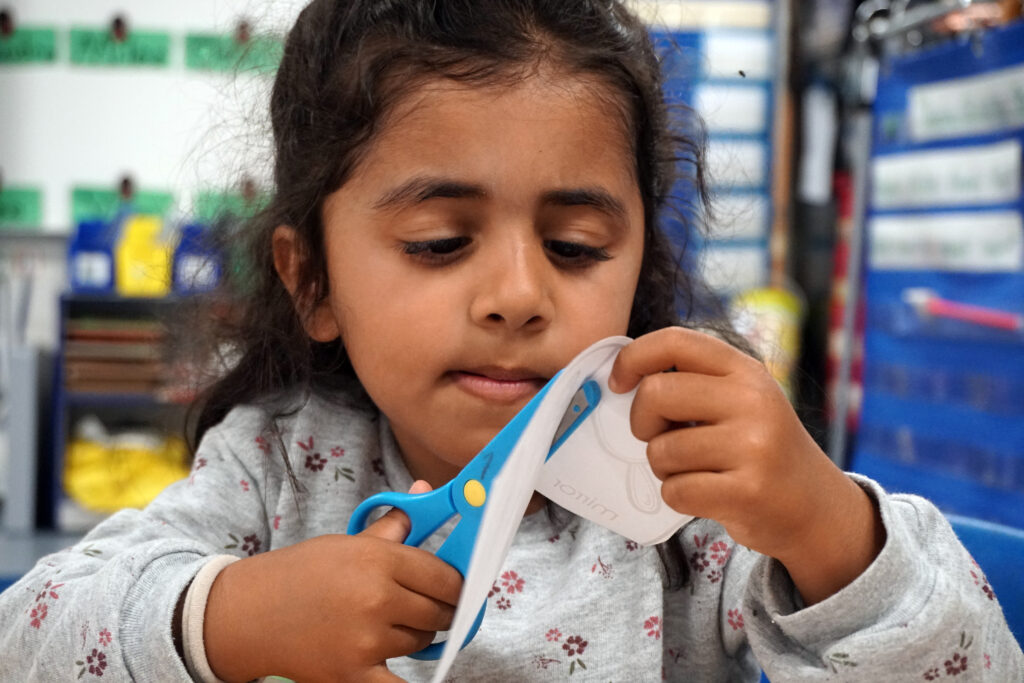
A Castro Valley Unified School District TK student uses scissors to cut a square by following the lines on the paper.
Credit: Andrew Reed / EdSource
The Cruz family has experienced two sides of a prekindergarten journey: one that transitions from preschool into kindergarten and one that includes transitional kindergarten, or TK, before kindergarten.
Play, potties, preschool: TK for All
 Credit: Andrew Reed / EdSource
This story is part of a special series on transitional kindergarten in California.
California is now offering TK to all 4-year-olds. What does quality TK look like? Who should staff it? And a new challenge: How can teachers manage a class and help kids not yet potty-trained?
This series explores those issues and more.
Read more: Inside transitional kindergarten: Where play, curiosity and early learning meet
Read more: California expands TK, but thousands of 4-year-olds remain unenrolled
Read more: Finding the ideal TK teacher: A challenge of credentials and preschool experience
Read more: ‘Can you come wipe me?’: Younger 4-year-olds pose new challenges for TK
TK provided Caleb Cruz with a balance of play and academics.
For circle time, he and the other 4-year-olds would bring toys and other items to class to match a letter of the alphabet. They would describe the toy for their peers to guess. What do you do with it? Do you play with it? These are simple yet significant questions young learners should ask each other. Caleb often wanted to stump his peers, which is why he brought a toy eggplant the week his class focused on the letter “E.”
The experience incorporated play and curiosity, reinforced communication and social skills, and was based on academics.
The TK program at the Castro Valley Unified School District helped prepare Caleb, now 5, academically and socially for kindergarten by setting the tone for what elementary school would be like, said his mom, Jeannie Cruz. And students often already have friends from TK when they continue to do kindergarten at the same school. (The San Francisco Unified School District, for the first time this year, is automatically enrolling kindergarten students at the school they attended for TK in the 2024-25 school year without having to reapply.)
Cruz compares Caleb’s TK experience to his brother Cohen’s in private preschool. While several factors could have contributed, their reading skills differ. Caleb started kindergarten this year and was able to read a little.
“Cohen tends to be more on the shy side anyway, so I feel like he really could have benefited socially as well as academically,” Cruz said. Cohen, now 7, wasn’t eligible for TK a couple of years ago when it was still rolling out to 4-year-olds.
This school year, TK is free for all 4-year-olds. It’s designed to provide developmentally informed, high-quality instruction to all 4-year-old children in the year preceding kindergarten, regardless of the child’s location, background, home language or needs.
“It’s a great foundation,” Cruz said. “I think it really does help prepare children in many different ways.”

The program was once designed to serve only children who missed the kindergarten age cutoff. Now it’s an option, alongside Head Start, the California State Preschool Program and private preschool, to create a play-based learning environment for students to grow academically and socially in preparation for kindergarten.
It’ll be a parent’s choice which program best suits their children’s and family’s needs. Many factors go into a family’s decision.
“Parents want different things out of care,” said Abigail Stewart-Kahn, managing director for the Stanford Center on Early Childhood. Twenty-five percent of families surveyed in 2024 said their family prefers a different early childhood education option than TK, 15% of families said they like to keep their child at home, and 8% of families said they didn’t think their child needed TK.
For most families, the logistics of the program are the determining factor. These include cost, transportation, program hours, and whether the program offers before- and after-school care.
“For TK to fully support children and families,” Stewart-Kahn said, “parents tell us that transportation must work; before and after care must be accessible; and families have to feel confident leaving their little ones in the public system’s care.”
Here’s what families should know about the four types of programs available to California’s youngest learners. In addition, some families choose to have relatives, friends or nannies watch their children.
According to the California Department of Education, all programs are available to families regardless of their immigration status. The Trump administration recently said Head Start would no longer be available to undocumented immigrant children, but California and other states challenged the move in court, and the change to eligibility is on hold while the case is pending. Parents and child care advocates have also worried that possible federal funding cuts could limit the number of children in Head Start or end it altogether. Currently, it is still available.

“It goes back to what’s best for families,” said Patricia Lozano, executive director of the advocacy group Early Edge California. “What is it that parents need? My intuition is that they just want something that is easy, accessible, and affordable, and where they feel like (their) child is learning and is safe.”
EdSource reporter Zaidee Stavely contributed to this report.