What Technology Assistance Actually Exists for Low-Income Students
76 percent. That's the share of low-income high schoolers who have a laptop at home, according to ACT's 2024 national study on student technology access. Compare that to 92 percent among high-income students and you're staring at a 16-point gap that hasn't moved much in years. But device access is only half the problem. The other half — the one that gets less attention — is what kind of internet these students are actually using.
The Gap Is Bigger Than the Device Numbers Suggest
ACT's research found that 70% of students from households earning under $36,000 a year rely exclusively on monthly cellular data plans for their internet access. Among high-income students, that number drops to 58%. That gap might sound small. It isn't.
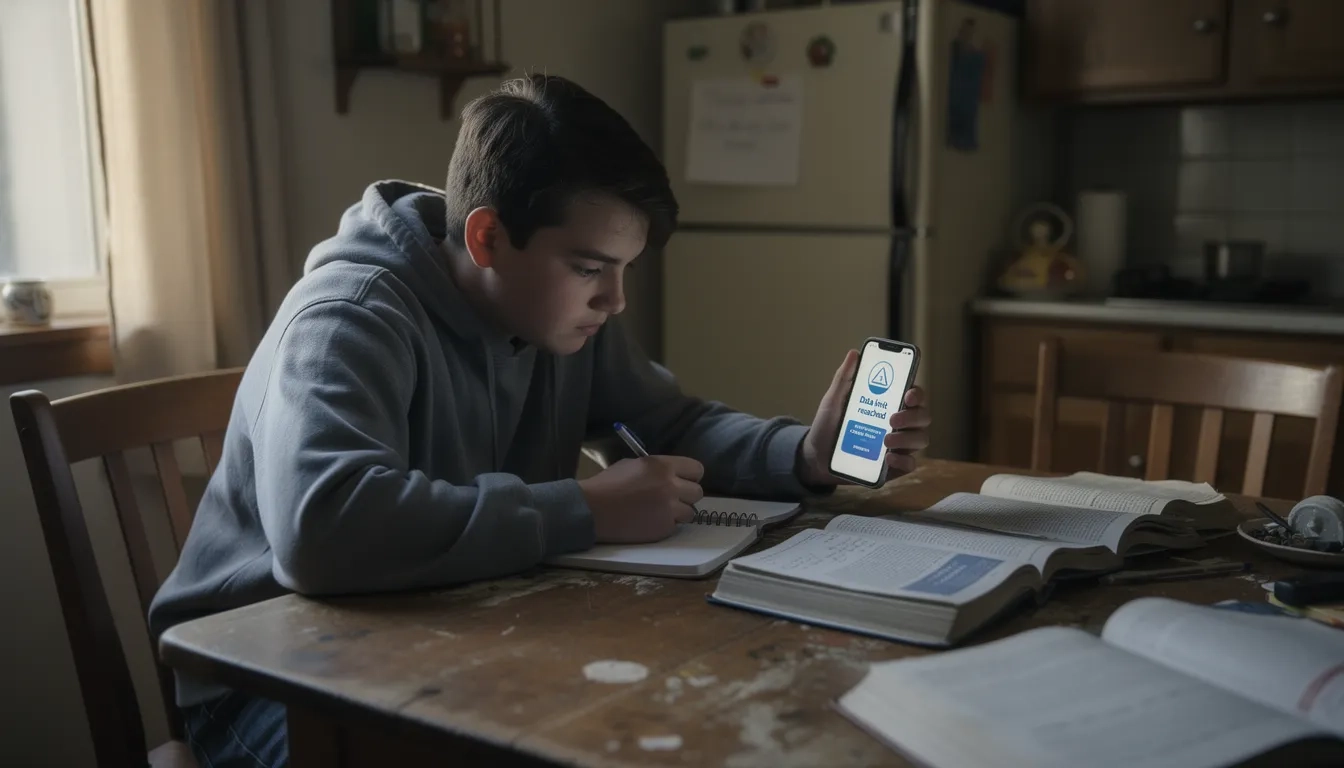
Streaming a recorded lecture on a capped data plan is a fundamentally different experience than having home broadband. Hit your 10GB limit in week two of the month, and suddenly every assignment involving video becomes impossible. A student cramming for finals on a throttled connection isn't disadvantaged in some vague sociological sense — she's concretely blocked from the resources her classmates take for granted.
Dial-up usage persists too, which is worth naming out loud: 5% of Black students and 4% of Hispanic students still use dial-up connections, compared to 2% of white students, per the same ACT study.
"Device and internet access of students with lower family incomes is lagging that of students with higher family incomes." — Jeff Schiel, ACT research scientist, 2024
The Pew Research Center's numbers tell a similar story at the household level. Broadband adoption sits at 92% for households earning $100,000 or more, falls to 78% for the $30,000-$69,999 range, and drops to just 57% for households earning under $30,000.
That bottom tier — 57% — is where most low-income students live.
What Happened When the Safety Net Disappeared
For a few years, the federal Affordable Connectivity Program (ACP) was genuinely helping. At its peak, 23 million households used the $30-per-month subsidy to offset broadband costs. For a family paying $70/month for internet, that meant a $40 bill. Not nothing when you're choosing between Wi-Fi and groceries.
Congress let the funding expire. The ACP stopped accepting applications in February 2024 and fully shut down June 1, 2024.
Within months, an estimated 5 million households cut internet service entirely, per a Brattle Group report. A National Lifeline Association survey from January 2025 found that nearly 40% of former ACP participants reduced food spending just to keep paying their internet bills. Another 36% discontinued telehealth services.
For students, losing reliable internet isn't a lifestyle inconvenience — it's a functional dropout risk. College applications, financial aid forms, online coursework, virtual tutoring: all of it requires a stable connection. When that connection disappears or gets throttled to a capped cell plan, students start falling behind in ways that compound.
Some states moved fast to fill the hole. New York passed the Affordable Broadband Act, the first law in the country to require ISPs to offer $15/month plans to qualifying low-income households. California, Massachusetts, Vermont, Connecticut, Maryland, and Minnesota have proposed similar mandates. The federal net frayed; a few state nets caught people before they hit the ground.
Where to Get Free or Low-Cost Devices
The device assistance landscape is messier than it should be. There's no single federal portal, no universal application. But programs do exist, and they work if you know where to look.
Dell Scholars Program is one of the most generous packages available for high school seniors: a laptop plus a $20,000 scholarship, targeting first-generation college students from low-income backgrounds. The application is competitive, but the payoff is real.
Nonprofit distributors are often the fastest path to a device. Human-I-T has distributed over 100,000 refurbished computers since its founding, collecting hardware from corporate donors and giving it to qualifying individuals. Compudopt runs a similar model. Eligibility for both typically requires proof of participation in a federal assistance program — SNAP, Medicaid, or free/reduced lunch usually qualifies.
The Silicon Project offers free refurbished computers to individuals enrolled in qualifying federal assistance programs. The machines aren't brand-new, but a three-year-old refurbished ThinkPad running a clean Windows install handles Google Docs, Zoom, and most academic software without breaking a sweat.
School district device lending is the most underused resource on this list. Many districts have technology loaner programs sitting largely dormant because students don't know to ask. The right door to knock on is the district's technology coordinator or student services office — not the general school office, which often doesn't know these programs exist.
| Program | What You Get | How to Qualify |
|---|---|---|
| Dell Scholars | Laptop + $20K scholarship | Low-income, first-gen college students |
| Human-I-T | Refurbished laptop or desktop | SNAP, Medicaid, or free/reduced lunch |
| Compudopt | Refurbished computer | Income-based (varies by location) |
| The Silicon Project | Free refurbished PC | Federal assistance program enrollment |
| School district 1:1 loan | Device loan | District enrollment, need-based |
Apply to multiple nonprofit programs simultaneously. Waitlists are common. First one to respond wins.
Internet Programs Still Standing After ACP
The federal fallback is the FCC's Lifeline program, which predates ACP by nearly 40 years. Lifeline provides up to $9.25/month off phone or internet service (up to $34.25/month for households on Tribal lands). That won't cover a full broadband bill alone, but stacked with a carrier's own low-income plan, it can close the gap.
Several major ISPs run subsidized plans for qualifying households:
- Comcast Internet Essentials: $9.95/month for 25 Mbps, available to households with a K-12 student enrolled in free or reduced lunch
- AT&T Access: $10-20/month plans for households receiving SNAP benefits
- Spectrum Internet Assist: approximately $17.99/month for 30 Mbps, available to K-12 or community college students on free lunch or Lifeline
These speeds aren't impressive. But 25 Mbps is more than sufficient for video calls and coursework, and $10/month is within reach for most families who qualify.
The missing piece is that none of these stack with federal subsidies the way ACP did. Lifeline and ISP programs are largely separate tracks. EducationSuperHighway, a nonprofit focused on school connectivity, proposed in December 2024 that Congress repurpose existing Universal Service Fund dollars to create a permanent ACP replacement — no new appropriations required. That proposal is still waiting on Capitol Hill.
What E-Rate Does (and Doesn't Cover)
The FCC's E-Rate program is the biggest technology equity program almost no one talks about at the kitchen table. It's been funding school internet since 1997, and in funding year 2025, its cap sits at $4.456 billion. Schools and libraries receive discounts ranging from 20% to 90% on broadband and Wi-Fi infrastructure, with discount levels tied directly to a school's poverty rate.
In June 2025, the Supreme Court upheld E-Rate's constitutionality after a legal challenge had threatened the whole program. That ruling mattered. About 1 in 4 school districts still hadn't met the FCC's baseline bandwidth goal of 1 Mbps per student, and many of those districts depend on E-Rate to get there at all.
But here's what E-Rate does not do: it funds connectivity inside school buildings, not in students' homes. A school can have blazing-fast Wi-Fi in every classroom. Those same students go home to a capped cell plan.
Some districts are bridging this with Wi-Fi hotspot lending programs — checking out mobile hotspot devices like library books. This is worth asking about, though availability varies widely. Districts with strong Title I funding tend to have more of these than those without.
How to Actually Navigate the System
The biggest practical problem isn't that programs don't exist. It's that they're siloed, inconsistently advertised, and require knowing which door to knock on.
Here's a framework that works:
Get enrolled in a federal benefit program first. SNAP, Medicaid, free/reduced lunch, SSI, or Federal Public Housing Assistance — enrollment in any of these is the master key for almost all device and internet assistance programs. If you're eligible but not enrolled, fix that before anything else.
Check your district and state before going national. Ask the district's student services or Title I coordinator what's available locally. Many states run their own programs that don't get national coverage. Texas has the Texas Connects All Program for underserved rural households. Your state may have something equivalent.
Stack what you can. Lifeline plus an ISP low-income plan plus a school hotspot loan is a combination that can get a student fully connected at very low cost. No single program covers everything, but three modest ones stacked together often do.
Apply to multiple device programs simultaneously. Waitlists are real. Submit to Compudopt, Human-I-T, and your local library or community action agency at the same time.
Ask at the start of the school year. Many districts replenish device loans and distribute surplus equipment in August and September. Mid-year, stock is often depleted.
The Confidence Gap Nobody Measures Well
Here's something the access statistics miss: even among low-income students who have devices and internet, ACT's research found they consistently report less confidence using technology for schoolwork than higher-income peers.
This isn't abstract. A student who grew up using a shared family phone for social media but rarely for academic research is going to struggle with database searches, citation tools, and document collaboration platforms in ways that aren't obvious to teachers.
Digital literacy programs in public libraries are chronically underfunded but often the best option available. Many local branches run free workshops — they're just not well-publicized. Chicago Public Library's YOUmedia program is one of the better-known models, offering teens dedicated tech space and adult mentors.
The research on this is pretty clear: access alone doesn't close the outcome gap. Pairing device distribution with actual skills instruction is what moves the needle. A low-income student handed a laptop without training on how to use it academically ends up with a slightly nicer device for gaming.
Bottom Line
The technology gap for low-income students is real, persistent, and got measurably worse when the ACP ended in mid-2024. Five million households losing internet isn't a rounding error — it's a generation of students starting to fall behind in real time.
Programs exist, and they're stackable:
- Enroll in a federal benefit program first — it's the master key for almost everything else
- Ask your school or district directly about device loans and hotspot programs before applying anywhere national
- Stack Lifeline with an ISP low-income plan to approximate what ACP used to cover at a fraction of the cost
- Apply to multiple nonprofit device programs simultaneously — Human-I-T, Compudopt, and local community action agencies are the best starting points
- Don't treat a device as the finish line — pairing access with digital literacy training is what actually changes outcomes
The structural fix — a permanent ACP replacement funded through Universal Service Fund dollars, as EducationSuperHighway proposed — would do more than all of these combined. But that's waiting on Congress. In the meantime, the patchwork works if you know where to pull.
Frequently Asked Questions
Is there still a government internet program for low-income students after ACP ended?
Yes, though the coverage is thinner. The FCC's Lifeline program still provides up to $9.25/month off internet or phone service for qualifying households. Combined with ISP-specific low-income plans from Comcast, AT&T, or Spectrum, students can still find home service in the $10-20/month range. It's not as seamless as ACP was, but the combination is real and available.
Can low-income students get a completely free laptop from the government?
No single federal agency distributes free laptops directly to individuals. What exists is a mix of nonprofit programs (Human-I-T, Compudopt, The Silicon Project), school district lending programs, and scholarship packages like Dell Scholars that include a device. These require applications and sometimes have waitlists, but they are legitimate and do come through.
Does free or reduced lunch automatically qualify a student for tech assistance programs?
For most programs, yes. National School Lunch Program enrollment is one of the most widely accepted proofs of eligibility for device distribution nonprofits, Comcast Internet Essentials, and similar programs. It won't cover every program, so check individual requirements, but NSLP enrollment opens the door for the majority of what's available.
Is doing schoolwork on a phone actually a disadvantage, or is it just inconvenient?
It's a concrete academic disadvantage, not a preference issue. Writing a 10-page research paper, managing spreadsheets, running academic software, or coding are genuinely harder — often impossible — on a smartphone. ACT's 2024 data shows 70% of low-income students depend primarily on cellular connections, and a meaningful share of those are also limited to phones as their only device. The penalty shows up in grades and completion rates, not just comfort.
What does E-Rate actually fund, and does it help students at home?
E-Rate funds internet connectivity and networking equipment inside school buildings and public libraries, with a $4.456 billion annual cap and discounts up to 90% based on poverty level. It doesn't cover home connections. The Supreme Court upheld the program in June 2025. Students benefit indirectly through better in-school connectivity, but E-Rate won't help with the homework gap.
My school says they have no device lending program. What should I do next?
Ask the district's Title I coordinator specifically — many programs exist at the district level and aren't visible at individual schools. If the district has nothing, your public library is the next stop: both for device loans and in-building access. Community action agencies, searchable through Community Action Partnership (communityactionpartnership.com), often run device distribution programs funded through local grants that fly under the radar nationally.
Sources
- ACT Research: Digital Divide Still Holds Students Back
- eSchool News: The Digital Divide Still Holds Students Back
- Broadband Breakfast: One Year Without the Affordable Connectivity Program
- K-12 Dive: Digital Divide Persists as 22% of Low-Income Households with Children Lack Internet
- Pew Charitable Trusts: States Reckon With Lapse of the Affordable Connectivity Program
- Nomadix: E-Rate 2025 Explained
- gov-relations.com: Free Government Laptops for Students in 2026