Federal Student Loans: Subsidized vs Unsubsidized Explained
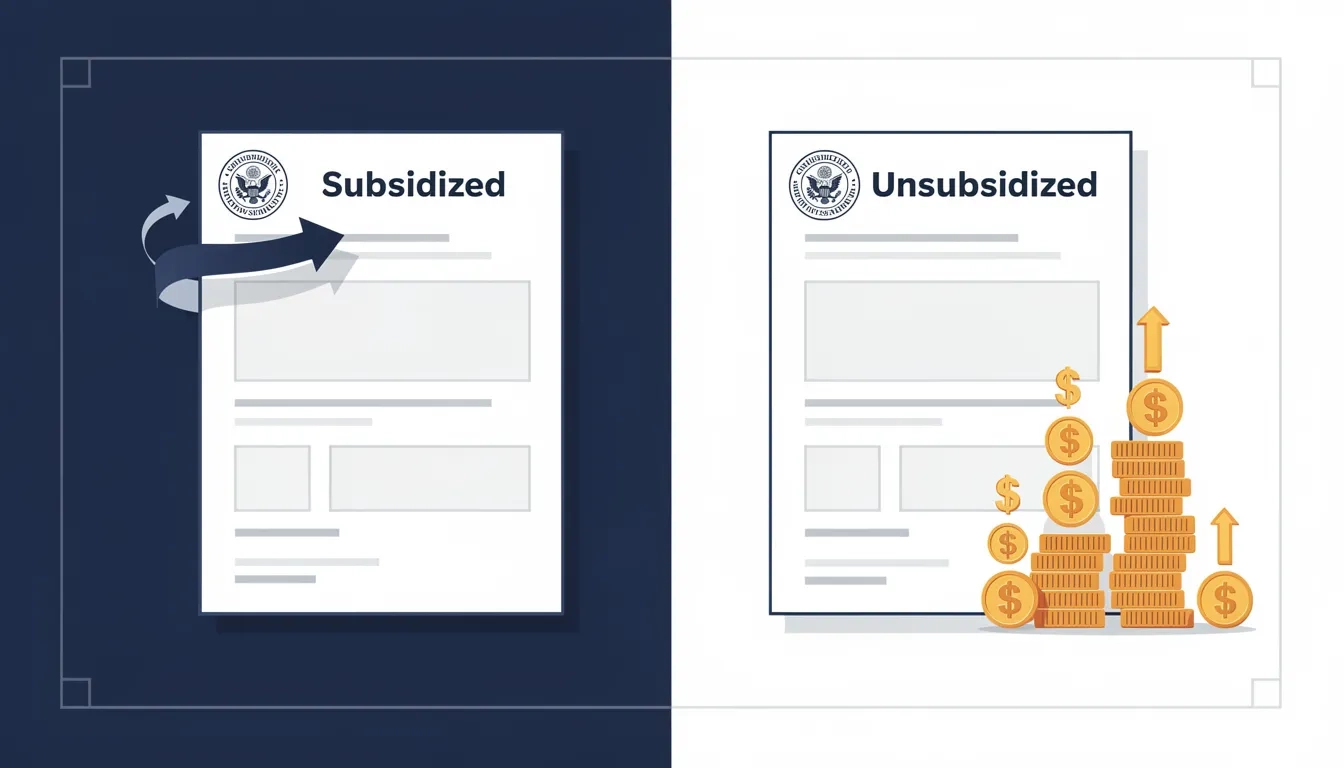
Here's a number buried in the paperwork: if you borrow the maximum subsidized amount across four undergraduate years and carry those loans through the six-month grace period, the federal government pays roughly $3,547 in interest on your behalf — at today's 6.39% rate. Not a scholarship. Not forgiveness. Just interest charges that never appear on your balance because someone else covered them. Most students accept whatever mix of loans shows up in their financial aid award letter without realizing one type is significantly cheaper than the other.
The Core Difference: Who Pays the Interest
Both types are federal Direct Loans issued by the U.S. Department of Education. Same repayment options. Same income-driven plans. Same 6.39% rate for undergraduates in 2025-2026. The single thing that divides them is who covers the interest while you're in school.
With a Direct Subsidized Loan, the Department of Education pays interest during three specific windows: while you're enrolled at least half-time, during the six-month grace period after leaving school, and during authorized deferment. You graduate owing exactly what you borrowed.
With a Direct Unsubsidized Loan, interest accrues from the first day of disbursement. It never pauses. Skip paying it and it gets capitalized — folded into your principal — so that you're paying interest on accumulated interest from the moment repayment begins.
That capitalization event is where many borrowers get blindsided. The number on your promissory note and the number you actually owe at repayment are often two different figures.
Who Qualifies for Each Loan Type
Subsidized loans require demonstrated financial need through the FAFSA. Your Student Aid Index (the number the application produces) gets compared against your school's cost of attendance. Only undergraduates qualify — graduate students lost access to subsidized loans in 2012 under the Budget Control Act of 2011.
Unsubsidized loans carry no need requirement. Undergrad, graduate, and professional students can all receive them. You still file a FAFSA, but eligibility is based purely on enrollment status.
Both loan types require:
- U.S. citizenship or eligible non-citizen status
- At least half-time enrollment in an eligible degree or certificate program
- Satisfactory Academic Progress (SAP), as your school defines it
- No existing default on a federal loan
You don't choose which type you receive. Your school's financial aid office determines your mix from FAFSA data. The award letter shows what you've been offered. You can accept all of it, part of it, or none — and that last option is underused more often than it should be.
Loan Limits by Year and Dependency Status
Annual and aggregate limits cap how much you can borrow in each category.
| Year / Status | Total Annual Limit | Max Subsidized |
|---|---|---|
| Dependent Freshman | $5,500 | $3,500 |
| Dependent Sophomore | $6,500 | $4,500 |
| Dependent Junior+ | $7,500 | $5,500 |
| Independent Freshman | $9,500 | $3,500 |
| Independent Sophomore | $10,500 | $4,500 |
| Independent Junior+ | $12,500 | $5,500 |
| Graduate Student | $20,500 | Not eligible |
Aggregate lifetime limits apply on top of annual ones. Dependent undergrads can borrow no more than $31,000 total, with $23,000 of that subsidized. Independent undergrads cap out at $57,500, though the subsidized ceiling stays at $23,000. The extra borrowing room for independent students is entirely unsubsidized.
Graduate students face a $138,500 aggregate ceiling including undergraduate borrowing — and none of it can be subsidized.
One thing worth noting: the subsidized cap doesn't increase with independent status. Both dependent and independent undergrads hit the same $23,000 lifetime subsidized limit. Independence just unlocks more unsubsidized access.
How the 6.39% Rate Gets Calculated
Federal loan rates aren't negotiated by Congress each spring. They're derived from a Treasury auction. The Department of Education takes the high yield from the 10-year Treasury note auction held in early May, then adds a statutory percentage depending on loan type.
For 2025-2026, the May 6 auction produced a yield of 4.342%. Adding the 2.05 percentage-point statutory add-on for undergraduate Direct Loans produces 6.39%. Graduate unsubsidized loans use a higher add-on (3.60 points) for a rate of 7.94%. PLUS loans apply 4.60 points for a total of 8.94%.
Once set at disbursement, your rate is fixed for the life of that loan. A loan taken in fall 2025 at 6.39% holds that rate regardless of what Treasury yields do in 2030 or 2035.
This matters when comparing federal and private options. Private variable-rate loans can look cheaper upfront. But a rising-rate environment over a ten-year repayment window can make them more expensive than the federal fixed rate you locked in freshman year. That stability has real value.
The Real Cost of Skipping Interest Payments
Here's what the math looks like in practice. Borrow $7,500 in unsubsidized loans as a dependent freshman — the annual limit — and pay nothing toward interest while in school.
At 6.39%, that loan generates roughly $479 in interest in year one. Four years later, before the grace period even ends, that $7,500 has grown to approximately $9,564 in principal plus accrued interest. Capitalization locks that inflated figure as your new principal, and every future payment gets calculated on the bigger number.
The Institute for College Access & Success (TICAS) has documented this pattern consistently: borrowers who skip in-school interest payments regularly underestimate what they owe when repayment starts. The gap isn't shocking semester by semester. It compounds.
Some ways to reduce the damage:
- Pay the monthly interest while enrolled. Even $50/month prevents capitalization and shrinks your total borrowing cost.
- Apply work-study or part-time income to interest first. It's often the highest-return use of those earnings.
- Sign up for autopay. Both loan types qualify for a 0.25% interest rate reduction (not huge, but it costs nothing).
One less-obvious risk after graduation: if you enroll in an income-driven repayment plan and your monthly payment doesn't cover the monthly interest, your balance can still grow while you're paying. This happened to many SAVE plan enrollees before courts blocked the plan. Negative amortization is a real phenomenon worth watching, not a hypothetical.
Borrow Subsidized Loans First. Every Time.
This is not subtle advice. It just doesn't always get stated directly.
Subsidized and unsubsidized undergraduate loans carry the same 6.39% rate. They qualify for the same repayment programs. But one costs nothing during school, and the other bills you from day one of disbursement. The right order is always subsidized first.
If your award letter shows $3,500 subsidized and $2,000 unsubsidized for freshman year, take the full $3,500 subsidized. Only accept the unsubsidized portion if you genuinely need it after exhausting the subsidized amount.
When federal loans aren't enough to cover your costs, the sequence looks like this:
- Accept all offered subsidized loans
- Accept unsubsidized loans up to your annual limit
- Evaluate Parent PLUS or private loans only if a funding gap remains
Private loans sometimes carry lower rates for borrowers with strong credit. But they can't replicate the federal safety net. Income-driven repayment, Public Service Loan Forgiveness, and deferment options are federal-only benefits. The elephant in the room with private borrowing is what happens if your income drops after graduation — federal loans have flexibility built in that most private lenders don't offer, regardless of APR.
What Changes in July 2026
Federal student lending is shifting significantly this summer. Subsidized undergraduate loans are unaffected. But if any of the following programs are part of your funding picture, the changes matter.
Graduate PLUS loans are being eliminated for new borrowers starting July 1, 2026. Students already enrolled in a program can continue borrowing under a three-year legacy provision, provided they remain in the same course of study.
Parent PLUS loans are getting caps for the first time ever. New parent borrowers face a $20,000 annual limit and a $65,000 lifetime cap per dependent student. Before this change, Parent PLUS had no aggregate limit beyond the school's cost of attendance — parents could borrow whatever the gap required, year after year.
New lifetime limits for graduate students set ceilings at $100,000 for non-professional grad students and $157,500 overall (including undergraduate borrowing). Liberty University's financial aid office has noted that several implementation details are still pending further Department of Education guidance.
Families who planned to use PLUS loans to bridge large funding gaps should model their full financing picture now, before July.
Bottom Line
- Borrow subsidized loans first, always. Same rate, same programs as unsubsidized — but the government covers interest during school while you finish your degree.
- Pay at least the monthly interest on any unsubsidized loans while enrolled. It's not required, but it prevents capitalization and keeps your balance honest.
- The 2025-2026 undergraduate rate is 6.39%, fixed at disbursement for the life of the loan. That fixed-rate feature is a genuine structural advantage over variable private alternatives.
- Grad PLUS disappears for new borrowers on July 1, 2026. Parent PLUS gets annual and lifetime caps for the first time. If those programs are in your plan, adjust before the deadline.
- File your FAFSA every single year. Subsidized eligibility is recalculated annually, and your aid mix can shift even if your situation feels similar.
Frequently Asked Questions
Can I convert an unsubsidized loan into a subsidized loan?
No. The loan type is determined at origination based on your financial need and year in school. Once disbursed, an unsubsidized loan stays unsubsidized. The only path to subsidized loans is being offered them in a future aid year, which requires re-filing FAFSA and demonstrating need again.
Does the government pay subsidized loan interest during income-driven repayment?
No. The interest subsidy applies only during in-school enrollment, the grace period, and authorized deferment — not during repayment. Once you enter any repayment plan, including income-driven options like IBR or PAYE, interest accrues on both loan types and you're responsible for covering it.
Do I have to accept every loan listed in my financial aid award?
No, and this is genuinely useful to know. You can accept partial amounts or decline specific loan types entirely. Accepting the subsidized portion while skipping the unsubsidized one is a valid choice. Contact your school's financial aid office to adjust your award before you sign a Master Promissory Note.
Is the government's coverage of subsidized loan interest taxable income for me?
No. The interest subsidy is not reported as taxable income and has no effect on your federal tax return. It functions similarly to other qualified educational benefits under the federal tax code.
What happens to my subsidized eligibility if my financial situation changes?
Your eligibility is recalculated every year when you re-file FAFSA. A change in family income, household size, or enrollment intensity can shift your Student Aid Index and affect how much subsidized borrowing you're offered. Students who lose subsidized eligibility can still access unsubsidized loans up to their annual limits.
Why can't graduate students get subsidized loans?
The Budget Control Act of 2011 eliminated graduate and professional student access to subsidized Direct Loans, effective July 1, 2012, as part of a broader deficit-reduction package. Before that date, graduate students could borrow subsidized loans. Now their only direct federal option below PLUS rates is unsubsidized at 7.94%.
Sources
- Federal Student Aid: Subsidized and Unsubsidized Loans
- Interest Rates for Direct Loans First Disbursed 2025-2026 | FSA Partners
- Federal Student Loan Amounts and Terms 2025-26 | TICAS
- Average Student Loan Interest Rate 2026 | Education Data Initiative
- Important Federal Student Loan Changes Effective July 1, 2026 | Liberty University