Students become lifeline for peers facing suspensions, mental health struggles
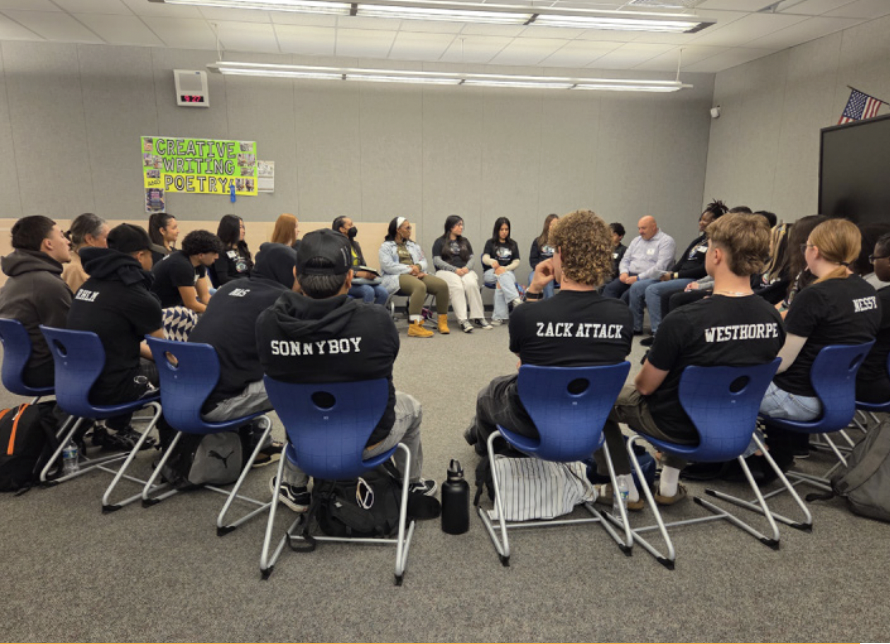
Students at Antioch High School attend training to become peer advocates. Credit: Antioch High School
Top Takeaways
- At Antioch High School in Contra Costa County, students sign up to become peer advocates and support peers through counseling, mentorship, conflict mediation and brief interventions for substance use and mental health.
- Peer advocates have helped students avoid suspension when they are caught with a substance on campus.
- The program has enabled peer advocates to improve their communication and interpersonal skills, with some inspired to pursue careers in mental health after graduation.
It took about three years and many peer counseling sessions for Cristian Topete to recognize his potential.
As a freshman at Antioch High School in Contra Costa County, Cristian remembered feeling overwhelmed by negative emotions while adjusting to high school. He said he felt far from being the role model he had envisioned for himself, which led him to sign up as a peer advocate.
“I was very troubled. The transition was difficult for me, and it was hard putting myself more out there,” Cristian said. “Once I joined this program, it made me realize that I wasn’t alone in my situation and that there are a lot of other people that were going through the same things I was.”
Cristian, now a senior and third-year peer advocate, is part of Antioch High School’s extensive peer support program, which includes 80 peer advocates who provide support to students. Advocates receive about six months of training in their first year, after which they are dispatched to mentor, facilitate mediations, provide brief mental health and drug-related interventions and build community with other students.
“School support was always important to us, but it became more of a priority to the state after Covid,” said Shira Sweitzer, the peer advocates coordinator and restorative practices facilitator at Antioch High. “And a lot of our growth has come by having the students drive the program, because ultimately they know the needs of the community.”
Peer-to-peer support has seen a surge in school interest since the Covid pandemic and its aftermath, as reports indicated a rise in youth isolation, anxiety, depression and trauma exposure from the pandemic. Starting in 2019, California expanded school-based peer support programs across state schools as part of its historic $4.9 billion Children and Youth Behavioral Health Initiative. Sweitzer started Antioch’s peer support program a decade ago in response to a persistent shortage of mental health counselors, and she used additional Covid funds to expand its capacity.
She developed a new ninth grade mentoring program where she matched incoming students and peer advocates who had signed up to guide new freshmen in their transition into high school. Sweitzer also helped train students in Peer Intervention Education, a peer-led alternative to suspension for students who are found using substances such as alcohol and tobacco for the first time.
“Students don’t want to hear an adult lecture them about their substance use. They’ve already heard it many times,” said Justin Escobedo Lopez, a senior and third-year peer advocate. “I think they’re way more comfortable talking to someone their age about it and not having to hear, ‘What you are doing is bad.’ ”
Peer advocates spend at least three meetings talking to students about their relationship with drug use, exploring why they might use and potential alternatives to use, without applying pressure on the student to quit.
Justin said the moment he recognized himself as a peer advocate was when he helped a student understand and eventually break nicotine addiction. Cristian remembered working with a student who had been caught drinking on campus, and after a few sessions, helped her quit the habit before it stuck.
“At the end, she told me that she didn’t necessarily like drinking on school campus, and it was more or less her friends that influenced her,” Cristian said. “She told me that she would either talk to her friends and tell them to not include her or to distance themselves, or that she was going to think about just unfriending them in general.”

In the five years since Peer Intervention Education began, peer advocates have helped bridge the gap between counselors and students who aren’t willing to speak openly with an adult, Sweitzer said.
Anna Gamble, a senior and third-year peer advocate, recalled being warned by school administrators that a student who had been caught smoking on campus would likely not open up to her. The student had refused to cooperate with a counselor and had already resigned herself to being suspended, she said.
“I ended up meeting up with him almost twice a week for quite a few weeks, and he ended up responding really well,” Anna said. “He was telling me how he would start cutting back his use each time, and he also opened up in other ways than just about his use.”
Antioch High’s program is also part of a peer-to-peer youth mental health pilot program led by The Children’s Partnership and the California Department of Health Care Services, which evaluated the first of a roughly $8 million three-year grant initiative to strengthen student well-being. The pilot’s research indicated that 96% of students who accessed peer support across eight schools said they felt better afterward, and about 91% of peer mentors reported that their training was useful for developing communication and leadership skills.
Anissa Mangabat, a senior and third-year peer advocate, often leads conflict mediation sessions between friends or classmates stuck in a fight or disagreement. She said that learning to negotiate between two competing perspectives has taught her to be more articulate and detail-oriented.
“I learned how to build a relationship with others that I don’t really know that well, and that learning to communicate really helps me grow as a person,” Anissa said.
For Venessa Humphries, a senior and third-year peer advocate, her time as a peer advocate has inspired her to study psychology and become a family therapist after she graduates from college. Helping other students on campus has taught her how to tackle the deeper roots of a problem, she said, a skill she intends to keep practicing as a future therapist.
“When I first joined the program, I was struggling a lot mentally, and going through the trainings helped me to understand not only other people’s emotions, but also how to manage my own,” Venessa said.