Student-run co-ops provide affordable housing at UC Berkeley
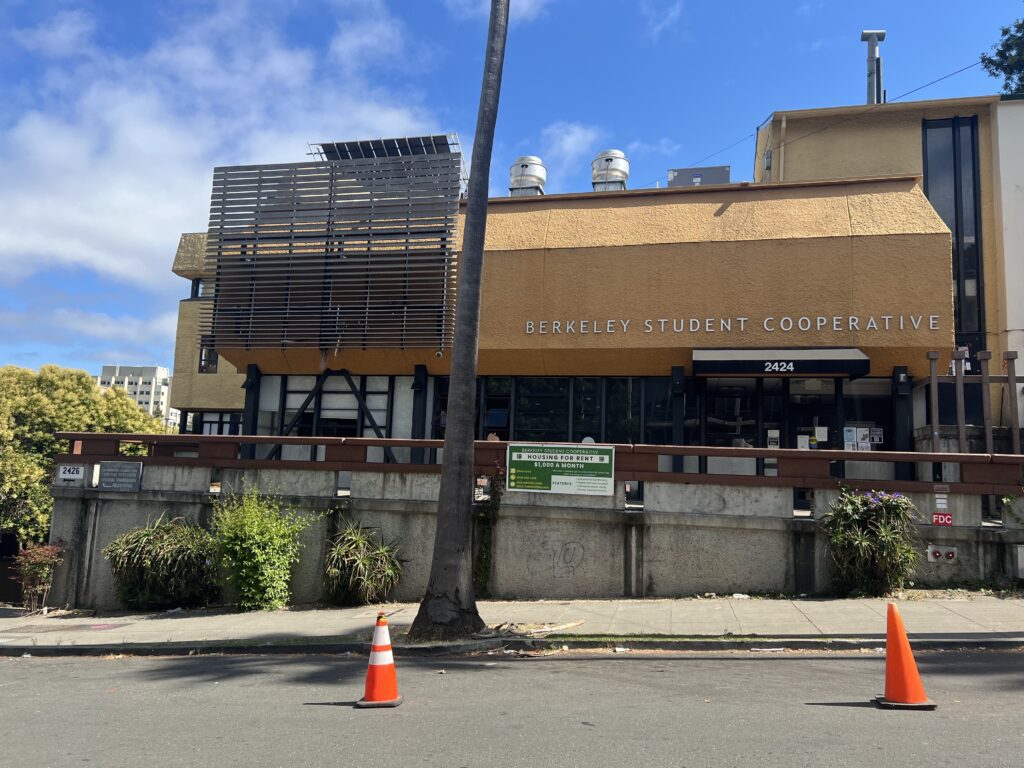
The Berkeley Student Cooperative was founded in 1933.
Megan Lam
Top Takeaways
- The Berkeley Student Cooperative has more than 1,300 student members in its 17 houses and three apartment buildings.
- Student housing can cost over $18,000 per year, compared to $4,600 per semester for a single-room co-op.
- The co-op creates housing spaces for specific groups to build community.
When Cyn Macias-Gomez was preparing for his freshman year at UC Berkeley in 2021, he was stunned to learn that on-campus housing would cost $18,000 — excluding a meal plan.
“I just have this vivid memory (of) when I went to tell my parents … how much (housing) was going to cost, and they kind of turned the question back to me, ‘Where are we going to get this money from?’” said Macias-Gomez, a recent graduate.
Rather than burden his parents with debt or take out a loan like many others have, he opted to move into Cloyne Court, a student housing cooperative.
Unlike most college campuses that have residence halls or off-campus housing, UC Berkeley students have a third option: the Berkeley Student Cooperative, or BSC.
The co-op has more than 1,300 student members in its 17 houses and three apartment buildings, all of which are democratically run and maintained by students. Most of the houses are owned by BSC; however, it leases some properties, such as Cloyne Court, The Convent, and the land where Fenwick Weavers and Rochdale apartments are located, from the university. The nonprofit is affiliated with NASCO, a larger alliance of housing cooperatives in North America with 35 registered co-op systems.
Other campuses such as UCLA, UC Davis and UC Santa Barbara offer similar co-op housing options. Still, none are as extensive and historic as the BSC, which boasts lower rents than campus dorms and average city apartments. Students who are accepted to live in a co-op pay rent on a semester basis. Some of the houses also revolve around themes that are intended to create community spaces for residents with shared identities to live together.
Affordable student housing

Ella Mui Shonk, an incoming senior who will return to her position as Casa Zimbabwe’s house president in the fall, lived in UC Berkeley’s Stern Hall dorm her freshman year. Her rent decreased from $19,000 to $9,000 after she moved into Casa Zimbabwe.
The cheapest dorm option UC Berkeley currently offers is a four-person room for $18,335 a year, which includes a required $6,555 meal plan. Most residence halls are closed during winter break, so students typically return home. Those who journey off campus to search for other options will find that the average one-bedroom apartment in Berkeley is $2,295 per month, according to Zillow.com.
In comparison, the BSC’s standard housing option costs $4,638 per semester for a single room, including food and utilities — less than half what UC Berkeley charges. For a four-person room, one BSC house charges just $2,982 per semester.
The cooperative was founded in February 1933 by former YMCA director Harry Kingman and 14 UC Berkeley students during the Great Depression. They had hoped to provide low-cost food and housing to the campus community. They also listed anti-discrimination, access to education, expansion and member education as goals for the project.
BSC executive director Yoshi Fenton described the co-ops as an “essential part of the educational ecosystem that exists here in the East Bay. Thousands and thousands of students wouldn’t be able to attend university if not for the BSC.”
Building community

Isaac Duarte Valdez, an incoming fifth-year senior, has lived in Kidd Hall since he arrived at UC Berkeley in fall 2021. He said Berkeley’s co-ops teach residents how to maintain a shared space, something that often helps bridge the gap between living in a home and living independently in college. He served as Kidd’s house president from spring 2022 to spring 2025 and will continue his leadership on the BSC board of directors next semester.
Macias-Gomez, another BSC board member, said the key to maintaining low rent is the organization’s work-shift system.
“With over 1,000 folks in our community, there’s no shortage of folks to lean into for that labor,” he said, noting that “outsourcing” for household chores does not align with the BSC’s mission.
House members are required to work five hours per week to maintain the house throughout the semester, whereas apartment residents must contribute 12 hours per week, according to the BSC website. The houses receive food and supplies in bulk from a central warehouse, which helps minimize room and board costs.
“We do our own chores, and there are certain managers who take care of the facilitation and organization of each house; that’s how we’re able to keep rent costs low,” Duarte Valdez explained.
To create a sense of community for specific identity groups, the African American Theme House opened in 1997, followed by the Oscar Wilde House for LGBTQ+ residents in 1999.
“When we look at archival photographs … the BSC’s members looked very different,” Fenton said. “It’s a reminder of the history of marginalization in this country. Every 10 or 15 years, there seems to be yet another group of folks who are finding college access and opportunity more difficult to realize.”
Fenton said the Covid-19 pandemic was “very disruptive for our organization and this space,” noting that occupancy throughout the past five years has been below 90%. With a decrease in word-of-mouth advertising, Fenton said the BSC is now looking for new ways to attract new students.
The experience you have here really is what you make it.
Cyn Macias-Gomez, UC Berkeley recent graduate

This academic year, the BSC plans to open a house intended to serve students of color and graduate and reentry students, building off of the previous African American Theme House, which has been on hiatus for the past several years.
Incoming junior Rin Hinosawa lived in the Oscar Wilde House, the LGBTQ+ themed co-op, last academic year. They said it was “nice to have an option where you know (your housing) will be safe for you” and that they found a sense of community at the Wilde House, where residents could bond over shared experiences.
“There’s so many people like you, you get to have a social experience without having to sacrifice time,” Duarte Valdez added. Weekly house dinners, meetings and regular social events give members a chance to form strong connections with their communities without the time and travel that often goes into making plans with friends who live elsewhere.
“The experience you have here really is what you make it,” Macias-Gomez said. “In a moment where we feel like there’s so little in our control … systems and institutions like ours are something I hope more folks lean into.”
Ella Carter-Klauschie is a senior at UC Berkeley, majoring in media studies and sociology; Megan Lam is a junior at UC Berkeley, majoring in integrative biology and rhetoric with a minor in journalism. Both are members of EdSource’s California Student Journalism Corps.