Student return to L.A. schools amid fire health concerns: what parents need to know
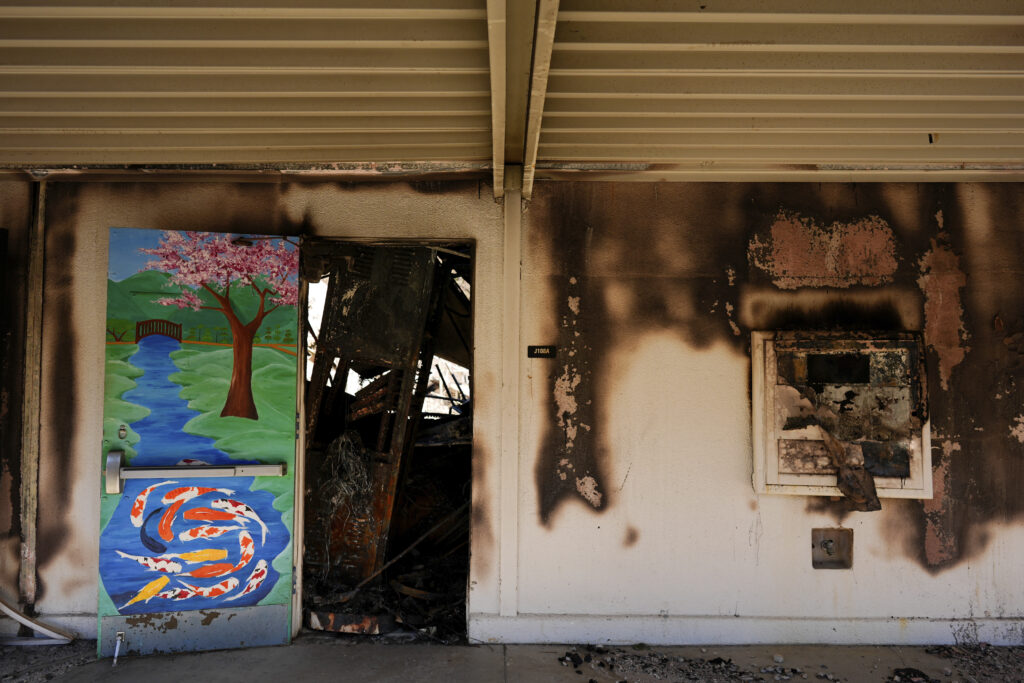
The entrance to a classroom is seen at Palisades High School in the aftermath of the Palisades fire in the Pacific Palisades neighborhood of Los Angeles on Jan. 14, 2025. (AP Photo/Carolyn Kaster)
Some Los Angeles students impacted by the Palisades and Eaton fires are returning to their original campus, which, for months, had been unsafe. The rest of the L.A. students who attended campuses that had been damaged or destroyed by the January fires will gradually return as campuses slowly rebuild.
The Army Corps of Engineers has completed cleanup efforts in the Los Angeles Unified School District and the Pasadena Unified School District, which collectively lost nearly a dozen schools. Starting Sept. 30, students at Marquez Charter Elementary in Pacific Palisades returned to school, but in portable classrooms. The remaining campuses in both districts will welcome students back once permanent structures have been built, which could take years.
Here’s what parents need to know about fire-related health hazards:
What are the main health hazards that come from spending time in fire-damaged spaces?
Spending time in a burn zone can come with exposure to certain toxins — sometimes including lead, arsenic, mercury and chromium-6 — which can lead to a range of adverse health issues, ranging from respiratory problems and organ damage to irritations to the skin and eyes.
Children are generally more vulnerable, largely due to their small size and higher respiratory rates, meaning they breathe at a faster rate than adults. That causes them to inhale more pollutants per minute.
Younger kids also tend to spend more time outdoors over the course of a school day.
Can I access my school’s environmental reports to check the numbers?
Accessing a school’s environmental report depends on the district and the school.
Los Angeles Unified and Pasadena Unified released their soil and/or water testing results at different points in the period following the Palisades and Eaton fires.
What do LAUSD’s test results say about the safety of Marquez Charter Elementary for students returning now?
LAUSD’s testing of Marquez’s exposed soil took place in July and came back with positive results, according to Sanjay Mohanty, an associate professor of engineering at UCLA. If he were a district parent, he said he would feel comfortable sending his children back with the current numbers.
Mohanty also stressed the importance of placing the current results into a broader context.
“[If] you live in a place in some other industrial area in Los Angeles, the contamination level is exactly the same or even worse than this,” he said. “So, just because there is a fire now, we should be careful — but we should also put in context what was there before. And, the levels are very similar to what [it] was before the fire.”
How might the concentrations of different toxins decrease over time?
It largely depends on the toxin, according to Mohanty. Some are more likely to naturally dissolve, while others, including those that have metallic properties, might need rain in order to be washed away.
As a result, it also depends on the region’s climate and terrain. The Palisades, for example, lies in a more mountainous landscape, which makes it advantageous for washing away toxins when the rain comes.
What can be done to ensure children’s safety once they return to campus?
For now, Mohanty said schools should check their air filters every six months for pollutants, noting that the testing so far has been more focused on the outdoors than the indoors.
“Kids will walk outside, and they’ll bring fine dust into the rooms, and those will all circulate,” he said. “And, fine dust has much [higher] concentration than the soil.”
Is LAUSD planning on tracking any factors in real time?
Superintendent Alberto Carvalho said during a press conference on Tuesday that the school has been equipped with an air sensor that monitors air quality in real time, including noxious substances, particulate matter, and the direction of the wind.
The same censors will be installed at every school across Los Angeles Unified, he said.