Complete Guide to Student Loan Repayment Plans in 2026
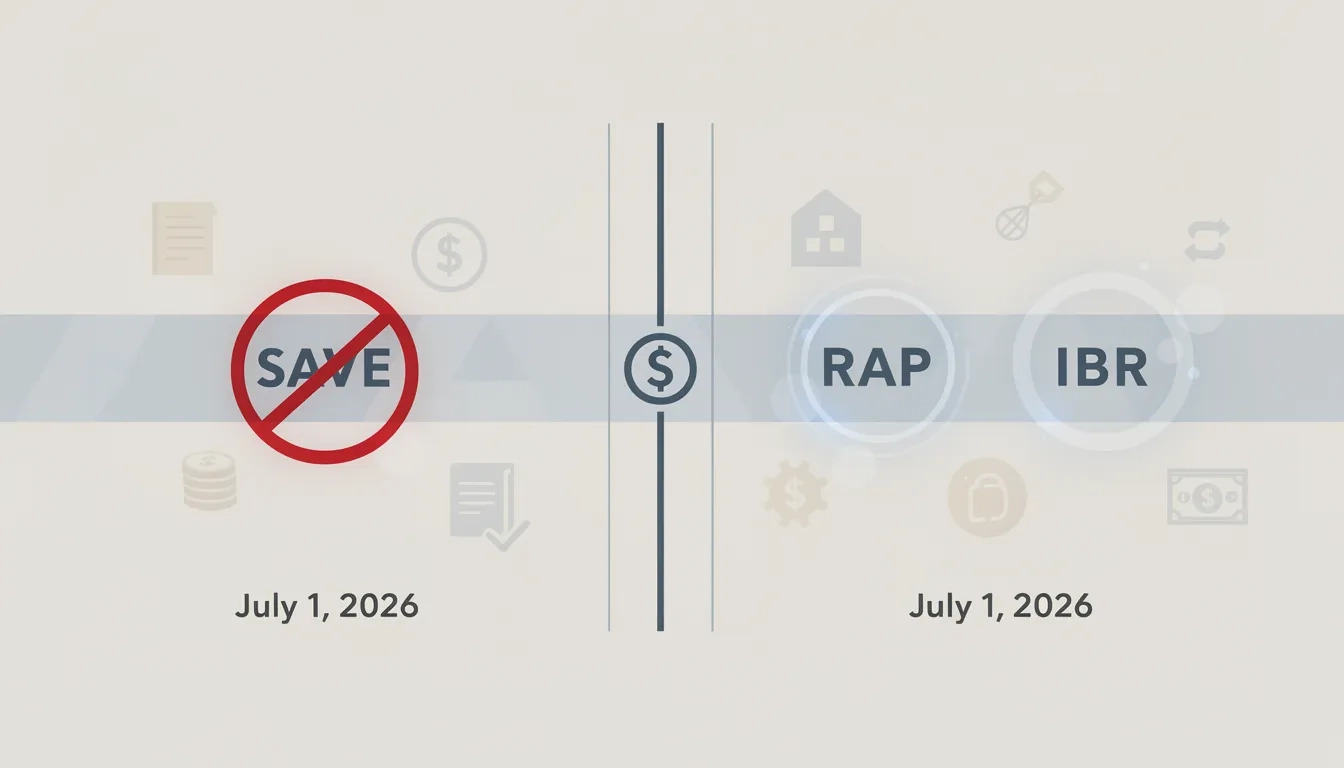
Seven and a half million borrowers found out in 2026 that their repayment plan had been declared unlawful. The SAVE plan — which the Biden administration built as the most generous income-driven option in federal loan history — was struck down by a federal court on March 10, 2026. The One Big Beautiful Bill Act (signed July 4, 2025) then restructured the entire repayment system from scratch. Two entirely new plans launched July 1. Legacy options are sunsetting. If you haven't reviewed your plan since 2024, you're almost certainly paying more than you need to or drifting toward auto-enrollment in something you'd never choose voluntarily.
What Changed on July 1, 2026
The repayment menu looks nothing like it did three years ago. Two waves of change collided this year: litigation that killed SAVE and legislation that replaced it with a restructured system.
Here's the full plan menu as of mid-2026:
Fixed-payment plans (no income factor, no forgiveness outside PSLF):
- Standard Repayment: 10-year term, highest monthly payment, lowest total interest cost
- Graduated Repayment: payments escalate every two years over a 10-year window — limited to loans disbursed before July 1, 2026
- Extended Repayment: 25-year term for borrowers with $30,000+ in Direct Loans — also restricted to pre-July 2026 loans
- Tiered Standard Plan (new): term runs 10 to 25 years based on your total outstanding balance; no income consideration, no forgiveness path
Income-driven plans (payment varies with earnings, forgiveness applies):
- Income-Based Repayment (IBR): the only income-driven plan that survived as legally permanent
- Repayment Assistance Plan / RAP (new): launched July 1; the primary SAVE replacement
- Pay As You Earn (PAYE): closed to new enrollees July 1; sunsets entirely by July 2028
- Income-Contingent Repayment (ICR): same sunset timeline; still available for consolidated Parent PLUS loans until the deadline
The core shift: if you begin repayment after July 1, 2026, your income-driven choices are IBR and RAP only. PAYE and ICR are gone for new borrowers. The Grad PLUS loan program also terminated for students starting new programs after that date, replacing unlimited graduate borrowing with annual caps.
According to the tateesq.com breakdown of the new law, borrowers currently on PAYE or ICR should take note: those plans remain open to existing enrollees until 2028, but you cannot switch back into them once you leave.
How the Repayment Assistance Plan Actually Works
RAP is now the government's headline income-driven offering, and it operates on simpler math than its predecessors. Instead of calculating payments on discretionary income (income above a poverty-line multiple), RAP applies a flat percentage directly to your full adjusted gross income across 11 brackets.
The complete payment table for 2026:
| AGI Range | Rate | No Dependents | 1 Dependent | 2 Dependents | 3 Dependents |
|---|---|---|---|---|---|
| $0 – $10,000 | Flat | $10 | $10 | $10 | $10 |
| $10,001 – $20,000 | 1% | $17 | $10 | $10 | $10 |
| $20,001 – $30,000 | 2% | $50 | $10 | $10 | $10 |
| $30,001 – $40,000 | 3% | $100 | $50 | $10 | $10 |
| $40,001 – $50,000 | 4% | $167 | $117 | $67 | $17 |
| $50,001 – $60,000 | 5% | $250 | $200 | $150 | $100 |
| $60,001 – $70,000 | 6% | $350 | $300 | $250 | $200 |
| $70,001 – $80,000 | 7% | $467 | $417 | $367 | $317 |
| $80,001 – $90,000 | 8% | $600 | $550 | $500 | $450 |
| $90,001 – $100,000 | 9% | $750 | $700 | $650 | $600 |
| $100,001+ | 10% | $1,000+ | $950+ | $900+ | $850+ |
Each qualifying dependent cuts your monthly bill by $50, with a $10 floor for all borrowers regardless of income.
A single borrower earning $55,000 falls into the 5% bracket and pays $229 per month. Two dependents brings that down to $129. The math is transparent in a way older IDR plans never were.
Two RAP features are genuinely new to federal lending. First, unpaid interest doesn't capitalize: if your payment falls short of the monthly interest charge, the excess is waived rather than added to your balance. Second, the Education Department contributes up to $50 per month toward your principal when payments come up short — no prior plan included anything like that.
The catch worth knowing upfront: forgiveness under RAP takes 30 years, compared to 20-25 under IBR. And unlike IBR, RAP has no payment ceiling — bills keep climbing as income grows.
IBR: The Plan That Survived (and When It Wins)
Income-Based Repayment is now the only permanently available income-driven plan. Payments are calculated on discretionary income (the portion of AGI above 150% of the federal poverty guideline for your household size — roughly $22,590 for a single person in 2026).
Two IBR tracks exist depending on your loan history:
- Loans first disbursed before July 1, 2014: 15% of discretionary income, forgiveness after 25 years
- Loans first disbursed on or after July 1, 2014: 10% of discretionary income, forgiveness after 20 years
Because IBR excludes income up to that poverty-line threshold, it produces $0 payments for anyone earning below roughly $22,590. RAP requires $10/month even at zero income.
Here's where IBR genuinely beats RAP on monthly payments: very low earners and higher earners. At $25,000 income (single), IBR generates about $20/month while RAP calculates to $42. At $85,000 income, IBR runs to roughly $520/month while RAP reaches $567. The crossover point for single borrowers (where IBR becomes cheaper than RAP) sits around $82,000-$84,000.
For most middle-income borrowers earning $30,000-$82,000, RAP produces the lower monthly payment. But IBR forgives in 20-25 years, not 30 — a significant gap. If you carry a large balance that you're unlikely to pay off fully, IBR's earlier forgiveness clock can save more lifetime money than RAP's lower monthly bill provides, even when the individual payments are higher.
Which Plan Is Actually Right for You
The right answer depends on three things: your current income, your loan balance, and whether you're pursuing forgiveness. Here's a practical framework:
| Situation | Best Plan | Reason |
|---|---|---|
| Low debt, solid income | Standard Repayment | Cheapest total cost; done in 10 years |
| Government or nonprofit job | IBR or RAP | Both qualify for PSLF; pick lower payment |
| Income $30K–$82K, no dependents | RAP | Lower monthly bill than IBR |
| Income below $28K | IBR | Poverty exemption can reach $0/month |
| Income above $83K | IBR | Poverty exclusion beats RAP's rate |
| High balance, long horizon, not PSLF | IBR | Forgives 5-10 years sooner than RAP |
| New borrower post-July 2026 | IBR or RAP only | PAYE and ICR unavailable |
For most borrowers in the $30,000–$82,000 income range, RAP produces lower monthly payments. But if you're not pursuing PSLF and expect to still carry a balance at year 20, IBR's earlier forgiveness is worth more than the monthly savings.
The single most common mistake borrowers make: defaulting to Standard Repayment because it "feels responsible," without realizing they qualified for PSLF. Someone working at a county hospital for 10 years who borrowed $70,000 could have had the balance forgiven entirely — but only if they were on a qualifying plan the whole time. That's real money, not a technicality.
Running the numbers in both plans takes 20 minutes using the StudentLoanPlanner.com RAP vs IBR calculator. Do it before enrolling in anything.
PSLF in 2026: Still Works, But the Goalposts Moved
Public Service Loan Forgiveness still delivers tax-free forgiveness after 120 qualifying payments for borrowers in government or qualifying nonprofit roles. For someone in medicine, teaching, or public service law who borrowed $120,000 or more, PSLF remains among the most valuable financial tools available anywhere.
But the rules shifted for new borrowers. According to the Congressional Research Service's analysis of P.L. 119-21, borrowers who take out more than $25,000 in new federal loans after July 1, 2026 cannot use the Standard Repayment Plan to generate PSLF credit. They must use RAP or the 10-year Standard Plan specifically — and for large balances on a 10-year Standard timeline, monthly payments often exceed $1,000.
Payments made under RAP do count toward PSLF's 120-payment requirement. The path remains open; it's just funneled through RAP for most higher-debt new borrowers.
Three things to get right for PSLF:
- Employment at a qualifying organization — federal, state, local government, or 501(c)(3) nonprofit
- Enrollment in a qualifying repayment plan — IBR or RAP, not the Tiered Standard Plan
- Annual submission of the Employment Certification Form — not at year 10, every year
The PSLF buyback program (which let borrowers retroactively purchase credit for certain missed months) has been restricted under the new rules. Treat your certification forms as annual filings, not a one-time formality.
If You Were on SAVE: Your 90-Day Window
Starting July 1, 2026, the Education Department began notifying the 7.5 million borrowers still enrolled in SAVE. Each borrower gets 90 days after receiving their servicer notice to select a new plan. Miss that window and you get auto-enrolled in either Standard Repayment or the Tiered Standard Plan — neither offers IDR forgiveness outside of PSLF, and monthly payments will likely run higher than IBR or RAP would.
Some borrowers received notices in early July and are already deep in that countdown.
What to do before the clock runs out:
- Log in to StudentAid.gov and check your current plan status right now
- Locate your most recent tax return — you need your AGI to calculate RAP payments accurately
- Run your numbers in both IBR and RAP before committing to either
- Enroll through your servicer before the 90-day window closes
- If you have Parent PLUS loans, call your servicer today — the June 30, 2026 consolidation deadline has already passed
Parent PLUS borrowers face the harshest outcome in the entire 2026 restructuring. As studentloanborrowerassistance.org documented, Parent PLUS loans issued after July 1, 2026 have no income-driven repayment path and no route to PSLF. Parents who missed the consolidation deadline are locked into fixed repayment permanently.
One more timeline that matters: starting July 1, 2027, new borrowers lose access to economic hardship deferments entirely. Forbearance gets capped at 9 months within any 24-month period. If you've been using forbearance as a regular financial buffer, building a sustainable plan now — while those options still exist — is worth prioritizing.
Bottom Line
The 2026 loan restructuring is the most significant change to federal student loan repayment in decades, and the decisions you make in the next few months carry real financial weight.
- Check your plan status at StudentAid.gov today — if you're listed as SAVE, your 90-day transition window is already running
- Run IBR vs. RAP numbers before choosing — for income between $30,000-$82,000, RAP usually wins on monthly payment, but IBR forgives 5-10 years sooner
- Public service workers: get on IBR or RAP and submit your employment certification form now, not at year 10
- Parent PLUS borrowers: call your servicer — options are narrowing and some deadlines have already passed
- New borrowers (post-July 2026): IBR and RAP are your only income-driven choices; pick the right one from day one using your actual AGI
Honest take: RAP is a serviceable plan, but it's a step backward from SAVE for most borrowers. The 30-year forgiveness timeline and uncapped payments make it more expensive over a lifetime for middle-income borrowers. If you have pre-2026 loans, IBR is worth a serious look — especially if your income is below $28,000 or above $83,000.
Frequently Asked Questions
What replaced the SAVE plan in 2026?
The SAVE plan was struck down by federal court on March 10, 2026. Its primary replacement for new borrowers is the Repayment Assistance Plan (RAP), which launched July 1, 2026. Borrowers with pre-July 2026 loans can also access Income-Based Repayment (IBR), which remains permanently available.
Is IBR or RAP better for someone earning $55,000 per year?
At $55,000 income with no dependents, RAP produces a lower monthly payment ($229) than IBR (approximately $270), because RAP applies a flat 5% to your full AGI while IBR applies 10% only to the portion above the poverty-line threshold. However, IBR forgives in 20-25 years versus RAP's 30 — so if you expect to carry a balance for decades, IBR can mean less total paid even with higher monthly payments.
Can I still qualify for Public Service Loan Forgiveness?
Yes. PSLF still delivers tax-free forgiveness after 120 qualifying payments for eligible public-sector and nonprofit employees. Both IBR and RAP payments count. New borrowers who take out more than $25,000 after July 1, 2026 cannot use Standard Repayment for PSLF credit — they need RAP. File employment certification forms annually, not just at the end.
Do my SAVE payment months count toward IBR or RAP forgiveness?
Generally yes — payment history typically carries forward when switching plans. But the exact credit depends on consolidation history and which plan you're switching to. Contact your loan servicer to verify your payment count before you switch; this is too consequential to assume.
What if I miss the 90-day SAVE transition deadline?
You'll be auto-enrolled in either the Standard Repayment Plan or the Tiered Standard Plan — neither offers IDR forgiveness outside of PSLF, and both likely produce higher monthly payments than IBR or RAP would for most borrowers. You can still switch plans after auto-enrollment, but you'll lose any months that could have counted toward forgiveness timelines while you were on a fixed plan.
Are any of these changes relevant to private student loans?
None of them. RAP, IBR, PSLF, and all federal repayment plan changes apply exclusively to federal Direct Loans and certain consolidated loans. Private loans operate under whatever terms your lender set — refinancing is the primary lever available there, and the federal forgiveness programs have no effect on privately held debt.
Sources
- Federal Student Loan Repayment Plans in 2026: What Changed and How to Choose
- Big Bill Means Big Changes For Student Loan Borrowers
- RAP Income Brackets & Payment Table 2026
- U.S. Department of Education — Next Steps for SAVE Plan Borrowers
- Federal Student Aid — Income-Driven Repayment Plans
- The Repayment Assistance Plan (RAP) in P.L. 119-21 — Congressional Research Service