Student Loan Tax Deduction: How to Claim Interest and Save
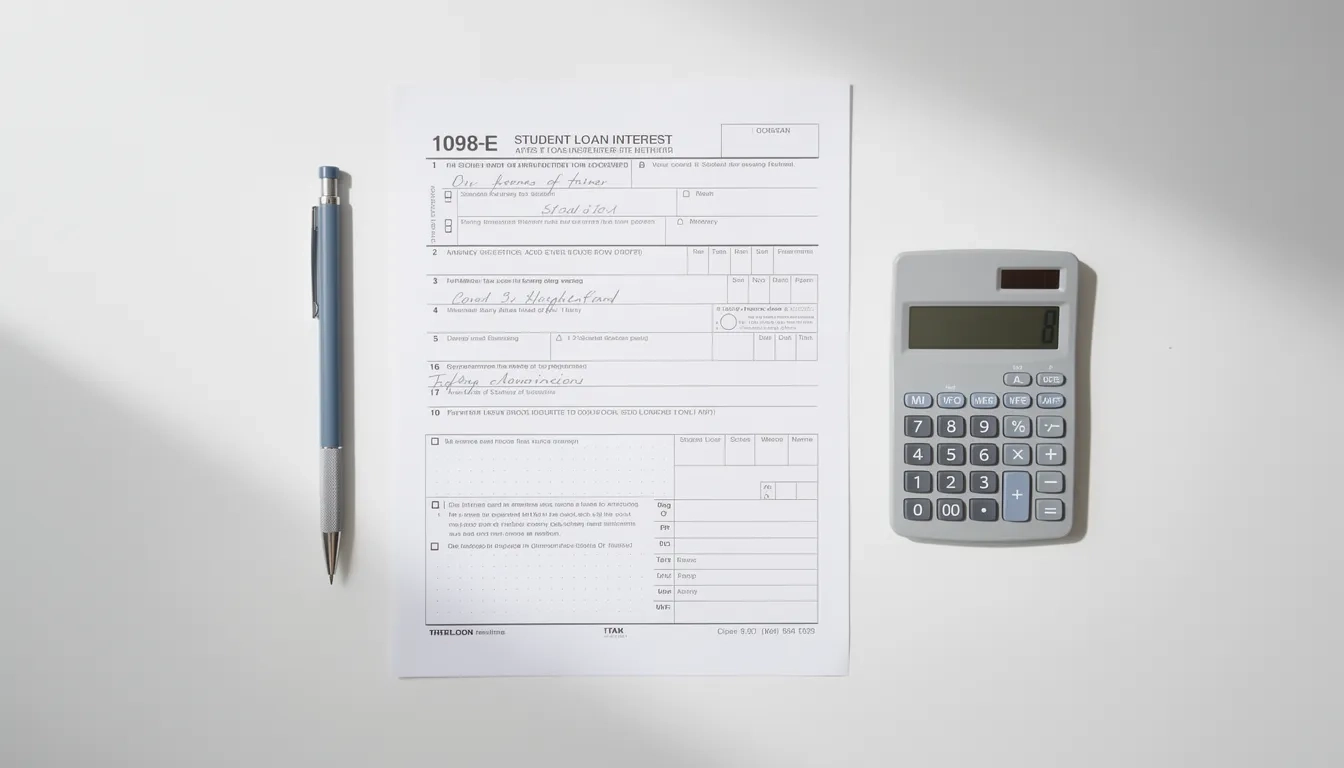
Most people filing their taxes assume the student loan interest deduction only matters if they itemize. It doesn't. This is an "above-the-line" deduction, which means it lowers your taxable income whether you take the standard deduction or not. The standard deduction for 2025 is $14,600 for single filers, and about 90% of Americans take it. So for nine in ten borrowers with student loans, this deduction is sitting on the table — unclaimed — simply because nobody told them they didn't need to itemize to get it.
What This Deduction Actually Does
The student loan interest deduction reduces your adjusted gross income (AGI) by up to $2,500 per year. Not your tax bill directly — your taxable income. If you're in the 22% federal bracket, a full $2,500 deduction translates to roughly $550 back in your pocket. Not dramatic, but real.
What makes this unusual is where it lives in the tax code. You claim it on Schedule 1 of Form 1040, under "Adjustments to Income." That puts it upstream of the standard-vs.-itemize decision entirely. You get this deduction and the standard deduction. Both. At the same time.
The deduction covers interest you paid, not principal. If your monthly payment is $380, only the interest slice counts — not the portion reducing your balance. Early in a repayment term, when interest eats most of each payment, this matters less. By year eight or nine of a standard repayment plan, when the principal component has grown, your deductible amount may be much smaller than you expect.
Who Can Claim It
The IRS specifies five conditions. You need to meet all of them.
- You paid interest on a qualified student loan during the tax year.
- You're legally obligated to repay the loan (your name is on it).
- Your filing status is not Married Filing Separately.
- Your Modified Adjusted Gross Income falls below the phase-out ceiling.
- Neither you nor your spouse (if filing jointly) can be claimed as a dependent on someone else's return.
That fifth condition trips people up more than any other. A parent who still claims their college student as a dependent on their own return cannot deduct interest on a loan taken out for that child, even if the parent is making the payments. The student would need to be filing independently.
One misconception worth clearing up: Parent PLUS Loans. A parent who took out a Parent PLUS Loan can deduct the interest, because the parent is the legally obligated borrower. The student, whose education the loan funded, cannot claim it — the loan isn't in their name. The deduction always follows the legal obligation, not the beneficiary of the education.
The Income Limits and the Phase-Out Formula
Most guides wave their hands at "income limits" without showing the math. Here it is.
For the 2025 tax year (the return you file in spring 2026), your deduction depends on your MAGI:
| Filing Status | Full Deduction Up To | Phase-Out Range | Deduction Eliminated Above |
|---|---|---|---|
| Single / Head of Household | $85,000 | $85,000 – $100,000 | $100,000 |
| Married Filing Jointly | $170,000 | $170,000 – $200,000 | $200,000 |
| Married Filing Separately | — | — | Ineligible entirely |
For 2026, the MFJ range shifts slightly: it phases out between $175,000 and $205,000, while the single-filer range stays unchanged.
If your income falls inside the phase-out range, you lose a proportional slice of the deduction — not all of it. The formula from IRS Publication 970:
- Phase-out fraction = (Your MAGI − lower limit) ÷ (upper limit − lower limit)
- Allowable deduction = Interest paid × (1 − phase-out fraction), capped at $2,500
Here's a real example. Single filer, MAGI of $91,500, paid $1,800 in student loan interest last year:
- Phase-out fraction = ($91,500 − $85,000) ÷ $15,000 = 0.4333
- Reduction = $1,800 × 0.4333 = $780
- Allowable deduction = $1,800 − $780 = $1,020
That's still $224 in tax savings at the 22% bracket. Small, but free money is free money.
Note that joint filers have a wider phase-out window in dollar terms ($30,000 vs. $15,000 for single filers), so their deduction tapers more gradually. Couples sometimes assume they make too much without doing the actual calculation. Run the numbers before writing it off.
What Loans Actually Qualify
The distinction isn't about who issued the loan — it's about what the money was used for.
Eligible loans include:
- Direct Subsidized and Unsubsidized Loans
- Direct PLUS Loans (Parent and Graduate)
- Perkins Loans
- Private student loans from banks or credit unions
- Refinanced student loans, as long as the original purpose was educational
Not eligible:
- Personal loans used to pay tuition (the IRS doesn't care about your intent — the loan must have been structured as a student loan)
- Credit card debt
- Loans from relatives
- Employer-sponsored education assistance
The refinancing question deserves more attention. If you refinanced federal loans with a private lender like Earnest or SoFi, your new loan still qualifies for the deduction. But if you rolled in other debt during the refinance — credit card balances, a car loan — only the portion attributable to the original student loan qualifies. Most borrowers don't think to track this split, and it can create a reporting headache if you're ever audited.
IRS Publication 970 also allows deductions for loan origination fees and capitalized interest — interest that was added to your principal balance and later paid off. These amounts don't always appear prominently on your 1098-E, so log into your servicer's account history and look.
How to Actually Claim It
The process has four steps. None are complicated if you know what to expect.
Step 1: Collect your Form 1098-E. Loan servicers are required to issue this form if you paid $600 or more in interest. They typically post it online or mail it by January 31st. If you have multiple servicers — common after refinancing, or if you hold both federal and private loans — you'll get a separate 1098-E from each. Add all the interest amounts together.
Step 2: Don't skip it if you paid under $600. Servicers aren't required to issue a 1098-E below the $600 threshold, but the IRS still lets you claim the deduction. Log into your servicer's portal, pull your payment history, and find the interest total manually. A few hundred dollars in paid interest might only save you $50 in taxes — but it takes ten minutes and that's still $50.
Step 3: Enter your total on Schedule 1, Line 21 of Form 1040. Tax software (TurboTax, H&R Block, TaxAct) handles this automatically — it'll prompt you for the interest amount and calculate the phase-out reduction if applicable.
Step 4: Verify your MAGI. For most borrowers, MAGI equals AGI. But if you exclude foreign income, deduct IRA contributions, or have other adjustments, MAGI can diverge. The IRS adds back certain deductions to compute MAGI specifically for this phase-out. If your income is anywhere near $85,000 (single) or $170,000 (joint), double-check the MAGI calculation rather than assuming.
Strategies That Can Protect the Deduction
Here's my honest position on this: the $2,500 cap has been frozen since 2001. Adjusted for inflation, that ceiling would be roughly $4,380 today. Congress has nudged the income phase-out thresholds upward over the years, but the deduction itself has lost more than 40% of its purchasing power in two decades. Use it every year, but don't build a financial strategy around it.
That said, if you're near the phase-out threshold, there are concrete moves that help. Contributing to a traditional IRA lowers your MAGI dollar for dollar — up to $7,000 for 2025 if you're under 50. Same goes for HSA contributions if you're enrolled in a qualifying high-deductible health plan (up to $4,300 for individual coverage in 2025). A $4,000 traditional IRA contribution from someone earning $89,000 MAGI drops them to $85,000 — right at the full-deduction floor. The IRA contribution itself saves taxes; the preserved student loan deduction is a bonus.
Borrowers on income-driven repayment plans (SAVE, IBR, PAYE) sometimes pay very little interest — or none, during subsidy periods. Your 1098-E will reflect that. Don't assume there's a form error; the plan is genuinely reducing or suspending interest. Claim only what you actually paid.
The marriage cap is real and absolute. Two spouses, two sets of loans, $5,000 in combined interest paid — the household cap is still $2,500 on a joint return. If both spouses have loans and significant individual incomes, the arithmetic may favor strategies that keep more income out of the phase-out range rather than expecting the deduction to compensate.
A Note on What This Deduction Won't Do
The student loan interest deduction is a legitimate tax break, but it doesn't bend the arc of student debt repayment by itself. At the 22% bracket, even a full $2,500 deduction saves $550. Over a standard 10-year repayment term, a borrower claiming the full deduction every year might accumulate $4,000 to $5,500 in total tax savings — meaningful, but not transformative.
The deduction also doesn't count toward Public Service Loan Forgiveness eligibility, doesn't reduce your actual loan balance, and doesn't interact with your servicer's records in any way. It's purely a federal income tax benefit.
Claim it every year you qualify. But pair it with a repayment strategy that actually fits your income and goals.
Bottom Line
- Claim the deduction — it's above-the-line, so you get it alongside the standard deduction. There's no reason to skip it.
- Collect Form 1098-E from every servicer, including private lenders and refinancing companies. If you paid under $600, look up your interest total in your account history anyway.
- Run the phase-out formula if your income is anywhere near $85,000 (single) or $170,000 (married filing jointly). A partial deduction is still a deduction.
- Traditional IRA or HSA contributions can lower your MAGI enough to preserve more of the deduction if you're right at the phase-out edge.
- The $2,500 cap is frozen at its 2001 level. Use the deduction, but don't over-rely on it — good repayment strategy matters more.
Frequently Asked Questions
Can I claim the student loan interest deduction if I'm still in school?
Yes, as long as you're actually making interest payments during the tax year. Some borrowers make voluntary interest payments while enrolled specifically to prevent interest capitalization — those payments qualify for the deduction, provided you meet all other eligibility requirements.
What if my parents paid my student loan interest, but the loan is in my name?
If your parents paid your loan interest but you're not their dependent, the IRS treats it as a gift to you — and you're considered to have paid it. So you (not your parents) can potentially claim the deduction. But if you're still being claimed as their dependent, neither party can take it. This situation is genuinely tricky; a tax professional can help you sort the specifics.
Does the deduction apply during forbearance or deferment periods?
Only if interest actually accrued and you paid it. During the federal COVID-era payment pause, interest on most federal loans stopped accruing entirely — so there was nothing to deduct. During standard forbearance, interest typically does accrue, but if you didn't make payments, you didn't pay interest. Check your servicer's statement for actual interest paid during any pause period.
Myth vs. reality: Does refinancing student loans disqualify the interest deduction?
Myth. Refinancing doesn't eliminate the deduction. Your new private loan still qualifies as long as it was used to pay off an original qualified student loan. What refinancing does eliminate is access to federal programs: income-driven repayment, Public Service Loan Forgiveness, and any future federal relief. The tax deduction should be near the bottom of your list of reasons to keep or avoid refinancing.
My MAGI is $101,000. Can I claim any deduction?
No. The $100,000 ceiling for single filers is a hard cutoff for the 2025 tax year. One dollar above it and the deduction is completely gone. If you're consistently earning just above that threshold, contributing to a pre-tax retirement account before the April deadline may be worth calculating.
My spouse and I both have student loans. Do we each get a $2,500 deduction?
No. The $2,500 is the total household cap on a married filing jointly return, regardless of how many loans exist or how much interest was paid. Two borrowers, one cap. This is one of the quieter pieces of the marriage penalty embedded in the tax code.
Sources
- Topic No. 456, Student Loan Interest Deduction — IRS
- Publication 970 (2025), Tax Benefits for Education — IRS
- Student Loan Interest Deduction for 2025 and 2026 — SmartAsset
- About Form 1098-E, Student Loan Interest Statement — IRS
- Student Loan Interest Tax Deduction Calculator — Student Loan Planner
- How to Calculate Student Loan Interest Deduction with MAGI Phaseout — Claimyr