Student Loan Interest Rate Forecast 2027: What Borrowers Need to Know
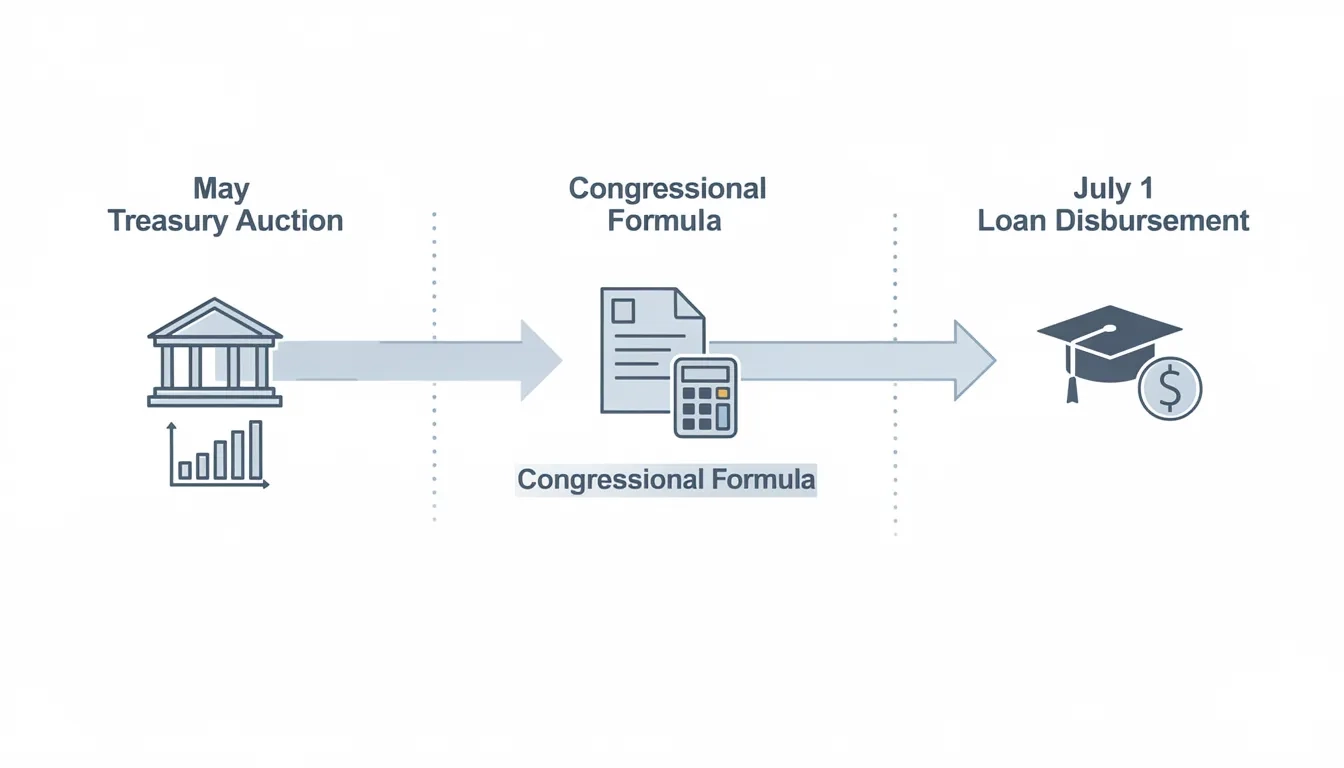
There's a single auction that happens every May — usually on a Tuesday, lasting about 35 minutes — that determines the interest rate on every new federal student loan for the coming academic year. No committee debate, no White House announcement. Just whatever rate the Treasury market will bear. For students borrowing in fall 2027, that auction happens in May 2027, and based on where projections currently sit, it looks like they could catch a modest break.
How Federal Student Loan Rates Actually Work
Federal student loan rates are not set by the Federal Reserve. This surprises a lot of people, especially when the Fed makes headlines by cutting rates.
The Bipartisan Student Loan Certainty Act of 2013 established the formula still in use today: each May, the Department of Education adds a fixed spread to the high yield of the 10-year Treasury Note auction. The spread depends on loan type:
- Undergraduate Direct Loans: 10-year Treasury yield + 2.05%
- Graduate Direct Loans: 10-year Treasury yield + 3.60%
- Parent PLUS Loans: 10-year Treasury yield + 4.60%
Whatever rate results applies to every new loan disbursed from July 1 through June 30 of the following year. And it's fixed for the life of that loan. A student who borrowed for fall 2020 has a 2.75% rate permanently. Someone borrowing this fall has 6.52% — forever, on that specific loan.
This fixed-for-life structure is important context for thinking about 2027. You're not locking in "today's rate environment." You're locking in whatever the Treasury market prints on one specific auction day.
Where Rates Stand Heading Into 2027
The May 12, 2026 Treasury auction cleared at 4.468%. That single data point — one afternoon's auction in Washington — produced the rates for the entire 2026-27 academic year.
| Loan Type | 2025-26 Rate | 2026-27 Rate | Change |
|---|---|---|---|
| Undergraduate Direct | 6.39% | 6.52% | +0.13% |
| Graduate Direct | 7.94% | 8.07% | +0.13% |
| Parent PLUS | 8.94% | 9.07% | +0.13% |
Student loan expert Mark Kantrowitz, whose analysis CNBC published ahead of the rate announcement, calculated that borrowing $10,000 at the new undergraduate rate would produce monthly payments of $113.64 under a standard 10-year repayment plan — roughly $76 more in total repayment than the prior year's rate.
Small increases. But the direction matters, and so does the trend.
The 2027-28 Rate Projection
The rates for loans disbursed between July 1, 2027 and June 30, 2028 won't be official until the May 2027 Treasury auction. Anyone offering a precise number is guessing. But the guesses can be grounded.
The Congressional Budget Office projects the 10-year Treasury yield declining to roughly 3.715% on an annual average in 2027, down from 4.2% in late 2024. An earlier CBO student loan forecast put undergraduate rates at approximately 5.64% for 2027-28 — internally consistent with a May 2027 Treasury auction landing around 3.6-3.7%.
Here's how a range of plausible May 2027 yields would translate into loan rates:
| May 2027 10-yr yield | Undergrad rate | Graduate rate | PLUS rate |
|---|---|---|---|
| 3.5% | 5.55% | 7.10% | 8.10% |
| 3.7% | 5.75% | 7.30% | 8.30% |
| 3.9% | 5.95% | 7.50% | 8.50% |
| 4.1% | 6.15% | 7.70% | 8.70% |
The middle scenario — undergraduate rates near 5.75-5.95% — represents a real drop from 6.52%. On a $35,000 undergraduate loan paid over 10 years, the difference between 6.52% and 5.75% works out to approximately $1,547 in total interest savings. Not life-changing, but real.
My read: rates are more likely to fall than rise in 2027. The CBO has projected declining yields, the Federal Reserve cut rates three times in late 2025, and inflation has moderated. The tariff environment and fiscal uncertainty could keep long-term Treasury yields stickier than the models expect, but the base case points downward.
The rate for 2027-28 will be whatever the Treasury market says on one Tuesday in May 2027. The best forecast available says that number is probably lower than today's.
The OBBBA Factor: What Rate Articles Keep Missing
For anyone borrowing in 2027, the interest rate may not be the most important number on their loan agreement.
The One Big Beautiful Bill Act fundamentally restructured federal student lending, and several provisions take effect specifically for loans originated on or after July 1, 2027:
- Forbearance is capped at nine months in any two-year period
- Economic hardship deferments are eliminated for new loans
- Unemployment deferments are eliminated for new loans
These changes mean borrowers who lose a job or face a financial disruption won't have the same cushion that previous generations of borrowers took for granted. The writing was on the wall when the legislation eliminated Graduate PLUS loans and capped graduate borrowing at $20,500 annually (or $50,000 for law and medical students), but the deferment changes hit a broader population.
According to Brookings Institution analysis of the OBBBA, roughly 26% of graduate students currently borrow above the new annual caps, affecting an estimated 370,000 to 500,000 borrowers annually.
The repayment side also changed completely. New borrowers now choose between a Tiered Standard Plan and the Repayment Assistance Plan (RAP), which replaces REPAYE, PAYE, ICR, and other income-driven options. The CBO estimates RAP will reduce federal costs by $271 billion over 10 years — which tells you something about how it compares to the plans it replaced.
A graduate student borrowing at 8.30% in fall 2027, with no unemployment deferment available, is in a meaningfully different position than a graduate student who borrowed in 2024 at 8.08% with full deferment access. The rate is almost identical. The terms aren't.
Federal Reserve Policy and Private Loans
The Fed's rate decisions don't move federal loan rates. But they matter for private student loans.
As of March 2026, the Fed held its benchmark rate at 3.5-3.75% after three cuts in late 2025. Variable-rate private student loans track closely to the federal funds rate — when the Fed cuts, those rates typically adjust within a billing cycle. Borrowers who took out variable-rate private loans when rates peaked in the 2022-2023 tightening cycle have already seen relief.
Fixed-rate private loans are more complicated (lenders price them based on their own credit models and competition), but the broader trend has been downward. If the Fed continues its path through 2027, private variable rates keep falling.
One important caveat: refinancing a federal loan into a private loan permanently removes federal protections. Income-driven repayment eligibility, Public Service Loan Forgiveness, and federal forbearance all disappear. Given the OBBBA's tightened forbearance rules on new federal loans, this trade-off is narrower than it used to be — but PSLF eligibility alone keeps federal loans worth keeping for many borrowers in public service careers.
What the Historical Record Shows
Federal undergraduate loan rates have ranged from a COVID-era floor of 2.75% in 2020-21 to a high of 6.80% in 2006-07 and 2007-08. The current 6.52% rate sits near the top of the historical range.
The 2.75% rate wasn't normal. It was a product of extraordinary monetary policy during an extraordinary crisis, and treating it as a baseline was a mistake many borrowers made. The mid-5% range that CBO projections point toward for 2027-28 is probably closer to the long-run average under the current rate-setting formula.
Rates fell from 6.53% in 2024-25 to 6.39% in 2025-26, then ticked up slightly to 6.52% for 2026-27. The pattern isn't a steady decline — it's a gradual retreat from the post-COVID peak, with year-to-year volatility depending on where Treasury yields land in May.
What Borrowers Should Actually Do
Different situations call for different decisions. Here's a direct framework:
If you're borrowing now for 2026-27: You're locked into 6.52% for undergraduate loans. That rate is fixed regardless of what happens next May. Borrow only what you need — reducing principal beats any rate improvement.
If you're enrolling in fall 2027: You may get a lower rate, potentially in the 5.75% range, but you're also subject to the OBBBA's tighter forbearance and deferment rules. Run both scenarios before assuming 2027 is automatically better.
If you have existing federal loans: Your rate never changes. But if you're in a REPAYE or PAYE plan, you need to migrate to Income-Based Repayment, RAP, or a fixed plan by 2028. Don't wait for your servicer to prompt you — that migration process can be slow.
If you have variable-rate private loans: A declining Fed trajectory is working in your favor. Watch rate announcements and model whether locking into a fixed rate now makes sense given your timeline.
The single most important move most borrowers skip: calculating their total cost of borrowing, not just their monthly payment. Monthly payment optimization (stretching the term) often means paying substantially more over the life of the loan.
Bottom Line
Student loan interest rates for 2027-28 look likely to fall from the current 6.52% undergraduate rate, potentially landing near 5.75% if CBO Treasury yield projections hold. That's a meaningful improvement, but not transformational.
The bigger story for anyone borrowing in 2027 is structural: the One Big Beautiful Bill Act eliminated graduate deferment options, capped forbearance, and replaced multiple income-driven repayment plans with a single RAP structure. These changes matter more for long-term affordability than a half-point shift in the interest rate.
- New borrowers in 2027-28: Watch the May 2027 Treasury auction. Expect undergraduate rates somewhere between 5.55% and 5.95% if current projections hold.
- Existing federal borrowers: Audit your repayment plan now. The 2028 migration deadline will create a rush — get ahead of it.
- Private loan holders: Falling Fed rates favor variable-rate borrowers, but weigh refinancing carefully if any federal loans are in the mix.
Frequently Asked Questions
How are federal student loan interest rates set each year?
The Department of Education uses the high yield from the 10-year Treasury Note auction held each May, then adds a fixed spread based on loan type: 2.05% for undergraduates, 3.60% for graduate students, and 4.60% for PLUS loans. The resulting rate applies to every new loan disbursed from July 1 through June 30, and stays fixed for the life of that loan.
Will student loan interest rates go down for the 2027-28 academic year?
Probably yes, modestly. The CBO projects the 10-year Treasury yield declining to roughly 3.7% in 2027, compared to the 4.468% that produced the current 6.52% undergraduate rate. A May 2027 auction near that level would put undergraduate rates around 5.75%, though fiscal uncertainty and tariff pressures could keep yields elevated.
Does a Fed rate cut automatically lower my student loan rate?
No — at least not for federal loans. Federal student loan rates are tied to the 10-year Treasury Note, not the federal funds rate. Fed cuts can influence long-term yields indirectly over time, but they don't trigger an automatic adjustment to federal loan rates. Variable-rate private student loans are a different story: those do adjust when the Fed moves.
What is the One Big Beautiful Bill Act and why does it matter for 2027 borrowers?
The OBBBA restructured federal student lending starting in 2026. For loans originated on or after July 1, 2027 specifically, forbearance is capped at nine months in any two-year period, and economic hardship and unemployment deferments are eliminated entirely. These changes reduce the safety net available to borrowers who hit financial difficulty.
Is refinancing into a private loan a good idea if rates fall in 2027?
Usually not for most federal borrowers. Refinancing into a private loan permanently removes federal protections — income-driven repayment, Public Service Loan Forgiveness eligibility, and federal forbearance rights. A lower rate might look attractive, but the lost optionality costs more than the interest savings in many situations, particularly for borrowers who might qualify for PSLF.
I'm currently on REPAYE — what do I need to do before 2028?
Borrowers in REPAYE, PAYE, or ICR plans need to migrate to Income-Based Repayment, the new Repayment Assistance Plan, or a standard fixed plan by 2028. Don't rely on your loan servicer to prompt you in time. Log into your studentaid.gov account, review your current plan, and initiate the change yourself before the deadline creates a backlog.
Sources
- Federal Student Loans Are About To Get More Expensive — Here's What To Know
- 2026-27 Federal Student Loan Interest Rates - Taming The High Cost of College
- Student Loan Interest Rates by Year: Historical Federal Rates and Fees
- How OBBBA Reshapes Student Lending - Brookings Institution
- CBO Releases Economic Projections From 2025 to 2028 - Committee for a Responsible Federal Budget