OT Student Loan Forgiveness: Your 2026 Playbook
If you graduated from an occupational therapy program in the last five years, you already know the number. Student Loan Planner, which has counseled thousands of healthcare borrowers, reports the average OT in their client base carries about $180,000 in federal student loans. The Bureau of Labor Statistics pegs the median OT salary at $86,000 annually. That's a 2:1 debt-to-income ratio — before rent, before groceries, before anything else. And unlike physicians or nurse practitioners, occupational therapists don't have automatic access to most of the big federal healthcare forgiveness programs. You're working with a smaller menu.
The good news: the menu still has real options. The choice you make in your first year post-graduation often determines whether you pay $20,000 or $200,000 total over the life of your loans. That's not hyperbole. It's arithmetic.
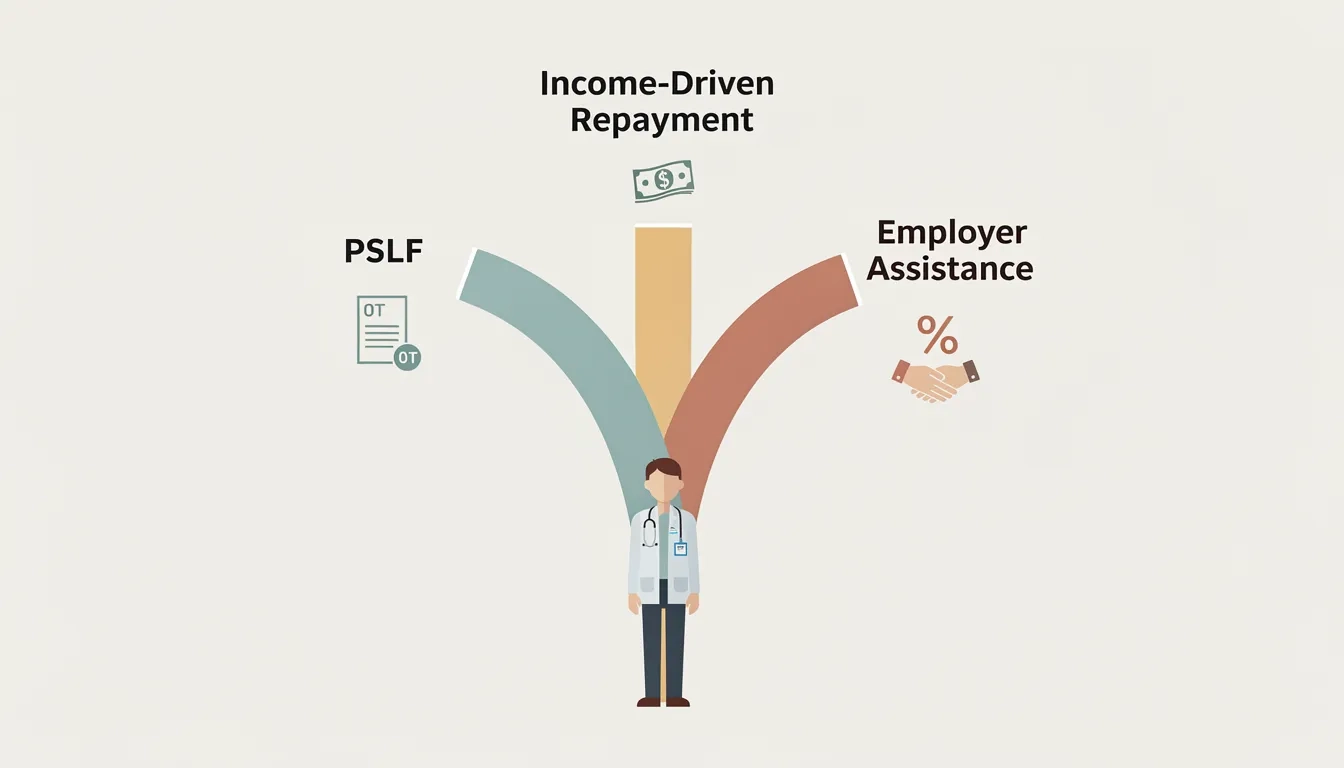
Your Three Real Choices
Before we get into the program specifics, it helps to frame what your actual options are. There are exactly three strategies that make financial sense for most occupational therapists.
- Pursue Public Service Loan Forgiveness (PSLF) — Work for a qualifying nonprofit or government employer, make 120 payments on an income-driven plan, and walk away with the remaining balance forgiven tax-free after 10 years.
- Refinance and pay aggressively — If you're in private practice or not interested in being tied to nonprofit employment, refinance to a lower rate and attack the balance directly.
- Income-Driven Repayment (IDR) forgiveness — The 20-to-25-year backup plan. Useful if you're not PSLF-eligible and can't swing aggressive payoff, but the forgiven amount is taxable income.
These paths are mutually exclusive. Refinancing kills PSLF eligibility permanently. Making extra payments while pursuing PSLF is money you're throwing away — that balance would have been forgiven anyway. Pick your lane early and commit to it.
A useful decision rule: if your total loan balance exceeds 1.5 times your expected starting salary, PSLF is almost certainly worth chasing. If your debt is closer to or below your annual income, refinancing and paying it off outright often wins.
PSLF: The Best Deal for Nonprofit and Government OTs
PSLF is the most powerful forgiveness option available to occupational therapists — and it's chronically underused in this field. Here's why it works so well for OTs specifically.
After 120 qualifying monthly payments while working full-time at a government agency, 501(c)(3) nonprofit hospital, or public school, the remaining federal loan balance is forgiven with zero tax consequences. For an OT carrying $175,000 who makes income-driven payments on a nonprofit salary for 10 years, the forgiven balance at the end could easily exceed $100,000.
The employer eligibility rules matter more than most people realize. Your job title is completely irrelevant. What matters is whether your employer qualifies. Nonprofit hospitals, public health systems, government clinics, school districts — these all work. For-profit home health agencies and private outpatient practices typically don't, even if the clinical work is identical to what a nonprofit OT down the street does.
Three mistakes that derail PSLF applications:
- Not submitting Employment Certification Forms every single year (do this annually, not just at the end of 10 years)
- Making payments on the wrong loan type (you need Direct Loans; if you have older FFEL loans, consolidate them first)
- Making extra payments toward principal while on PSLF (the forgiven balance doesn't shrink meaningfully in your favor — those extra dollars are just gone)
The U.S. Department of Education's PSLF Help Tool at StudentAid.gov lets you verify employer eligibility before you even accept a job offer. Use it every time you're considering a new position.
Income-Driven Repayment: The Long Game
When PSLF isn't an option, income-driven repayment keeps your monthly bill tied to what you actually earn rather than what you borrowed.
The available IDR plans right now are Income-Based Repayment (IBR), Pay As You Earn (PAYE), and Income-Contingent Repayment (ICR). Payments typically run between 10% and 20% of your discretionary income. For an OT earning $72,000 in their first year out, that can mean a monthly payment around $400 to $600 rather than the $1,800-plus a standard 10-year plan would demand.
The difference between picking IBR and PAYE isn't minor — Student Loan Planner documented a borrower who switched from IBR to PAYE and saved approximately $120,000 over her repayment lifetime, cutting four years off her timeline in the process.
Plan selection genuinely matters. If you're on IDR, get your specific plan reviewed, not just set up and ignored.
The tax bomb is real. IDR forgiveness after 20 or 25 years is treated as ordinary taxable income in the year it's forgiven. If $90,000 gets wiped, you may owe federal taxes on that full $90,000 that year. Some temporary tax relief provisions have existed at different points in time, but building your financial plan around future congressional goodwill is not a strategy.
Federal and Specialty Programs Worth Knowing
Beyond PSLF, a handful of targeted programs are available — each with real constraints you should understand before counting on them.
Indian Health Service (IHS) Loan Repayment
The IHS program is one of the few federal programs where occupational therapists are explicitly on the eligible list. You commit to two years of service at a facility serving American Indian and Alaska Native communities, and the program pays up to $50,000 toward your student loans. Placements span rural Alaska, the Southwest, the Northern Plains, and other regions. Many IHS sites offer strong clinical experience for OTs working with pediatric, neurological, and geriatric populations.
For an OT carrying $160,000 in debt, $50,000 paid over two years — tax-free — plus a competitive clinical salary is genuinely significant. Some clinicians renew for additional service years after their initial commitment ends.
National Health Service Corps (NHSC)
This is the frustrating one. NHSC offers some of the most generous loan repayment money in the federal system, up to $50,000 for two years in a Health Professional Shortage Area. But occupational therapists are not currently on the eligible disciplines list for the main NHSC Loan Repayment Program. It covers physicians, nurse practitioners, PAs, dentists, and some behavioral health clinicians. The NHSC State Loan Repayment Program, funded by HRSA grants to individual states, sometimes includes more occupations — worth checking your state directly.
State-Level Programs
A handful of states run their own loan repayment programs that include OTs. Iowa offers a program for health professionals who graduated from an eligible Iowa institution and practice in the state. These vary wildly in award amounts and annual funding, so they shouldn't be your primary plan, but they can supplement it.
NYC's Jose P. Program
If you're working as a therapist in New York City Public Schools, the Jose P. Loan Forgiveness Program offers tax-free grants of up to $24,000 for newly hired therapists in certain eligible roles. Very specific, but worth knowing if you're in that context.
| Program | Max Award | Service Requirement | Tax-Free? | OT Eligible? |
|---|---|---|---|---|
| PSLF | Full remaining balance | 10 years / 120 payments | Yes | Yes |
| IHS Loan Repayment | $50,000 | 2 years | Yes | Yes |
| NHSC LRP | $50,000 | 2 years | Yes | No |
| NYC Jose P. Program | $24,000 | NYC school employment | Yes | Yes |
| IDR Forgiveness | Remaining balance | 20–25 years | No | Yes |
The Employer Assistance Gap Most OTs Are Ignoring
Here's the elephant in the room: according to an analysis of the PT/OT workforce by the employer benefits platform Paidly, 80% of occupational and physical therapists carry student loan debt, but only 8% receive any employer assistance with it. That gap is staggering, and it exists largely because OTs don't ask.
Employer student loan assistance is a legitimate, increasingly common benefit. The IRS allows employers to contribute up to $5,250 per year toward employee student loan repayment, tax-free for both parties. Some healthcare systems have added this benefit proactively; many others will consider it if someone brings it up during negotiations.
Student Loan Planner documented one OT who pushed her employer's annual loan contribution from $2,000 up to $6,000 simply by initiating a conversation during the offer stage — no confrontation, just a direct ask. Over five years, that's a $20,000 swing.
Ask during your offer negotiation, not after you've signed. The answer will sometimes be no. But the floor is $0 either way, so asking costs nothing.
2026 Changes Reshaping the Picture
Two significant developments are affecting OT borrowers right now.
The SAVE Plan is gone. The Biden administration's SAVE income-driven repayment plan, which offered the most borrower-friendly payment terms of any IDR option, was blocked by federal courts and is no longer operational as of 2025. OTs who enrolled in SAVE and were placed in an administrative forbearance need to contact their loan servicer to confirm their current plan and whether those forbearance months count toward PSLF (the guidance on this has changed multiple times — verify directly).
New federal borrowing limits for OT programs arrive July 1, 2026. Effective that date, master's and doctoral OT programs will be reclassified from "professional programs" to "graduate programs" for federal borrowing purposes. This drops the annual Direct Loan limit to $20,500 with a $100,000 aggregate cap — significantly below what professional programs currently allow. Existing borrowers are not affected. But future students will need to cover the gap between this cap and actual program costs through other means, likely private loans at higher interest rates with no federal forgiveness eligibility.
The American Occupational Therapy Association tracked this issue through 2025 and pushed back against the reclassification. The concern is real: if program costs stay flat or rise while federal limits fall, the private loan share of new OT debt will grow, shrinking the population of graduates who can even access PSLF or IDR.
My read: if you're considering OT school after mid-2026, factor this into your school selection math more aggressively than prior cohorts needed to.
Bottom Line
The worst thing you can do with six figures in OT student debt is drift. The default 10-year standard repayment plan will likely cost you far more than either PSLF or a strategic IDR approach, and the difference can run into the tens of thousands of dollars.
- If you work at a nonprofit hospital, government agency, or public school: Apply for PSLF today, submit Employment Certification Forms every year, and stop making extra principal payments.
- If you're in private practice or for-profit settings: Refinance only if you're fully committed to an aggressive payoff timeline; otherwise stay on federal loans in case your employer situation changes.
- If you're considering IHS: Seriously weigh the $50,000 award against your debt and career goals. Two years in an underserved setting is often both professionally meaningful and financially transformative.
- Regardless of your path: Ask your employer about student loan assistance during your next offer negotiation. Most OT employers don't offer it proactively, but some will if asked.
The PSLF clock starts the day you make your first qualifying payment. Every month you delay is a month you cannot get back.
Frequently Asked Questions
Does PSLF forgive the full remaining balance, no matter how large?
Yes. If you meet all requirements — 120 qualifying payments on an income-driven plan, full-time employment at an eligible nonprofit or government employer — the entire remaining Direct Loan balance is forgiven with no federal income tax owed on it. There's no cap on the forgiven amount.
Do occupational therapists qualify for NHSC loan repayment?
Not for the main NHSC Loan Repayment Program. NHSC LRP covers primary care providers, dentists, and certain behavioral health clinicians, but OTs are not currently on the eligible disciplines list. The Indian Health Service program is the more relevant federal option for occupational therapists seeking a similar award.
Is the forgiven amount under income-driven repayment taxable?
Under standard IDR forgiveness after 20 to 25 years, yes — the forgiven balance is treated as ordinary income in the year of forgiveness, which can create a significant tax bill. PSLF forgiveness is tax-free. This distinction makes PSLF worth considerably more in real dollars for high-balance borrowers, even though the nominal forgiven amounts might look similar.
What happens to my federal loans if I refinance?
You permanently forfeit all federal benefits: PSLF eligibility, IDR plans, federal forbearance protections, and any future congressional relief programs. Refinancing makes sense only if you have a strong credit profile qualifying you for a rate meaningfully below your current federal rate and you're genuinely committed to paying off the balance fast. It's a one-way door — don't go through it while PSLF is still plausible.
Can I pursue PSLF while working travel therapy contracts?
Generally no, unless your contracts place you directly with a qualifying employer like a public hospital or government-run facility. Most travel therapy arrangements are staffing agency relationships, and for-profit staffing agencies don't qualify — what matters is who legally employs you, not where you physically practice.
My employer doesn't offer student loan assistance. Can I still negotiate for it?
Yes, and the odds are better than most OTs assume. The IRS allows employers to contribute up to $5,250 annually toward employee student loans tax-free (under current law), which means there's a legitimate, established framework for it. Many healthcare employers haven't formalized the benefit but will add it as a retention or recruitment tool if an employee asks clearly during the offer or review stage.
Sources
- Occupational Therapy Student Loan Forgiveness (2026 Guide) — Student Loan Planner
- Occupational Therapy Student Loan Debt: Best Repayment Strategies — Student Loan Planner
- Occupational Therapy and Student Debt — OT Potential
- OT School Loan Limits and Caps — AOTA
- Public Service Loan Forgiveness — StudentAid.gov
- NHSC Loan Repayment Program — HRSA