Student Loan Consolidation vs Refinancing: What You Need to Know
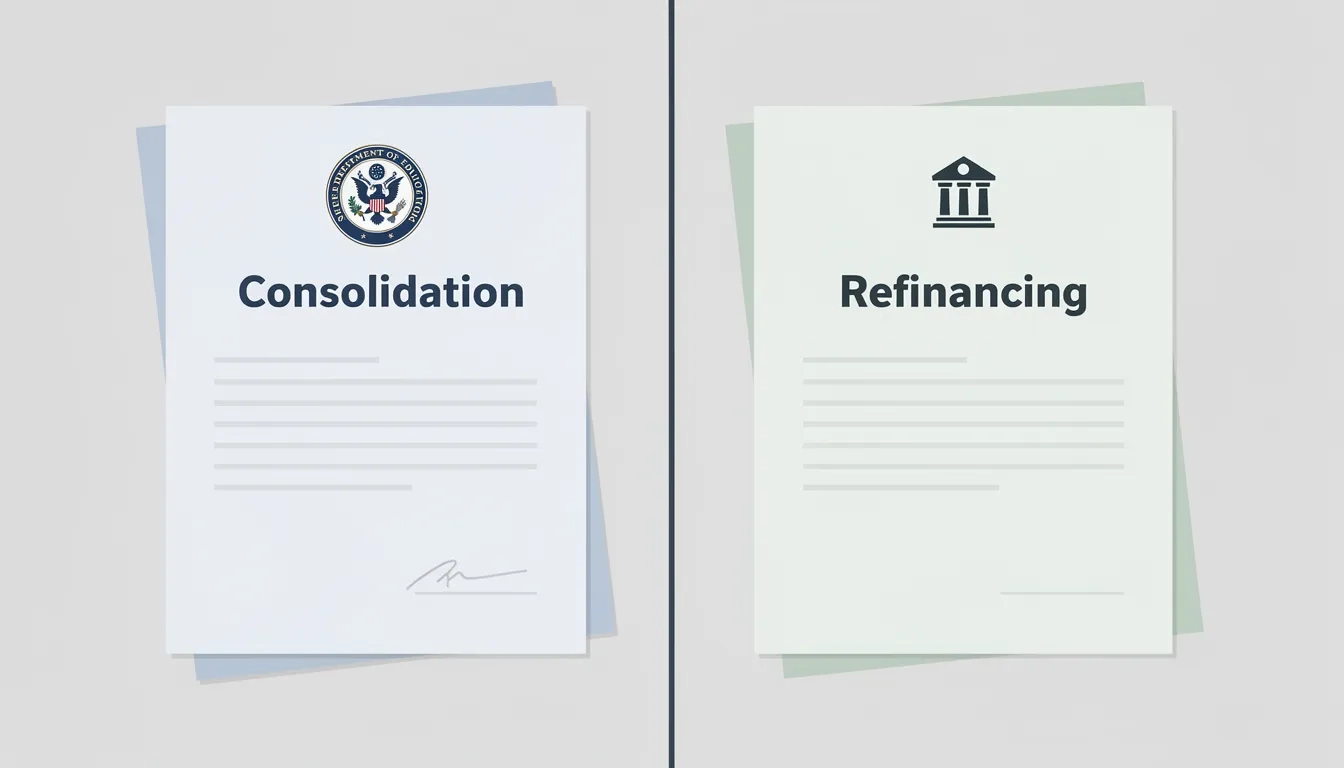
Here's a mistake that costs people years of progress: a borrower refinances their federal loans with a private lender to lock in a lower rate, and in doing so, permanently walks away from a loan forgiveness program they were 7 years into. One decision. Gone.
The confusion is understandable. "Consolidation" and "refinancing" sound interchangeable. Both can lower your monthly payment. Both result in fewer loans to track. But the mechanics are completely different, the risks are not the same, and choosing the wrong one for your situation can cost you thousands of dollars or years of PSLF credit you can never recover.
Here's exactly how each works, where borrowers get tripped up, and how to decide which path actually fits your life.
What Federal Consolidation Actually Is
Federal Direct Consolidation is a government program that rolls multiple federal loans into one. You're not switching to a new lender. You're not negotiating terms. You're combining accounts so one servicer handles one monthly payment.
The interest rate on your new consolidated loan is a weighted average of your existing rates, rounded up to the nearest one-eighth of a percent. If your loans average 5.3%, your consolidated rate will be 5.375%. Not lower. Just simpler.
There's no credit check and no application fee. You apply directly through StudentAid.gov, and it's free.
What consolidation unlocks (and what it breaks)
Some older federal loan types—Federal Family Education Loans (FFEL), Perkins Loans, Parent PLUS Loans—don't qualify for certain repayment programs unless they're first consolidated into a Direct Consolidation Loan. For those borrowers, consolidation is the key that opens the door to income-driven repayment and Public Service Loan Forgiveness.
But there's a real danger hiding in the fine print. The Consumer Financial Protection Bureau warns directly that consolidating a Direct Loan with existing PSLF qualifying payments "may decrease the total number of qualified payments credited to your new consolidation loan." Sixty qualifying payments, wiped to zero.
This is not a technicality. It's a trap that catches borrowers who consolidate mid-progress without asking their servicer for a payment count summary first.
What Refinancing Actually Is
Refinancing means going to a private lender—SoFi, Earnest, ELFI, Laurel Road—who pays off your existing loans and issues you a new private loan with new terms. Your new rate depends on your credit score, income, and debt-to-income ratio, not a government formula.
If your credit is strong, you might qualify for a rate meaningfully lower than what you're currently paying. That's the appeal.
But if you refinance federal loans into a private loan, those loans stop being federal. You lose income-driven repayment, PSLF eligibility, federal deferment during hardship, and any claim to future federal forgiveness programs. That trade-off is sometimes worth making. Often it isn't.
The refinancing math, with real numbers
Take a $10,000 loan at 5% interest. Extending repayment from 10 years to 20 years drops the monthly payment from $106.07 to $66.00—a real cash flow improvement if you're stretched thin. But total interest paid jumps from $2,727.70 to $5,838.18. That's $3,110.48 in extra interest for the privilege of a smaller bill.
Refinancing actually saves money when you can shorten your term or meaningfully lower your rate. A borrower who refinances $50,000 from 6.5% down to 4.5% over the same 10-year term saves roughly $6,400 over the life of the loan. Worth doing—if and only if the federal safety nets aren't something you'll need.
Side-by-Side: The Core Differences
| Feature | Federal Consolidation | Private Refinancing |
|---|---|---|
| Who's the lender | U.S. Dept. of Education | Private bank or lender |
| Eligible loan types | Federal loans only | Federal and/or private |
| Interest rate method | Weighted average (rounded up) | Based on credit profile |
| Credit check required | No | Yes |
| PSLF eligibility preserved | Yes (but resets payment count) | No |
| Income-driven repayment access | Yes | No |
| Federal deferment/forbearance | Yes | Depends on lender policy |
| Application fee | None | Typically none |
| Can actually lower your rate | No | Possibly |
The table makes it plain. Consolidation is about access and simplicity within the federal system. Refinancing is about cost reduction, outside of it.
How the 2025 Law Changes Shifted the Calculus
The student loan landscape changed significantly with the One Big Beautiful Bill, signed on July 4, 2025. The law introduced a new income-driven repayment option called the Repayment Assistance Plan (RAP), which replaces current IDR plans as the only income-based option for new borrowers starting July 1, 2026. Existing borrowers retain access to Income-Based Repayment alongside RAP.
The SAVE plan, which millions of borrowers enrolled in between 2023 and 2024, is being wound down. The Department of Education announced a proposed settlement in December 2025 ending the program, with borrowers in SAVE forbearance transitioning to other plans throughout 2026.
Parent PLUS borrowers face a hard deadline. If you hold Parent PLUS Loans and work in public service, you must consolidate into a Direct Consolidation Loan and enroll in Income-Based Repayment before June 30, 2026. After that date, Parent PLUS borrowers lose access to RAP, which cuts off their path to PSLF entirely. This deadline is real and not getting extended.
Graduate PLUS Loans are also being eliminated effective July 1, 2026, which adds more urgency for graduate borrowers still weighing their options.
When Consolidation Is the Right Call
Consolidation makes clear sense in these situations:
- You have FFEL, Perkins, or Parent PLUS Loans and want to access PSLF or income-driven repayment
- You're in default on a federal loan and want to restore good standing quickly
- Multiple servicers are creating genuine administrative chaos in your financial life
- You're a Parent PLUS borrower pursuing PSLF, and the June 30, 2026 deadline applies directly to you
What consolidation does not do: lower your interest rate, save you money on total interest, or instantly improve your credit score. If your only goal is saving money, consolidation alone won't get you there.
When Refinancing Makes Sense
Refinancing is the better move when rate reduction is the goal and you can genuinely afford to give up federal protections:
- Your credit score is 720 or above and you can qualify for a rate at least 1 percentage point lower than your current weighted average
- Your income is stable and you don't anticipate needing income-driven repayment over the next 5-10 years
- You already have private loans with no federal benefits at stake
- You don't work in public service and PSLF isn't part of your financial plan
- You're a high earner who realistically will pay off your balance in under 7 years
The gut-check question: "If I lost access to income-driven repayment tomorrow, could I still make my monthly payment?" If the answer is no, think twice before refinancing any federal loan.
The Misconception That Trips People Up
Many borrowers assume consolidation and refinancing are basically the same because both end with "one loan." They're not the same.
Consolidation keeps you inside the federal system. Refinancing moves you out of it. Once federal loans are refinanced into private debt, there is no mechanism to reverse it. You cannot un-refinance and reclaim federal protections.
And here's the elephant in the room: private lenders market refinancing heavily because it generates revenue. Federal consolidation is free, government-administered, and nobody profits from it. That marketing asymmetry creates a perception gap that leads real borrowers into decisions that hurt them.
My take, plainly stated: for most borrowers with federal loans who don't have top-tier credit and high income certainty, consolidation is the safer default. Refinancing makes sense for a narrower group—strong credit, stable income, no PSLF path, and a realistic horizon for paying off the balance quickly enough that the interest savings are material.
A Decision Framework
Work through these questions in order:
- What loan types do you have? Federal, private, or both? If you only have private loans, federal consolidation isn't available. Refinancing is your only option.
- Are you pursuing PSLF? If yes, do not refinance federal loans. Period. Consolidation may help you, but check your payment count with your servicer before doing anything.
- Run the rate math. What rate would you qualify for through a private refinance? Compare it to your current weighted average. If the monthly savings are under $50, the loss of federal protection is rarely justified.
- Assess income stability honestly. If your income could change—career switch, family, health—preserving access to IDR has concrete financial value.
- Make the call. Need access to federal programs? Consolidate. Have strong credit, stable income, private-only loans, and no PSLF plans? Refinancing may genuinely serve you.
Bottom Line
- Federal consolidation suits borrowers who need to access IDR plans or PSLF, especially those with FFEL, Perkins, or Parent PLUS Loans. It won't lower your rate, but it preserves every federal protection.
- Refinancing works for borrowers who can qualify for a meaningfully lower rate and are comfortable giving up federal protections permanently.
- The most expensive mistake is refinancing federal loans while you're mid-progress on PSLF, or while your income may not support non-IDR payments.
- If you're a Parent PLUS borrower with any public service connection, the June 30, 2026 deadline to consolidate and enroll in IBR is not theoretical. Act before it passes.
Frequently Asked Questions
Can I consolidate first and then refinance later?
Yes, and some borrowers do this deliberately. Consolidating FFEL loans into a Direct Consolidation Loan can open access to PSLF and IDR. Once you've completed a forgiveness program or no longer need federal protections, refinancing the remaining balance can make sense. The order matters: consolidate first, refinance after you've used what the federal system offers.
Will consolidating my loans hurt my credit score?
Federal consolidation typically has a neutral to minor impact. Opening a new account can cause a small, temporary dip, but closing multiple old accounts by rolling them into one is generally not harmful. Refinancing involves a hard credit inquiry from a private lender, which has a small short-term effect on your score.
Is the SAVE plan still available in 2026?
As of early 2026, the SAVE plan is in court-ordered forbearance and being phased out. A proposed settlement announced in December 2025 would formally end the program. Borrowers currently enrolled in SAVE are being transitioned to other repayment plans; contact your servicer to confirm which plan you'll land on.
What credit score do I need to refinance student loans?
Most private lenders want a score of at least 650-670 to approve an application, but borrowers who actually get competitive rates tend to have 720 or above (along with strong income and low debt-to-income ratios). Scores below 670 often yield refinancing offers no better than current federal rates, which makes refinancing pointless.
Is it possible to consolidate private loans?
Federal Direct Consolidation only accepts federal loans. Combining private loans requires refinancing with a private lender. Some borrowers refinance a mix of federal and private loans together into one new private loan, but doing so converts the federal portion to private and permanently strips all federal benefits from those loans.
What happens to my PSLF progress if I consolidate?
It depends on which loans you consolidate and whether they already have qualifying payments. If you consolidate a Direct Loan that has PSLF-qualifying payments, those payments reset to zero on the new consolidation loan. If you consolidate FFEL loans that couldn't count toward PSLF anyway, you may actually gain eligibility without losing anything. Before consolidating, request a payment count summary from your servicer—it's a five-minute phone call that can save years of confusion.
Sources
- Student Loan Consolidation vs. Refinancing in 2026 - Scholarships360
- Should I Consolidate My Federal Loans? - Consumer Financial Protection Bureau
- Consolidate vs. Refinance Student Loans: Here's the Difference - SavingForCollege
- Student Loan Borrowers: How Will New Federal Laws Affect Me? - DFPI
- 5 Things to Know Before Consolidating Federal Student Loans - Federal Student Aid