Streamlining college credit for veterans: A national imperative
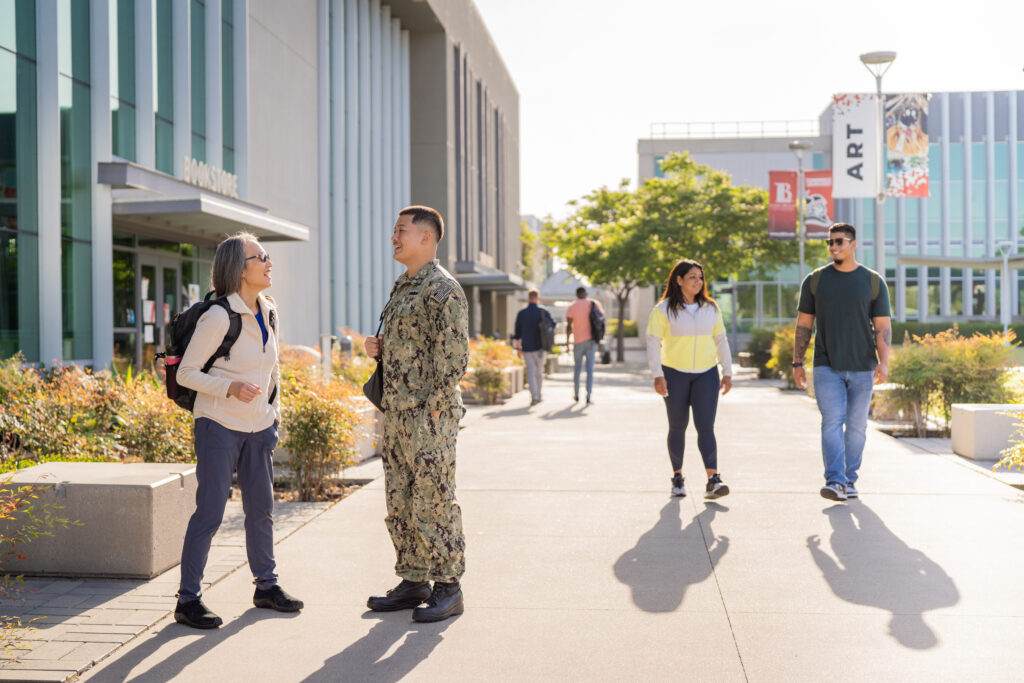
Two students at Long Beach City College Pacific Coast Campus
Credit: Nikki Ritcher / Long Beach City College
Army 1st Sgt. Joey Mora returned from four overseas deployments with hopes to advance into the next chapter of his life by graduating from college. It was a fight. Juggling classes and full-time policing, he watched his dream stall for over 10 years. Then, he arrived at Norco College, located 50 miles east of Los Angeles, in the Riverside Community College District. Staff helped him translate his Joint Services Transcript, the official document that details his military training and experience. He received 30 college credits, enabling him to complete an AA degree in one year, get promoted, and transfer to a four-year university for his BA and MS.
Mora’s success shouldn’t be the exception. It should be the norm.
We owe our former service members more than gratitude. As educators, we owe them clear, affordable pathways to degrees and credentials that lead to family-sustaining wages. One proven way to deliver that is Credit for Prior Learning, or CPL, which equates military skills to college credit. Too many veterans are still forced to navigate complicated administrative systems just to receive credit for what they’ve already learned in service to our country. This is time-consuming, discouraging and unnecessary.
In California, we have an initiative called Vision 2030: A Roadmap for California Community Colleges, which calls for implementing CPL at scale, so that recognizing the skills and experience of veterans becomes a standard, expected part of how our colleges operate. No red tape. Just respect, recognition and real progress toward a credential or degree.
We know the transformative power of extending these credits. For veterans, apprentices and working adults, Credit for Prior Learning reduces the stress of transition. It eliminates the frustration of repeating coursework. It honors the technical skills people already possess. And it saves time and money. Students who get credit for their non-college work experience are 25% more likely to graduate. They finish nine to 14 months faster and save $1,500 to $10,200. They also go on to earn higher wages and reenter the labor force more quickly.
Nearly every state, 46 in total, requires credits for military training. However, too many administrative systems are often lax, cumbersome or opaque. The advising is insufficient. The red tape is onerous, tangled by military acronyms that educators don’t understand or postsecondary acronyms that veterans don’t understand.
As a result, only 1 in 4 veterans received credit toward courses in their major, and more than 1 in 5 received no postsecondary credit at all.
These kinds of lapses and delays cost veterans dearly. Through the U.S. Department of Veterans Affairs and the GI Bill, current and former service members receive only 36 months of education benefits. The longer they wait for credits and graduation day, the more debt they’re likely to incur. Studies estimate that some 25% of veterans drop out without a college credential when their benefits run dry. This matters when 60% of America’s veterans face underemployment or unemployment for up to four years post-service.
We owe our veterans better. We owe them streamlined and proactive systems that ensure they receive the credits they have earned, validate the skills they have gained, and accelerate the progress they have made to improve their career outcomes.
To make this happen, community colleges across America are investing in the funding, technology and support services that can build the administrative capacity needed to make credit for prior learning accessible for veterans. The aim is for no guesswork. No delay. Just a clear path forward and the ability for those men and women returning home to jump right in and keep moving toward their educational goals.
The California Community Colleges system leads the nation in the number of military-affiliated students. Over 34,000 veterans and 10,000 active-duty and other military students attended our system in the 2024-25 academic year alone. For them, we launched the 2025 Veterans Sprint, led by Sam Lee. We’ve helped more than 18,400 veterans.
Leaders across the country are seeing the same need for change. In Congress, bipartisan bills are emerging to standardize the evaluation of military training, provide funding for assessments, and streamline the approval process. States like Kentucky and North Carolina are already acting. Kentucky is advancing legislation to convert military medical training into state credentials, and North Carolina recently passed the Military and Veterans Support Act, which expands access to higher education for service members and their families.
Here in California, the momentum is also strong. Both the governor and the Legislature have prioritized this effort, and for two consecutive years, they’ve invested resources to build the community colleges’ capacity to offer credit for prior experience systemwide. We aim to make it routine for someone who served, apprenticed, or trained to receive direct recognition and advance toward a degree or credential without having to start over.
Some may worry that Credit for Prior Experience could dilute academic standards, reduce enrollment or threaten funding. But in practice, it does just the opposite. It honors and validates the real-world knowledge and skills that students bring from their time in the military or the workforce. It clears unnecessary barriers, shortens time to completion, and improves career outcomes, especially for veterans. This approach is being incentivized in states like Texas, Florida and Ohio, where legislators are tying state investments to student outcomes, not just enrollment.
Here in California, we’re already ahead of the curve. Our Student-Centered Funding Formula recognizes the completion of a certificate or degree as a core driver of institutional funding. CPL helps us accelerate those completions in a way that is student-centered and worker-centered and aligned with Vision 2030.
No veteran should have to fight the bureaucracy to make their military learning count toward their college degrees. They have made hard decisions. They are protectors. They faced uncertainty and met it with discipline, focus and grit. We must respond with that same instinct, with urgency and with purpose.
Let’s make credit for prior learning accessible for all our veterans. They shouldn’t have to fight for the credits they’ve already earned.
•••
Sonya Christian is the chancellor of the California Community Colleges, the largest system of higher education in the nation.
The opinions expressed in this commentary represent those of the author. EdSource welcomes commentaries representing diverse points of view. If you would like to submit a commentary, please review our guidelines and contact us.