Shutdown complicates FAFSA process for California students
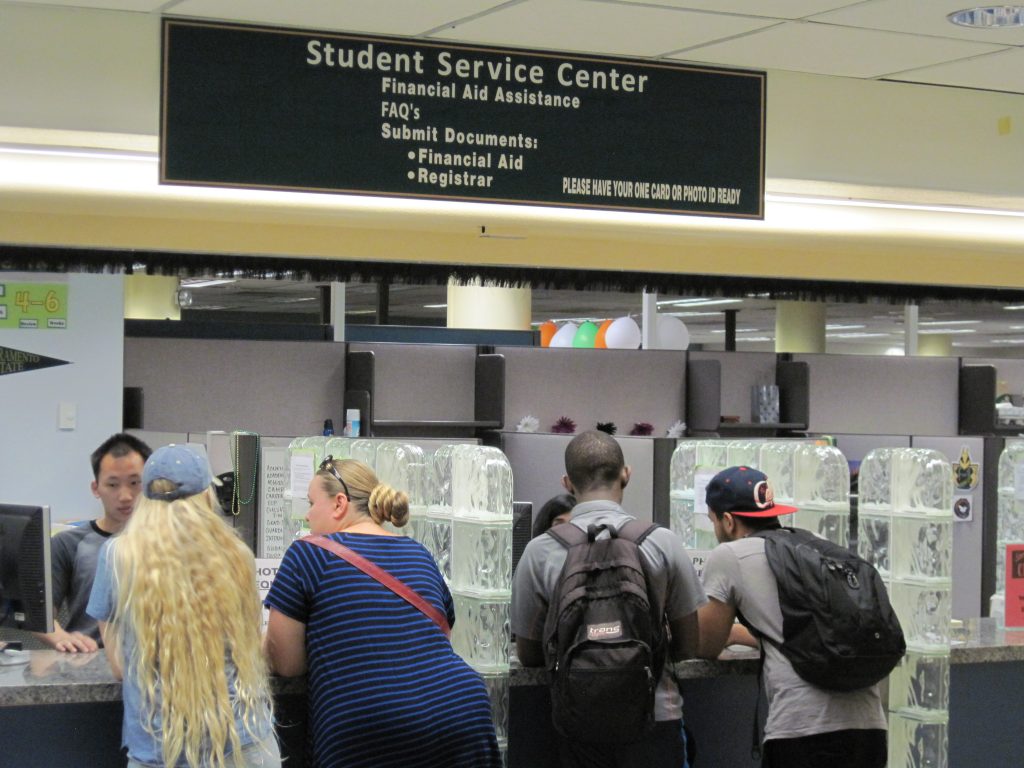
Sacramento State students line up to pay bills and receive financial aid information.
Larry Gordon/EdSource Today
When Congress failed to fund the government at the beginning of October, students seeking federal financial aid were plunged into a bureaucratic nightmare. As political leaders bicker over a spending bill, California students and families are left to navigate a financial aid process made even more cumbersome by the shutdown.
This year, the U.S. secretary of education celebrated the earliest launch of the Free Application for Federal Student Aid (FAFSA) in history. But the department’s efforts may be eroded due to the furlough of the U.S. Department of Education staff, including personnel in the Office of Federal Student Aid, which administers the FAFSA, as a result of the federal government shutdown. Although the department’s website states that students can still submit a FAFSA, responses to questions may lag. This could slow down an already burdensome process that requires students and families to complete a lengthy application.
The FAFSA determines students’ eligibility for federal awards, such as the Pell Grant, the country’s largest needs-based aid program, as well as state-based aid such as the Cal Grant. California serves the largest number of students who receive the federal Pell Grant, underscoring its critical role as a resource for students and families.
Students hoping to receive federal aid face the obstacle of income verification, in which colleges verify the accuracy of the information students provided on their FAFSA. To complete verification, students must provide documents such as tax transcripts, W-2s, and other personal documents. Students are ineligible to receive any federal financial aid until they complete verification.
In 2019, following the longest government shutdown in history, students attending a community college in California told us that the shutdown delayed their ability to complete the verification process. Some students and families could access tax transcripts only through their local IRS office, which was also affected by the shutdown. Students who were required to supply their federal tax transcripts for verification typically had to wait two to three months to receive their documents from the IRS. Because of the office closures, students encountered a further 34-day delay compiling the requested records to meet the verification requirements. This meant some students went into a second academic semester without access to federal aid.
The domino effect of the shutdown also forced students to strategize how to use their financial aid disbursements, according to the students we spoke to in 2019. Students saved their leftover financial aid disbursements to plan for potential future government shutdowns, which limited their ability to use aid for expenses such as books and housing.
Many students already face challenges accessing federal financial aid, whether because they are unaware of available programs or because they did not know they would attend college until shortly before the start of the academic year. We hope policymakers in Washington, D.C., realize that the shutdown will further complicate the financial aid process for the most vulnerable students, impacting their persistence and success in higher education.
•••
Devon L. Graves is an assistant professor in the College of Education at North Carolina State University and a former gubernatorial appointee on the California Student Aid Commission.
Cecilia Rios-Aguilar is a professor of education and department chair at the School of Education and Information Studies at UCLA.
The opinions expressed in this commentary represent those of the author. EdSource welcomes commentaries representing diverse points of view. If you would like to submit a commentary, please review our guidelines and contact us.