Redefining mentorship: Supporting new teachers through symbiotic relationships
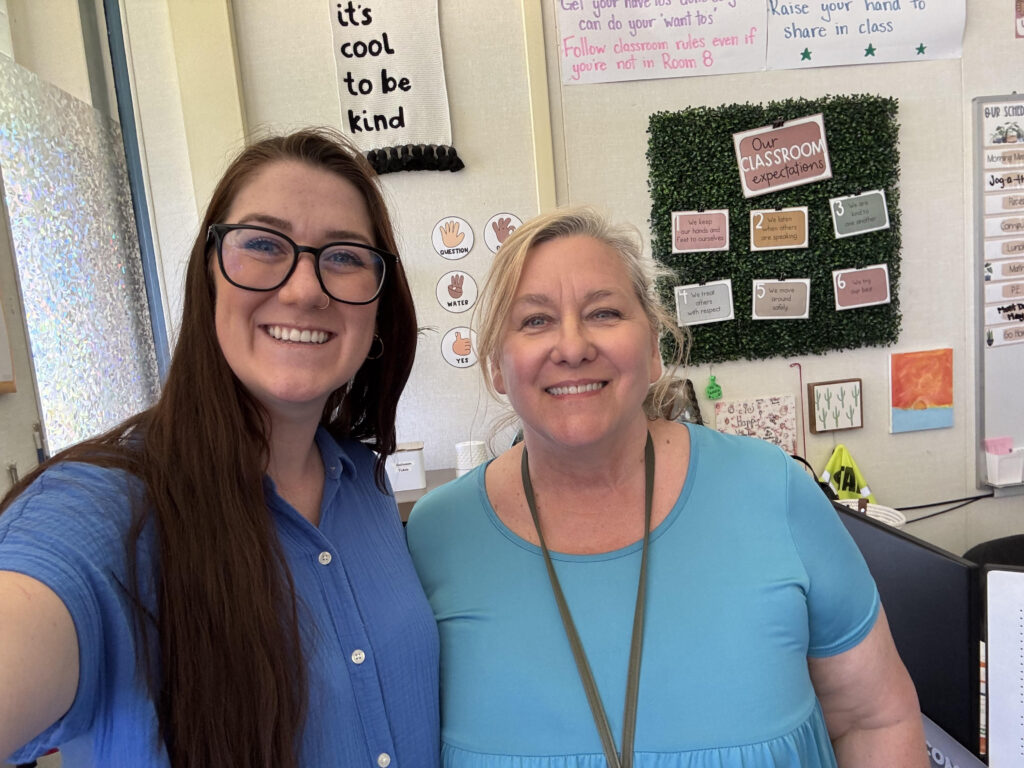
New teacher Alyssa Aucoin, left, and her mentor Christina Clayton from the Gateway Unified School District in Shasta County.
Courtesy: Jillian Damon
At a time when educator burnout, teacher shortages and varied credential pathways are realities, we need to rethink how we support new teachers and how we define mentorship itself.
We often frame mentorship as a one-way street in which a veteran teacher pours their wisdom into a novice teacher. That view of mentorship sells this powerful practice short.
Mentorship in education should not be seen as just one more thing on the mentor’s already full plate. When done well, mentorship is a symbiotic relationship, a reciprocal exchange in which both mentor and mentee grow, reflect and build stronger professional identities together.
In California and across the nation, new teachers are entering the classroom through increasingly diverse credentialing routes: internships, residencies, Career Technical Education credentialing programs, emergency permits and traditional student teaching models. While these pathways offer flexibility, they also present varying levels of preparation, leaving many new teachers in need of support as they transition from coursework to their new classroom.
Districts are contending with teacher shortages and turnover, especially in rural areas. Mentorship, when done well, offers a practical and powerful solution. But to be effective, we need to stop treating mentorship as a mere box to check.
The most effective membership creates a symbiotic relationship that is beneficial to both the mentor and novice teacher. New teachers bring fresh energy, new tools and innovation. They ask hard questions. They push us to reflect on why we teach the way we do. Veteran teachers bring insight, emotional intelligence and the ability to contextualize new practices within real classrooms.
When mentors listen as much as they lead, and when novice teachers feel safe enough to offer their perspectives, the relationship is rewarding to both parties. Mentors refine their own practice. New teachers build confidence and clarity, bridging the theory they learned in coursework into daily practices. Both educators grow, and our students benefit. Essential elements of this relationship include:
- Contextual coaching: Mentors help new teachers navigate site-specific expectations, systems and community dynamics, while also remaining open to adapting their own strategies.
- Mutual learning: Mentors ask their charges to share what they’re learning in credentialing programs, workshops, or even on social media about education. Mentors share lived experiences and institutional knowledge that textbooks can’t provide.
- Feedback loops: Mentors benefit from feedback, too. When a novice teacher shares specific feedback on what they implemented as a result of mentor input, it affirms to the mentor their efficacy.
When new teachers feel like their wisdom matters — when they are coached, not just corrected — they’re more likely to stay. Mentors should approach the relationship as one of mutual growth. This supports new teacher retention by building their trust, confidence, professional identity and connection to a larger professional community.
And for mentors? The benefits are equally impactful. Many veteran educators acknowledge that mentoring reinvigorates their passion for teaching. They take pride in helping to develop the new teachers on their campus. They, too, feel seen and recognized for their expertise as teacher leaders on their campus.
School and district administrators should support mentors through:
- Collaboration: Administrators should ensure that mentors are aware of school initiatives, instructional expectations, and site-specific needs. This helps mentors reinforce school goals while remaining responsive to individual candidate development.
- Communication: Administrators should regularly check in with mentors both individually and as a group. This allows administrators to observe emerging trends. Are new teachers struggling with engagement? Are they confident in lesson design? Themes that surface across mentorship conversations can inform schoolwide professional development.
- Coordination: Finally, administrators should support mentors by protecting time for them to meet with candidates, provide feedback and reflect. This signals to the mentor that their role is valued.
Mentorship is not just a box to check for credentialing requirements. Purposeful mentorship supports educators across all stages of their careers and allows them to grow together.
If we want schools to be places of belonging and growth for students, they must also be places of belonging and growth for teachers. Mentorship isn’t a one-way act of giving; it’s a symbiotic relationship that strengthens our schools and cultivates teacher retention. Let’s stop asking who benefits more: the mentor or the new teacher. In a truly symbiotic relationship, the answer is always: both.
•••
Jillian Damon, Ed.D., is the director of educator preparation programs for the Tehama County Department of Education.
The opinions expressed in this commentary represent those of the author. EdSource welcomes commentaries representing diverse points of view. If you would like to submit a commentary, please review our guidelines and contact us.