Pressure to overachieve in high school in Silicon Valley is a problem; here’s what has helped
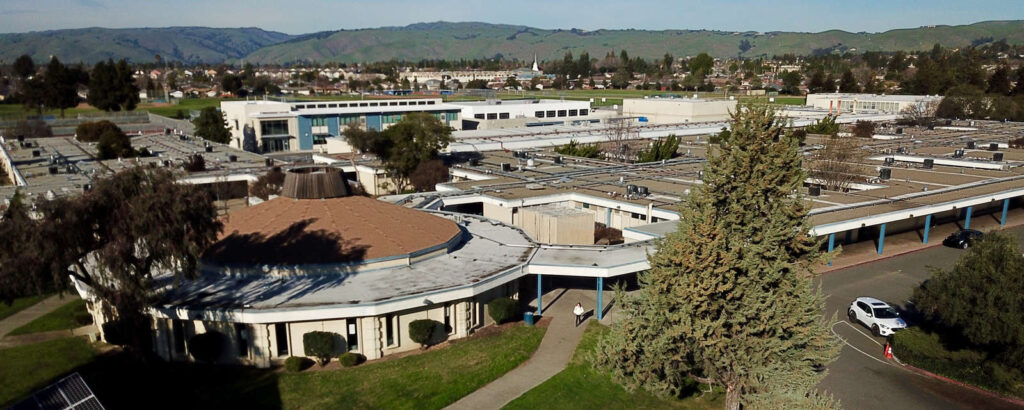
An aerial view of Irvington High School in Fremont.
Credit: Courtesy of Fremont Unified
I just graduated from a relatively competitive high school in Fremont. Many students at Irvington High School seem to have the same goals. We judge classes by how they look on transcripts to college admissions officers. We submerge ourselves in various internships, clubs and other extracurricular offerings. The dream is to major in computer science, business, engineering or pre-medicine at an elite UC or private university, and it is etched into many of our hearts. The belief that this narrow subset of students epitomizes educational success is inculcated into our culture.
I don’t mean to disparage my peers or their hard work. But it’s deceptively easy, especially at a high school as competitive, pre-professional, and Silicon Valley-adjacent as mine, to think that that’s the entire story.
The truth? It’s just not.
Despite what some parents and students seem to think, high school isn’t just a machine to churn out AP-certified students in the rat race for college. For every student shooting for a prestigious computer science or engineering degree, there are others whose goals aren’t so clear. These are the kids who often feel left behind and left out in our school’s culture.
This environment takes its toll. A decade ago, a study at my high school found that 60% of students had “moderate to severe symptoms of depression,” and 80% had “moderate to severe symptoms of anxiety.” The study found that the top stressors were all related to school, especially the pressure of college prestige, and that this kind of school culture was unfolding across the nation. The results still feel familiar at my high school today.
But teachers can offer different directions and contrasting perspectives from the singular college-oriented, often toxic mindset that children pick up from their parents. This was true for several of my classes.
I first enrolled in Digital Photography 1 as a prerequisite for a competitive business club. It wasn’t great for my GPA — by the end of my first semester, I had given up on a 4.0 — but its impact on me was incredible. My photography teacher introduced me to a new understanding of art — abstraction, self-portraiture and absurdism. They encouraged my photographic subjects to roam from jazz musicians to Ohlone activists to introspection. Today, as an arts enthusiast and arts reporter for my university’s student newspaper, I credit this teacher with kindling this interest.
Whereas my photography teacher taught us what it means to be an artist or activist, my AP English teacher taught me what it means to be an academic — and not just in English. Her teachings invited study from fields as diverse as philosophy, environmental studies and communications, requiring research papers with more nuanced lines of reasoning than we had ever used before. This class was a turning point in my understanding of the life of the mind, and it introduced me to new academic fields that I’m now interested in studying.
Both teachers and many others expanded my horizons, pointing me in unfamiliar yet enticing directions. Their broad, multidisciplinary approaches appealed to me. They challenged the narrative that only a small subset of well-paying majors are worth it.
Effective teachers also encourage students to think beyond the “traditional” paths into the workforce. While many social circles in my community believe going to community college indicates a lower level of achievement, that’s just not true. Classes at community colleges are the same intro-level and general education classes that one would find at a four-year university, offering comparable levels of intellectual rigor with a lower price tag. School counselors do their best to remind us that community college is a good option, with programs like Transfer Admission Guarantee guaranteeing a transfer to a reputable UC after two years.
Skilled trades are another equally valid route. Across the nation, a pattern of students looking to join the skilled trades has emerged, and this extends to my school. Some of my teachers emphasize alternative pathways to well-paying jobs in IT or infosecurity. Our school also collaborates with a local career technical education provider to provide hands-on training in fields such as nursing and auto repair. These efforts offer rewarding paths forward for people who are turned off by the academic route.
Teachers can also counteract these pressures by acting as role models. My teachers have shared so much about their paths to their current careers. Some went straight into teaching out of college, but others didn’t. A journalism teacher spent time as a firefighter, one English teacher spent time as a security guard, several are ex-military, and so on. Through stories like these, they teach their stressed-out students that the path to success is not linear. There are diversions, setbacks and successes. High school does not have to be a narrow path to a singular career — it can be just the first of many winding steps to a future one can accept.
These combined efforts can’t fully counter the prestige-oriented culture at my high school. But it’s through efforts like these that many of us can find satisfaction in what we do, accepting the diverse and varied paths to our future lives.
When we, as a community, downplay or stigmatize the alternatives to prestigious four-year educations, we succumb to cultural elitism and lose sight of the fact that everyone has their own path through life. It’s unproductive to judge people for their perceived success; what matters is giving support to every student who’s trying to make it out of adolescence.
To me, it’s clear that there’s more to competitive high schools than just stress. The teachers I have mentioned — those who encourage students who don’t fit into the competitive narrative — help make the stressful culture a little bit more bearable. Ultimately, it’s up to students and their parents to ease off on the competitive mindset, making high school a more comfortable and productive environment for all.
•••
Francis Luo is a student and writer from Fremont who graduated from Irvington High School in Fremont in spring 2025. He is now in his first year at UC Berkeley, where he writes for the Daily Californian.
The opinions expressed in this commentary represent those of the author. EdSource welcomes commentaries representing diverse points of view. If you would like to submit a commentary, please review our guidelines and contact us.