Potential pilot with San Jose State could bring big changes to Silicon Valley law school
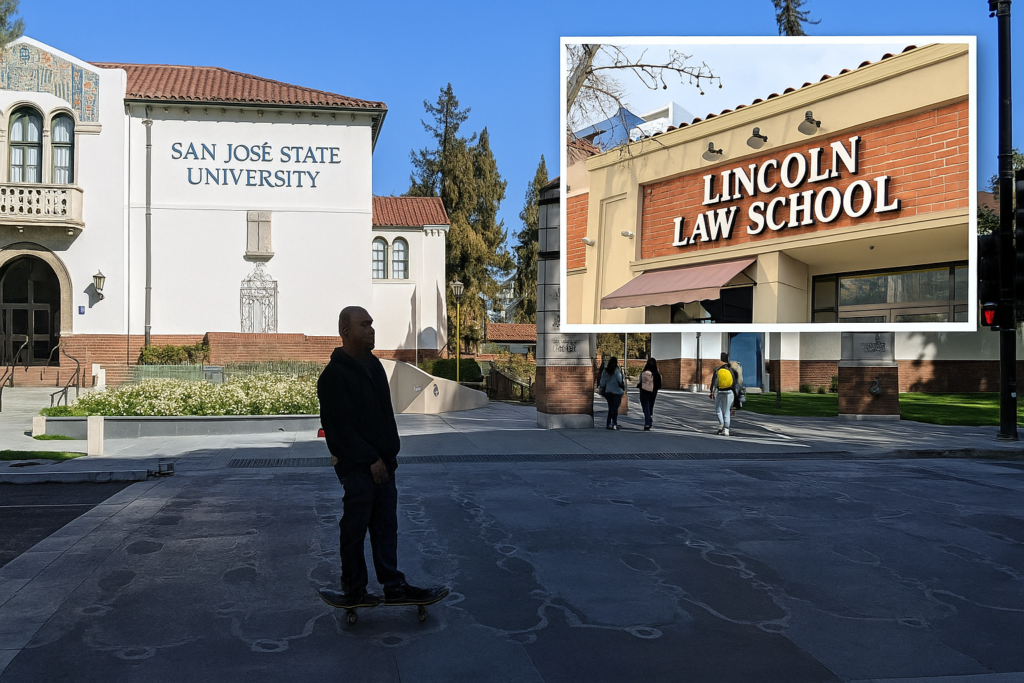
A legislative proposal could allow San Jose State to offer joint programs with nearby Lincoln Law School of San Jose.
Credit: Andrew Reed / EdSource | Lincoln Law School /Linkedin
Top Takeaways
- An earlier proposal would have allowed a private law school to merge with San Jose State University.
- The latest plan would instead permit the state university to pilot a joint legal education program.
- The state’s Master Plan for Higher Education says only UC should have public law schools.
Does Silicon Valley need a public law school?
That question is at the heart of a debate about the future of the state’s Master Plan for Higher Education and access to affordable legal education.
A bill in the California State Senate initially would have made it possible to merge a nonprofit private law school into San Jose State University, forming the city’s first public law school. The bill’s author, state Sen. Dave Cortese, is a graduate of the most likely candidate for such a partnership, Lincoln Law School of San Jose, which has recently faced enrollment and accreditation troubles.
But the merger idea was met with criticism. The University of California and others opposed the effort, pointing to existing law schools within a one-hour radius of San Jose and suggesting that a statewide coordinating entity should weigh such degree proposals to avoid duplication.
So, Senate Bill 550 has morphed into a more modest bid for San Jose State to pilot a joint legal education program with a private law school. That opportunity also appears to be intended for Lincoln Law School of San Jose, a 106-year-old institution located not far from the California State University campus. Such a program would require approval from the CSU Board of Trustees as well as the law school’s board.
Cortese, D-San Jose, said the bill, which opens the door to joint law degrees and undergraduate law-related certificates, aims to expand access to legal education to students who have no choice but to work during the day and take classes at night.
“These are a lot of times people coming from families who haven’t had much of an opportunity to better themselves, to achieve any kind of a doctoral degree or accumulate any wealth,” he said. “San Jose State — and all CSUs and all community colleges — fill that role to some degree, but there’s not really a law school pathway like that.”
The bill’s co-author, Assemblymember Ash Kalra, D-San Jose, has worked as an instructor at Lincoln Law School of San Jose, which is not associated with a similarly named law school in Sacramento.
In addition to law degrees, Cortese suggested the schools could pilot evening certificate programs pitched to non-lawyers, educating mechanical engineers about laws relevant to seismic safety or teaching business students about tax law.
What supporters and opponents are saying
A collaboration between the two institutions could have a ripple effect on existing Bay Area law schools, even though Lincoln currently enrolls only dozens of students. Private universities, like Santa Clara University and Stanford University, operate in the heart of Silicon Valley, and the UC system includes two Bay Area law schools.
The state’s 65-year-old Master Plan for Higher Education gave UC exclusive rights to law instruction. UC officials emphasize that any change to that may be better handled by a proposed state coordinating body. That view is shared by the Association of Independent California Colleges and Universities, which represents dozens of private colleges like Stanford and Santa Clara.
“While SB 550 does not necessarily create a new standalone authority for law degrees to be offered by the CSU system, we are concerned that by authorizing a single CSU campus to absorb and offer existing programs, it functionally sets a new precedent for degree authority,” Alex Graves, the association’s vice president for government relations, wrote in a statement.
The bill is yet another way California lawmakers have signaled a willingness to blur some of the rigid lines drawn by the master plan, which placed bachelor’s and master’s degrees at CSU and undergrad through doctoral and professional degrees like medicine and law at UC.
Recent years have seen some California community colleges gain the ability to award certain bachelor’s degrees, despite objections from CSU. CSU, meanwhile, has expanded its ability to award certain applied doctoral and professional degrees under certain circumstances.
CSU officials have not taken a position on SB 550. A CSU spokesperson declined to comment further on the bill.
Cortese called the master plan “archaic” and said it has “thrust these three levels of higher education in California into mortal combat.” Meanwhile, prospective law students in cities like San Jose wonder why there is no public option in their community, he added.
Audrey Wei, a San Jose State sophomore studying criminology who co-captains the university’s mock trial team, said she thought a pilot between San Jose State and a law school would be a good opportunity for aspiring attorneys who can’t afford other law degrees.
“Limiting access to law seems a bit outdated,” Wei said. “Given how integral law is in today’s society and politics, denying it to lower-income individuals is unfair. So, this bill kind of opens that door for lower-income students to have access to the law.”
What Lincoln Law pitches to students
Lincoln Law School of San Jose pitches students on earning law degrees through evening classes at a comparatively inexpensive price.
“We provide an affordable law school option for people that work full time or have other family commitments,” said J. Jason Amezcua, dean of the law school, which was founded in 1919 and has recently enrolled as many as 70 to 80 students at a time.
Lincoln Law School of San Jose, once part of Lincoln University, charges $22,000 per academic year in tuition and fees — about $88,000 total assuming four years of study — while nearby programs with a three-year curriculum range from $61,000 per year at UC Law San Francisco to almost $80,000 annually at Stanford, counting both tuition and fees. (Students in the larger programs can receive federal aid such as loans, but Lincoln Law students cannot.)
Larger programs at Stanford or UC Law campuses are typically accredited by the American Bar Association, giving students the ability to take the bar in other states and practice nationwide. In contrast, Lincoln Law School of San Jose is among 21 California schools accredited through the State Bar’s Committee of Bar Examiners. Such programs are primarily geared toward students who take classes part time and plan to practice law in California.
Challenges the school faces
SB 550 comes as Lincoln Law emerges from a challenging period. The Committee of Bar Examiners terminated its accreditation at the end of 2022 after average bar exam pass rates dropped below 40%. Enrollment dwindled from 78 JD students in 2021 to 27 in 2024.
Since then, Lincoln Law’s bar exam pass rate has rebounded and Amezcua said enrollment is also returning to typical levels. The school was reaccredited in March.
The school recorded $1.3 million in revenue and $1.2 million in expenses in the year ending June 2024, earning the bulk of revenue from students’ tuition and fees. The nonprofit university reported net losses in the previous two years, tax records show.
Amezcua said the goal of SB 550 “is not necessarily to help us financially or grow our enrollment,” but rather to increase the number of attorneys working in public interest law practices. Piloting joint programs would create a more direct pathway from San Jose State to Lincoln Law, he said, and also attract more attention from prospective students due to San Jose State’s marketing expertise.
What’s next for SB 550
If the bill were to become law, the CSU Board of Trustees would still have to approve a pilot proposal, considering enrollment projections and the regional need for legal education. A proposal for a pilot would also have to show that San Jose State and its partner law school have consulted with UC and independent higher education institutions.
The bill also requires a law school to be continuously California-accredited for at least five years before the first cohort of a joint degree pilot program graduates. Acknowledging its recent accreditation, Amezcua said the requirement “would give [Lincoln Law] time to create that runway to a really strong implementation of this pilot program.”
Any joint law degree program could not charge more than the mandatory, campus and graduate professional fees at San Jose State.
Other CSU campuses have pursued alternative arrangements catering to students interested in earning a Juris Doctor, the formal name for a law degree.
San Diego State University and the University of San Diego have a dual degree program set to begin this fall for students seeking a JD degree and a Master of Public Administration. And California State University, Northridge, has a BA/JD program with the private Southwestern Law School in which students earn two degrees in six years instead of the typical seven.
At San Jose State, Wei, the sophomore mock trial co-captain, said she probably wouldn’t enroll at Lincoln Law as a standalone entity. But if it were tied to the state university, she added, “I’d be more open to attending there.”