Political tensions and tech shifts complicate roles on school boards, study shows
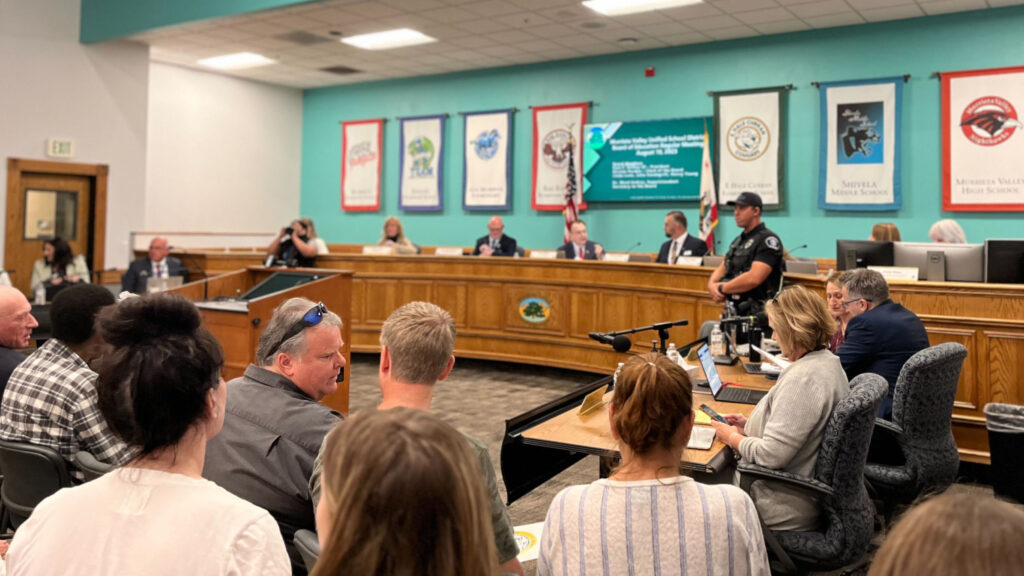
The Murrieta Valley Unified School District board mandates that parents be told if their child shows any indication of being transgender.
Credit: Mallika Seshadri / EdSource
Partisan politics, shifting school policies, changing technology and uncertain school funding are making being a school board member more difficult than ever.
“Navigating Democracy in Divided Times,” a study released Tuesday by the USC EdPolicy Hub, analyzed the experiences of 10 California school board members and offered recommendations to strengthen school board governance.
“School boards are one of the most visible and vital forms of local democracy,” said Julie Marsh, a professor of education policy at the USC Rossier School of Education and the lead author of the study. “At a time when national political divides increasingly spill into local education, understanding and supporting these leaders is critical to the future of public schools.”
School board members selected for the case studies came from school districts of all sizes throughout the state and have a diversity of backgrounds, Marsh said. They were allowed to remain anonymous for the study.
Time commitment, politics daunting
Overall, the trustees said managing partisan and local politics, and the large time commitment required for the job were the biggest challenges they had as school trustees, Marsh said. They also reported struggling to navigate relationships with other board members and members of the community.
Adversarial debates over book bans, critical race theory and other social issues have caused emotional distress for board members, but so has dealing with the board and other local politics, Marsh said.
“Which of these forms of politics are really driving the emotional well-being of folks?” Marsh asked. “We’re seeing a connection to that in our survey data and their willingness to run again, which I think is something we need to take seriously as a state.”
Researchers will take a larger look at the impact of politics and other challenges on school boards in a report set to be released next year as a part of Getting Down to Facts III, a statewide research initiative examining California’s education systems. The report will include surveys from 800 California board members.
Trustees want more training
The 10 board members participating in this USC study overwhelmingly said they wanted training to help them learn more about the requirements of their role as a trustee, how to better understand data and how to use technology, including how to stop online misinformation and harassment.
“The biggest issue is just learning how to effect change,” said Jonathan Zachreson, who has been a trustee in the Roseville City School District for almost three years. “You’re voted in … and you want to make a difference, and there’s this whole ecosystem in education that essentially works against new school board members — from just understanding the process to making change.”
Zachreson, who did not participate in the USC research, has advice for trustees who feel they are being targeted in the boardroom and on social media.
“You just have to have thick skin, and you have to be able to know how to talk to people cordially, even though they’re yelling at you sometimes,” he said. “Choose what to ignore. I think it’s hard for people to do that on social media in particular. You don’t have to answer every criticism.”
Higher pay would attract candidates
Board members who took part in the study also said that state leaders should increase board compensation to make the role more attractive to candidates. Last Saturday, California state legislators did just that — approving Assembly Bill 1390, which would substantially increase the amount school districts are allowed to pay trustees. The bill has been sent to Gov. Gavin Newsom for his signature.
Last year, more than half of the state’s school board races did not appear on the ballot because either there was only one candidate or none at all, according to an EdSource analysis.
The increased pay will help to encourage more people to run, Zachreson said. The Roseville City School District, which serves 12,324 students, is currently allowed to pay board members $400 per month. The new legislation would increase board pay to $2,000 monthly.
“If you want the regular citizen, who wants to be able to make this commitment, they should get paid appropriately for their commitment,” Zachreson said. “Therefore, I imagine, you could raise your expectations of them as well.”
The USC study was conducted in collaboration with researchers from the University of Delaware and the University of Alabama.