Perkins Loan Cancellation: Who Qualifies and How to Claim It
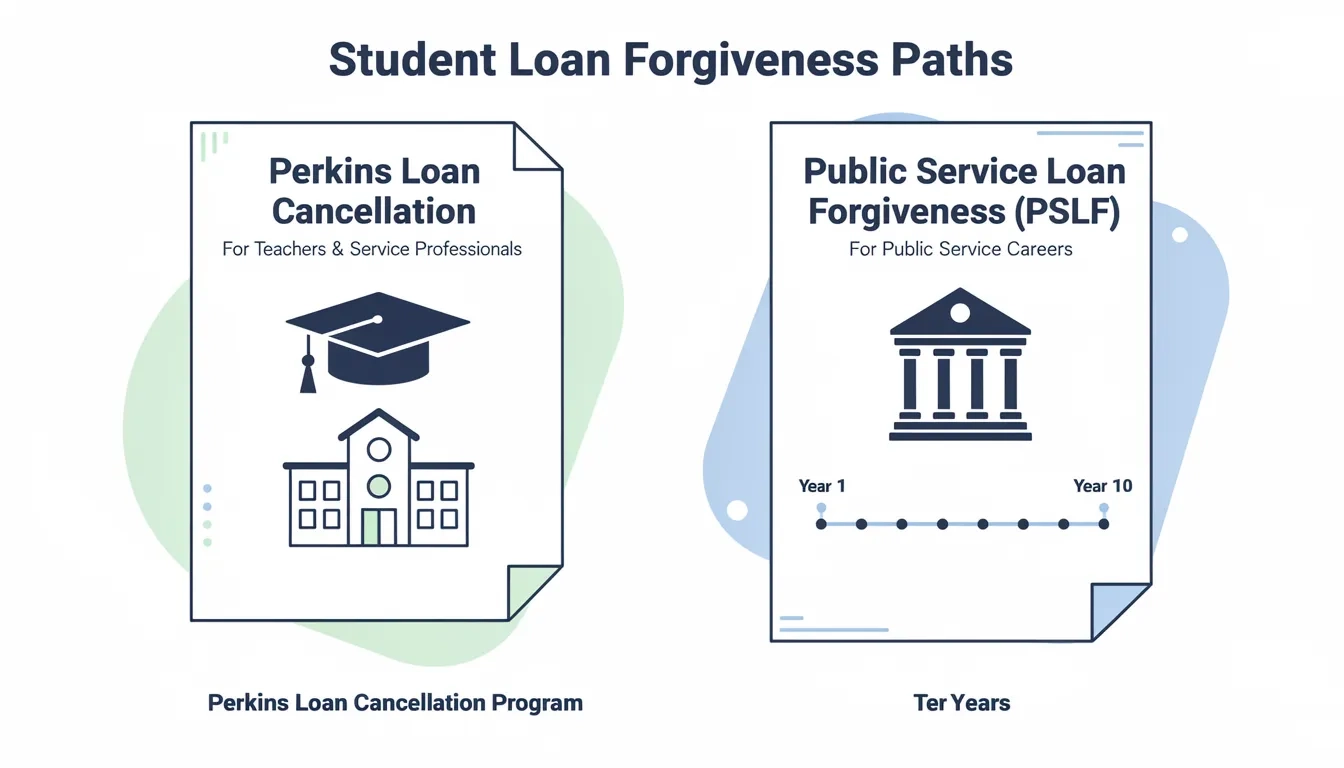
The Federal Perkins Loan program stopped accepting new borrowers in September 2018. But millions of people took out these loans before the window closed, and a surprising number are sitting on cancellation eligibility they've never acted on. Perkins cancellation is separate from Public Service Loan Forgiveness, often faster, and doesn't require a decade of qualifying payments to activate. If you work in teaching, healthcare, law enforcement, or several other roles, you might be closer to a zero balance than you think.
What Perkins Loan Cancellation Actually Is
Before anything else: Perkins cancellation and Public Service Loan Forgiveness are completely different programs. Confusing them leads borrowers to make decisions that cost thousands of dollars.
Perkins Loan cancellation is a service-based benefit built directly into the original loan structure — not a political promise tacked on later. These were campus-based loans: your school borrowed money from the federal government, lent it to you, and managed the debt itself. That's why the cancellation process runs through your school, not through a federal servicer.
The program works on a rolling annual basis. Each completed year of qualifying service wipes out a chunk of your balance. Borrowers who stay in eligible roles for five years can eliminate their entire Perkins balance. And unlike some forgiveness mechanisms that generate a tax bill, Perkins cancellation is not treated as taxable income under current law.
There's also a practical benefit few borrowers know about: eligible borrowers receive a pre-cancellation deferment during qualifying service. No payments required while you're actively working toward cancellation. You don't have to choose between making loan payments and building toward forgiveness — the deferment handles it.
By October 2024, the Department of Education was actively notifying schools about distributing their remaining Perkins revolving fund assets under a wind-down timeline for 2024-25. The program is being wrapped up administratively. The cancellation benefit for existing balances, though, isn't going anywhere.
Who Qualifies: The Full List of Eligible Jobs
The list of qualifying positions is longer than most borrowers realize. Per the 2025-2026 Federal Student Aid Handbook, here are the eligible categories:
Teaching:
- Full-time teacher at a low-income public or nonprofit elementary or secondary school
- Special education teacher (infants through youth with disabilities)
- Teacher in a shortage subject area: math, science, foreign languages, or bilingual education
Healthcare and Social Services:
- Nurse providing direct patient care (must be licensed)
- Medical technician providing direct patient care (must be certified or registered by the state)
- Full-time employee at a public or nonprofit child or family services agency providing direct services to high-risk, low-income children and families
Public Safety:
- Full-time law enforcement or corrections officer at an eligible publicly-funded agency focused on crime prevention or enforcement
- Full-time firefighter providing fire suppression or fire-related emergency response
- Federal public defender
Military and Volunteer:
- Active-duty military in a designated hostile fire or imminent danger area
- Peace Corps volunteer
- AmeriCorps VISTA volunteer
Education Support Roles (service must include or begin on or after August 14, 2008):
- Librarian with a master's degree in library science at a Title I-eligible school or a public library serving a Title I district
- Speech pathologist with a master's degree working exclusively with Title I-eligible schools
- Faculty member at a tribal college or university
The August 14, 2008 cutoff trips people up more than almost anything else in this program. A librarian who started at a Title I school in 2005 and continued through 2013 can only count the years from August 2008 onward. The earlier service simply doesn't qualify for this category.
There's also a double-dipping restriction worth knowing: you cannot claim Perkins cancellation for the same service period in which you received an AmeriCorps national service education award. If AmeriCorps already compensated that year, it doesn't count again.
Full-time service means exactly that. Part-time work in an otherwise qualifying role — even 39 hours a week at a qualifying employer — does not earn cancellation credit for that year.
How the Cancellation Rate Works Year by Year
The cancellation schedule is not linear. It's back-weighted: the program rewards borrowers who commit to the full five years by giving them the biggest single-year benefit at the end.
| Year of Service | Annual Cancellation | Running Total |
|---|---|---|
| Year 1 | 15% of principal + accrued interest | 15% |
| Year 2 | 15% of principal + accrued interest | 30% |
| Year 3 | 20% of principal + accrued interest | 50% |
| Year 4 | 20% of principal + accrued interest | 70% |
| Year 5 | 30% of principal + accrued interest | 100% |
Each year's cancellation applies to that percentage of your original principal, plus the interest that accrued on that portion during that year. The interest doesn't just get deferred — it disappears alongside the principal.
Peace Corps volunteers get different terms: maximum 70% over four years (15% per year for years one and two, 20% per year for years three and four). There's no year-five bump to reach 100%. If you're currently weighing Peace Corps against a teaching position in a low-income school and you still carry a Perkins balance, the teaching route eliminates more debt. Neither path is inherently better — they're very different commitments — but the math is worth knowing before you sign.
What happens if you leave a qualifying job partway through? Whatever cancellation you've already earned stays on the books. Finish three years and then move to a non-qualifying employer, and you've had 50% of your Perkins principal permanently eliminated. You just stop accumulating more. The canceled portion doesn't come back.
The PSLF vs. Perkins Decision: Why It Matters More Than You'd Expect
Here's where borrowers make an expensive and irreversible mistake.
Perkins Loans are generally not eligible for Public Service Loan Forgiveness because they're campus-based loans, not Direct Loans. The workaround is consolidation: fold your Perkins balance into a Direct Consolidation Loan, and it becomes PSLF-eligible. This sounds reasonable until you see what consolidation actually costs.
The moment you consolidate a Perkins Loan into a Direct Consolidation Loan, you permanently lose eligibility for Perkins-specific cancellation. There's no way to un-consolidate. The two programs cannot overlap. You're picking one, and the choice is final.
PSLF requires 120 qualifying monthly payments — ten full years in a public service role — before a single dollar is forgiven. Perkins cancellation reaches 100% in five. For a borrower whose primary balance is a Perkins Loan and who works in a qualifying role, the PSLF route means waiting twice as long.
There are cases where consolidating makes sense. If you have $85,000 in Direct Loans and $4,200 in Perkins loans, and you're already seven years into PSLF qualifying payments, folding the small Perkins balance in for the final three years is defensible. But if the Perkins loan is your main or only balance, consolidation is trading a bird in hand for something that takes a decade to materialize.
The Institute for Student Loan Advisors (TISLA) consistently recommends checking Perkins-specific cancellation eligibility before touching consolidation. That's the right call. Perkins cancellation is a concrete five-year path with no minimum payment requirement during service. PSLF involves ten years of payments, more administrative overhead, and more exposure to policy changes during that window. Check your loan types at studentaid.gov before you make any consolidation decision.
Non-Service Discharge: The Other Paths to Zero
Beyond service-based cancellation, Perkins Loans can be discharged entirely under circumstances that have nothing to do with your job. These apply whether or not you've ever worked in a qualifying role.
Discharge categories include:
- Death: The school must discharge the remaining balance. Unlike service cancellations (which the federal government partially reimburses), the school absorbs this loss from its own revolving fund.
- Total and permanent disability: Borrowers who qualify under the federal standard — the same criteria used for Direct Loans — can discharge their Perkins balance.
- School closure: If your school closed while you were enrolled, or within a qualifying window after you withdrew, you may be eligible for a closed-school discharge.
- Bankruptcy: Possible under the "undue hardship" standard, though rarely granted in practice.
One practical note: schools have historically been slower to process disability and death-related discharges than federal servicers like MOHELA, because the financial hit comes directly out of the institution's revolving fund rather than being reimbursed. If you're pursuing one of these, stay persistent and document everything in writing.
As of the 2025-2026 FSA Handbook, discharge amounts under death and disability remain excluded from taxable income. That's been consistent across recent handbook cycles, but confirm with a tax professional for your specific situation if you're navigating a discharge year.
How to Apply When There's No Federal Form
Here's the part that surprises most people: there is no standardized federal application for Perkins Loan cancellation.
PSLF has a single Employment Certification Form submitted through studentaid.gov. Perkins cancellation has nothing equivalent. You contact the college or university that held your Perkins Loan directly, request their paperwork, and submit documentation through them. Every institution has developed its own forms and handles its own internal review. And because the school is the decision-maker (not the Department of Education), there's no federal appeal if the school denies your application. Getting the documentation right the first time matters.
Here's a practical sequence:
- Confirm your loan type at studentaid.gov. If it shows as a Federal Perkins Loan (not consolidated), you're still eligible. If it was consolidated at any point, Perkins-specific cancellation is no longer available.
- Contact your school's financial aid or bursar office and request their cancellation application. If the school assigned the loan to a servicer, they'll point you there.
- Get employer verification — a signed letter or form from an authorized official at your employer confirming your full-time status and role. Schools will not accept self-certification.
- Apply annually, not all at once after five years. Each completed year of service is a separate cancellation event. Deferment runs alongside, so there's no reason to delay filing.
- If your school closed, search for the assigned servicer or contact Federal Student Aid at 1-800-433-3243 for guidance on where to send your application.
The FSA handbook is explicit that cancellation cannot be backdated to service performed before the loan was disbursed, or during the academic period the loan was intended to cover. If you graduated in May 2016 and received a Perkins Loan that spring, the teaching job you held in fall 2015 doesn't count — even if it was at an eligible school. Confirm your disbursement dates before mapping out your service timeline.
Bottom Line
- Perkins cancellation reaches 100% in five years — half the time PSLF requires, with no payment obligation during qualifying service. If you work in an eligible role and haven't filed, you're leaving money on the table.
- Do not consolidate your Perkins Loan into a Direct Loan until you've verified you're not Perkins-cancellation-eligible. Consolidation is permanent and immediately ends that option.
- Apply annually through your school, not all at once at the five-year mark. Lock in each year's cancellation as you complete it.
- If you fall into the librarian, speech pathologist, or tribal college faculty categories, count only service from August 14, 2008 forward — earlier years don't count for these specific roles.
- The canceled amount is not taxable income. The deferment runs during service. For many borrowers in qualifying public service roles, Perkins cancellation is the most efficient student loan benefit still available to them.
Frequently Asked Questions
Is Perkins Loan cancellation the same thing as PSLF?
No — they're separate programs with different mechanics and timelines. PSLF requires 120 qualifying payments (ten years) on Direct Loans. Perkins cancellation is service-based, reaches 100% in five years, and is administered by your school rather than a federal servicer. Many borrowers who qualify for Perkins cancellation assume PSLF is their only option. They can pursue Perkins cancellation directly without consolidating.
What if I already consolidated my Perkins Loan into a Direct Loan?
Once consolidated, your Perkins balance becomes a Direct Loan and Perkins-specific cancellation eligibility is gone permanently. You can pursue PSLF with the consolidated balance if you work in a qualifying public service role — but the five-year Perkins route is no longer an option. Check your loan history at studentaid.gov to see exactly what loan types you hold before making any decisions.
If I leave my qualifying job after three years, do I lose the cancellation I already earned?
No. Cancellation already granted is not clawed back when you leave a qualifying position. After three completed years, you've had 50% of your original Perkins principal — plus the interest that accrued on those portions — permanently eliminated. You simply stop accruing additional cancellation credit. The amount already canceled stays canceled.
Can I get Perkins cancellation for part-time work in a qualifying role?
No. The program requires full-time employment for a complete 12-month period to earn credit for a given year. Part-time work, even at a qualifying employer in an otherwise qualifying role, does not count. If you transition from part-time to full-time at an eligible job, only the years of full-time service count toward the five-year schedule.
What if my school has closed and I can't figure out who holds my Perkins Loan?
Start by checking studentaid.gov — your loan details should reflect the current holder or assigned servicer. If that's unclear, contact Federal Student Aid at 1-800-433-3243 for guidance. Schools that closed were required to assign or transfer their Perkins loan portfolios, so there should be a servicer on record. Don't assume the loan simply disappeared; closed-school discharge is a separate process with its own eligibility criteria.
Do Perkins Loan cancellations show up negatively on my credit report?
Cancellation events are generally reported as the account being satisfied or discharged (not as a default or charge-off), which is neutral to positive for credit. However, each school may handle credit reporting slightly differently. Ask your school's financial aid office how they report annual cancellation events before you apply — it's a reasonable question and the answer affects your credit profile going forward.
Sources
- Perkins Loan Cancellation Benefits — Federal Student Aid
- 2025-2026 FSA Handbook Vol. 6 Ch. 4 — Perkins Repayment, Deferment, Discharge, and Cancellation
- Perkins Loan Forgiveness Program — TISLA
- Perkins Loan Cancellation — Student Loan Borrowers Assistance
- Perkins Loan Program: Revolving Fund Distribution Timeline 2024-25 — FSA Partner Connect