Peer tutoring programs offer hope amidst budget cuts
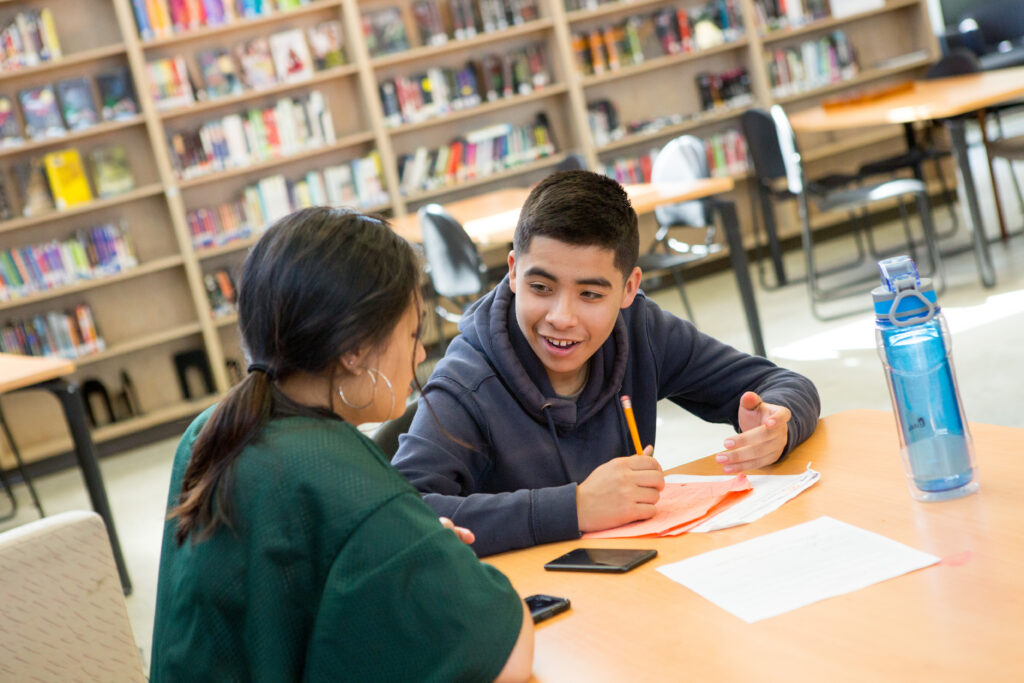
Students work together as part of an after-school tutoring club.
Credit: Allison Shelley for American Education
School closures and the lack of in-person education during the pandemic resulted in widespread learning loss, leaving nearly half of students a grade behind in at least one subject and disrupting future career outcomes.
To strengthen student education following the pandemic, 80% of school districts nationwide utilized the federal government’s Elementary and Secondary School Emergency Relief (ESSER) funds to establish new tutoring programs. At the same time, California launched a free online tutoring service for every K-12 student in the state. Through these projects, many focused on “high-dosage” or “high-impact” tutoring, which has been shown to strengthen student achievement in reading and English significantly.
However, federal grants are starting to expire while the U.S. Department of Education is on the verge of collapse due to staff and budget cuts, jeopardizing other funding opportunities. As California’s high schools navigate this budgetary uncertainty, especially for new tutoring programs, one solution has the potential to continue recent progress: peer tutoring, a program in which students receive tutoring and academic support from their peers.
For the past two years, I have worked as a peer tutor in my school’s Academic Resource Center. To qualify as a tutor, students need a B+ or higher in the subject they wish to tutor and receive their teacher’s recommendation. If spots are available, the applicant must pass a tutoring test and take some training to prepare them for the work. Once done, they can begin working a shift (say, one hour after school, under the supervision of an administrator or “head tutor”).
Since peer tutors are also in high school, they have previously taken the same classes as the students they are tutoring. This experience, unlike that of a teacher or paraprofessional, enables them to understand the unique challenges faced by students who need help and tailor their instruction accordingly. Furthermore, I have noticed that tutees are more likely to seek help from a peer tutor whom they see as a friend, compared to their teacher. Moreover, these academic benefits of peer tutoring have been rigorously confirmed by numerous scientific studies.
However, the increased academic achievement is not isolated to the students being tutored; studies have shown it also extends to the peer tutors. Students can develop their communication skills and confidence as they explain complex math, science and English topics to their peers, prompting them to devise interesting analogies and ideas. At times, I also took on challenging roles that helped develop my management and teaching skills. For example, I once tutored two students in Honors Chemistry, which forced me to quickly get both students on the same page to teach them.
In these small tutoring sessions, students can also bond with new students. As a peer tutor for my school, I was able to connect with people across grades and classes, gaining insight into their unique educational struggles, which I wouldn’t have otherwise known. Through this process, a school’s environment also becomes more collaborative as students willingly volunteer to support their peers.
For overburdened districts, peer tutoring saves schools money. Unlike other instructors, peer tutors are volunteers and widely available. Effective administrators can capitalize on these strengths by alleviating the workload of teachers and professional tutors (leaving them to support more at-risk students) and expanding tutoring access across class periods and lunch.
Many high schools in California (Leigh in San Jose, San Mateo in San Mateo, Acalanes in Lafayette) have peer-tutoring programs to model after.
With federal cuts and tighter state budgets, schools should tap into a resource they already have — their own students.
•••
Aayush Gandhi is a senior at Dublin High School.
The opinions expressed in this commentary represent those of the author. EdSource welcomes commentaries representing diverse points of view. If you would like to submit a commentary, please review our guidelines and contact us.