Opioid epidemic: California bill aims to protect students aiding overdose victims
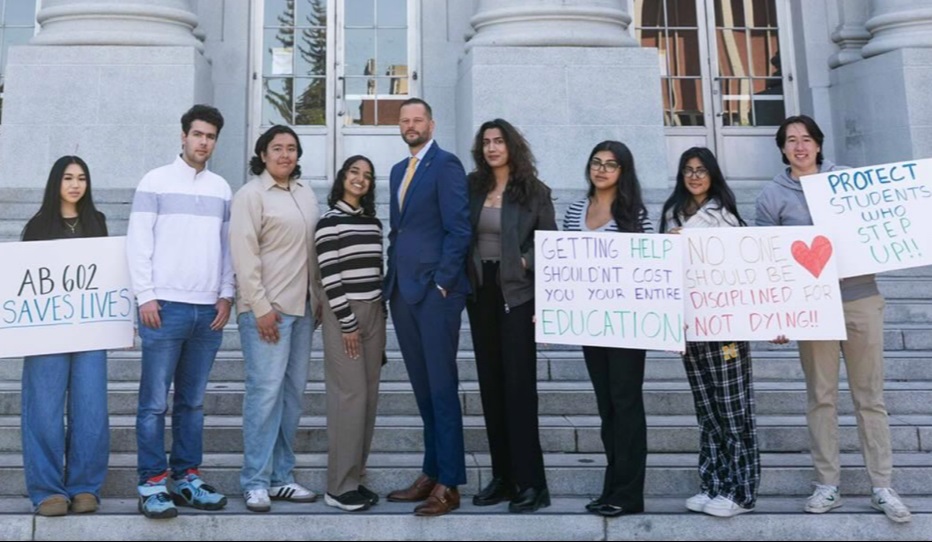
Students from the Youth Power Project at the state Capitol to rally support for a “good Samaritan” bill that would let students help a peer who’s overdosed on drugs or alcohol without fear of being disciplined by their institution for their compassion.
California stands on the verge of becoming a national model in a small but significant area of public health: allowing students to try to intervene to save the lives of peers who overdose on drugs without fear of being punished for their compassion.
It’s a need highlighted by UC Berkeley student T.J. McGee in his testimony to the Legislature on behalf of the bill:
“Imagine a boy lying on the floor of his dorm room,” McGee said. “He isn’t breathing right, pulse slow, and skin pale. He is having a seizure right in front of you that is progressively getting worse. His roommates hovered above him, scared and frantic.”
In a state that prides itself on progressive public health policy, it is unconscionable that a student could face disciplinary action for intervening to save a drug user’s life. And yet, under current California law, that is precisely what can happen. When a young person calls for medical assistance during a peer’s overdose, they may still be subjected to school-based or institutional punishment, even though their intervention could literally mean the difference between life and death.
Assembly Bill 602, authored by Assemblymember Matt Haney, D-San Francisco, with guidance from the Youth Power Project, is a long-overdue and courageous step toward dismantling a punitive framework that criminalizes compassion. It is the first state bill of its kind in the United States to extend medical amnesty protections to students who seek help for peers experiencing a drug or alcohol-related emergency. With overdose deaths continuing to rise, particularly among young people, Gov. Gavin Newsom must seize this moment and sign the bill into law.
California law currently offers limited immunity to individuals seeking emergency help for alcohol-related overdoses under the “911 Lifeline” policies. But when it comes to drug overdoses, particularly those involving fentanyl and other opioids, students remain vulnerable to harsh disciplinary responses from their school. These punitive measures, which include eviction, suspension, expulsion and even arrest, do not deter substance use. Instead, they fuel a climate of fear and silence. The message is clear: Better to let someone die than to expose yourself to risk by calling for help.
This is morally bankrupt, scientifically unfounded and socially destructive.
Overdose events are often the result of untreated mental health conditions, trauma or systemic neglect. When students are punished for seeking to help, it reinforces the view of addiction as a moral failure rather than the public health crisis that leading medical associations have classified it. When smoking nicotine leads to lung disease, we treat; we don’t arrest. When risky behavior causes injury, we care; we don’t suspend. Why is drug addiction the exception?
AB 602 recognizes what researchers and youth advocates have long insisted: Saving lives must come before assigning blame. Opponents may argue that such protections could embolden substance use or erode accountability, but the data shows something else: States that have enacted good Samaritan laws see higher rates of emergency calls and lower rates of overdose fatalities. By removing the threat of punishment, these laws encourage timely intervention, reduce hesitation to act and shift the paradigm from discipline to dignity.
Moreover, the racial and socioeconomic implications of current policy are too glaring to ignore. Disciplinary systems in schools disproportionately impact Black and Latino youth. When drug policy is enforced through school discipline rather than rehabilitative intervention, it becomes yet another mechanism of racialized punishment and an extension of the school-to-prison pipeline dressed in public safety rhetoric. AB 602 begins to decouple drug crises from disciplinary infrastructure and steers young people toward mental health resources.
Indeed, the bill’s deeper value lies in legal protection for good Samaritans and the cultural shift it demands. Gov. Newsom has spoken often about transforming California’s mental health system and tackling the opioid epidemic. Gov. Newsom, sign this bill into law and let California be the state where doing the right thing is never the wrong decision.
•••
Isabel Prasad is an undergraduate student at UC Berkeley and a policy advocate at the Youth Power Project.
The opinions expressed in this commentary represent those of the author. EdSource welcomes commentaries representing diverse points of view. If you would like to submit a commentary, please review our guidelines and contact us.