Ohio FAFSA Deadline 2026: State Aid Programs You Need to Know
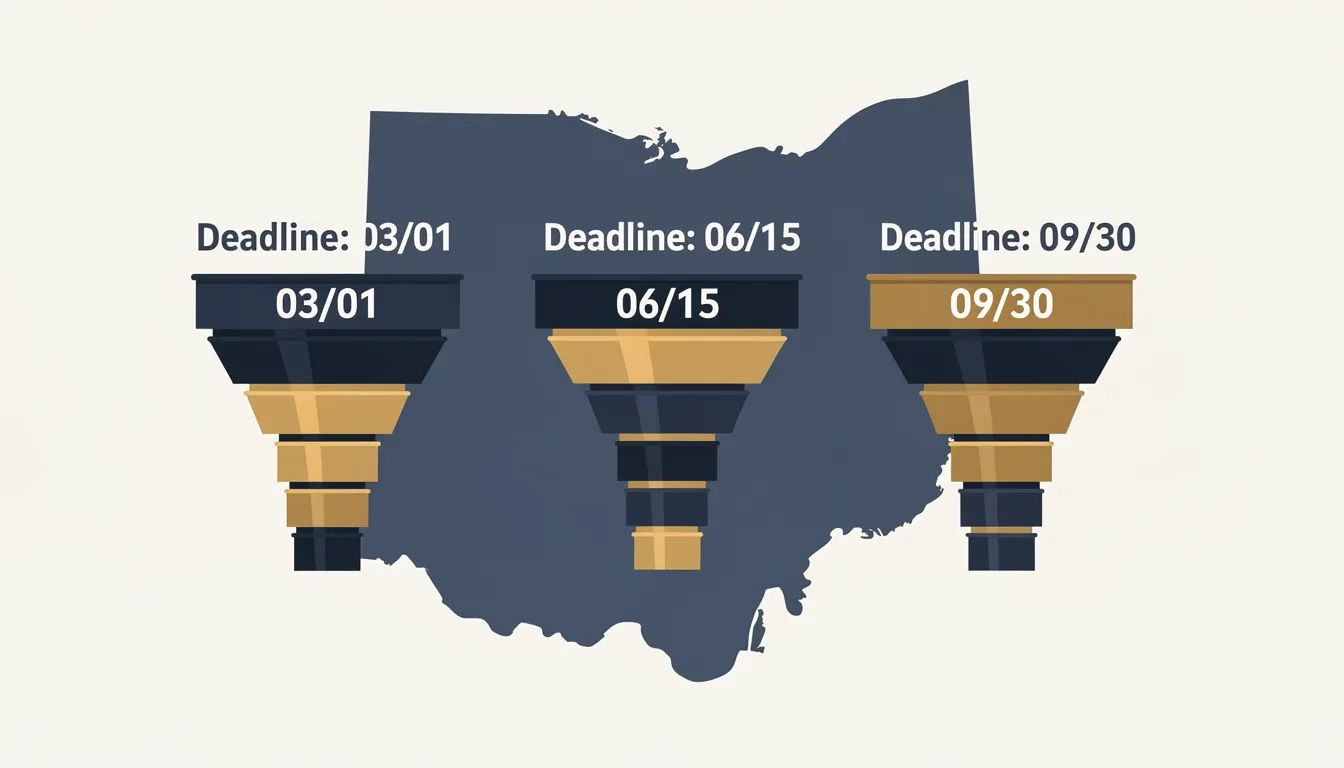
Most Ohio students hear "the FAFSA deadline" and think there's one date to hit. There isn't. There are three separate cutoffs, each guarding a different pool of money, and the one you've probably heard about most — October 1 — is actually the last resort, not the target. Miss the earlier school-specific dates and you're still eligible for state grants, but the institutional scholarship money your school controls may already be distributed. Getting clear on which deadline does what is the difference between a well-funded college year and a gap you fill with loans.
The Three Deadlines Ohio Students Actually Need to Track
Think of Ohio financial aid as three distinct pipelines, each with its own shutoff valve:
| Deadline Type | Typical Date | What You Risk Missing |
|---|---|---|
| School priority deadline | January–February | Institutional scholarships and grants |
| Ohio state grant deadline | October 1, 2026 | Ohio College Opportunity Grant (OCOG) |
| Federal FAFSA deadline | June 30, 2027 | Federal Pell Grant, subsidized loans |
School priority deadlines are the most time-sensitive, even though they're not the "official" state or federal cutoff. Ohio State University's priority date is February 1. Ohio University's priority date for incoming freshmen is January 15, with aid packages going out in early March. University of Cincinnati recommends filing between October 1 and November 1 to maximize eligibility for first-come, first-served funding, with a final institutional priority cutoff of February 1.
Ohio's state grant deadline is October 1 of the enrollment year. For the 2026-27 academic year, that's October 1, 2026. This is later than most states — Pennsylvania's state grant deadline is May 1, California's is March 2. That flexibility is genuinely useful, but it misleads students into thinking they have more breathing room for all aid than they do.
The federal FAFSA deadline for 2026-27 is June 30, 2027. You won't lose federal Pell Grant eligibility by filing in May or June, but by then school scholarships are long gone.
If you're reading this in spring or summer 2026 and haven't filed yet: your school's institutional aid window has likely closed, but the state OCOG deadline is still four-plus months away. File now.
The Ohio College Opportunity Grant: Ohio's Main State Award
The Ohio College Opportunity Grant (OCOG) is Ohio's flagship need-based program, administered by the Ohio Department of Higher Education. It's free money — grant, not loan — available annually to eligible Ohio undergraduates.
To qualify for 2026-27, you need all of the following:
- Student Aid Index (SAI) of 3,750 or less, as calculated from your FAFSA
- Household income at or below $96,000
- Ohio residency
- Undergraduate, degree-seeking enrollment at a certified Ohio institution
- FAFSA submitted by October 1, 2026
Award amounts scale directly with how many credit hours you're taking:
| Enrollment Level | Credit Hours | Annual Award |
|---|---|---|
| Full-time | 12+ hours | $4,000 |
| Three-quarter time | 9–11 hours | $3,000 |
| Half-time | 6–8 hours | $2,000 |
| Quarter-time | 1–5 hours | $1,000 |
There's a wrinkle that catches students off guard: if other aid already covers 100% of your tuition and general fees — athletic scholarships, institutional waivers, third-party employer coverage — you become ineligible for OCOG even if you meet every income and SAI threshold. The grant is designed to fill gaps, not stack on top of full coverage.
OCOG lifetime eligibility caps at 10 full-time semesters. Students who take longer paths to graduation, transfer between Ohio schools, or drop below full-time for several semesters should track their semester count carefully — there's no reset when you transfer.
The SAI is not the same as your income. Family size, number of college students in the household simultaneously, and asset values all feed into it. A household earning $88,000 with two kids in college at the same time may have a significantly lower SAI than a smaller household at the same income level.
Other Ohio State Programs Worth Knowing
OCOG gets most of the attention, but Ohio runs several other state aid programs targeting specific student populations.
Choose Ohio First is a scholarship program for students pursuing STEM, STEMM, or education fields. The state funds it but individual universities administer it, so award amounts and application requirements vary by school. If you're entering engineering, computer science, nursing, or education at a participating Ohio institution, ask your financial aid office directly whether your program qualifies.
Ohio National Guard Scholarship Program (ONGSP) covers 100% of instructional and general fees for current Ohio Army or Air National Guard members working toward an associate or bachelor's degree. At public universities, instructional fees alone represent a substantial portion of the total bill — this program effectively eliminates tuition for qualifying Guard members.
War Orphans and Severely Disabled Veterans' Children Program provides tuition assistance to qualifying dependents of Ohio veterans killed in service or permanently disabled as a result of service. Applications run through the Ohio Department of Higher Education, not individual schools.
Safety Officers College Memorial Fund covers full instructional fees at Ohio public institutions for children or surviving spouses of peace officers or firefighters killed in the line of duty in Ohio.
A quick reference:
| Program | Who Qualifies | Core Benefit |
|---|---|---|
| OCOG | Income-eligible undergrads (SAI ≤ 3,750) | Up to $4,000/year |
| Choose Ohio First | STEM/education students | Varies by school |
| ONGSP | Active OH National Guard members | 100% of instructional fees |
| War Orphans Program | Dependents of killed/disabled vets | Tuition assistance |
| Safety Officers Fund | Children/spouses of fallen officers | Full instructional fees |
How School Priority Deadlines Actually Work
School priority deadlines are where most students lose money they could have kept. This is worth understanding clearly, because the mechanism isn't obvious.
When a school posts a February 1 priority date, it doesn't mean you can't get federal aid after that. It means the school's own grant and scholarship dollars go out to students whose FAFSA results arrived by the priority date. Schools have limited institutional funds. They award them in roughly the order FAFSA data comes in, within eligibility tiers. File late, and you're drawing from whatever remains.
Ohio State's priority date of February 1 governs OSU's own scholarship programs. Ohio University's January 15 freshmen priority date determines who gets the early March aid package offers (which include the best institutional grants). UC's October-to-November filing window is a recommendation, not a hard cutoff, but filing in that window gets you into the first-come queue for work-study and limited institutional grant funding.
The practical implication: for students entering fall 2026, the priority windows at most Ohio schools have already closed as of spring 2026. That ship has sailed. What remains available is federal aid (still wide open), and state OCOG aid (open until October 1, 2026). Filing now still matters.
Filing Step by Step
For anyone who still needs to complete the 2026-27 FAFSA:
Get your FSA ID squared away first. Both student and parent (for dependent students) need separate FSA IDs at studentaid.gov. The ID verification process takes 1–3 days, so creating it the same day you plan to file is a mistake that delays everything.
Gather 2024 tax records. The 2026-27 FAFSA pulls from 2024 income data. Have your (and your parent's) 2024 federal tax return, W-2s, and records of untaxed income ready.
File at studentaid.gov. List every Ohio school you're considering. Schools receive your data automatically — you don't have to send it separately.
Review your Student Aid Report. After submitting, you'll get a Student Aid Report confirming your SAI. Check it for data entry errors. A typo in household size or income can shift your SAI enough to change OCOG eligibility.
Respond to school aid offers before their acceptance deadlines. Financial aid packages label every dollar as "grant," "scholarship," "work-study," or "loan." Grants and scholarships are free money. Work-study requires working for it. Loans require full repayment with interest.
Common Mistakes That Cost Ohio Students Grant Money
Treating October 1 as the actual deadline is the most expensive mistake. By the time fall semester begins and October arrives, institutional funding at virtually every Ohio school has been fully committed. Filing then still gets you OCOG (if eligible) and federal aid, but you're leaving the institutional layer on the table.
Assuming OCOG is automatic trips up students who meet the income requirements but haven't confirmed their school participates. Not every Ohio institution is OCOG-certified. Before counting on those dollars, verify with your financial aid office.
Skipping the annual renewal is another quiet budget-killer (and it happens more often than you'd think). FAFSA is not a one-time form. Every year requires a new submission. Students who file freshman year and assume they're set get an unpleasant surprise when sophomore-year OCOG doesn't show up in their package.
Missing the SAI calculation nuance catches families near the $96,000 income ceiling. The SAI incorporates more than income — it factors in family size and the number of dependents in college simultaneously. Two siblings enrolling in the same fall semester lowers each family's SAI. Worth running the numbers if you're close to the threshold.
Bottom Line
- File the FAFSA as early as possible — ideally before your school's priority deadline (typically January–February), not before the October 1 state cutoff.
- Ohio's OCOG deadline is October 1, 2026 for the 2026-27 academic year. SAI ≤ 3,750 and household income ≤ $96,000 are the two qualifying thresholds. Award is up to $4,000 for full-time enrollment.
- If you've already missed your school's priority date, file now anyway. Federal aid and OCOG are still accessible. Waiting longer doesn't help.
- Renew every year. FAFSA is an annual form, and so is OCOG eligibility. Missing one year means missing that year's state grant dollars.
- The single most actionable thing: stop treating October 1 as your target and start treating your school's February priority date as the real finish line.
Frequently Asked Questions
What is Ohio's FAFSA deadline for the 2026-27 academic year?
Ohio's state grant deadline is October 1, 2026 for the 2026-27 academic year. This is the cutoff to be considered for the Ohio College Opportunity Grant. However, individual schools set earlier priority deadlines — typically January or February — after which institutional scholarship and grant funds may already be committed.
Can I still get OCOG if I file after my school's priority deadline?
Yes, as long as you file before October 1, 2026 and meet the eligibility requirements (SAI ≤ 3,750, household income ≤ $96,000, Ohio residency, degree-seeking undergraduate enrollment). Missing your school's priority deadline affects institutional aid, not OCOG. The two pools of money are separate.
Is the Ohio College Opportunity Grant automatically added to my financial aid package?
No. OCOG is triggered by your FAFSA submission and eligibility review, but it's not guaranteed or automatic. Your school must be an OCOG-certified institution, and you must meet all eligibility criteria. If expected OCOG funds don't appear in your aid package, contact your financial aid office to confirm your school's participation and your eligibility status.
My family earns close to $96,000 — do we still qualify for OCOG?
Possibly, but it depends on your Student Aid Index, not income alone. The SAI factors in household size, number of college students in the family, assets, and other variables. A family of five earning $94,000 with two kids in college simultaneously could have a lower SAI than a family of three at the same income. Run the FAFSA College Cost Estimator at studentaid.gov to get a preliminary SAI estimate before making assumptions.
What happens to OCOG if I drop below full-time enrollment mid-semester?
Your award gets prorated based on actual enrollment at the point of your school's census date (typically the third week of classes). Dropping below 12 credit hours after the census date may still affect your aid calculation depending on your school's policy. Check with your financial aid office before dropping any class, because a single credit-hour change can shift you from the $4,000 tier to the $3,000 tier.
Does the Ohio National Guard Scholarship stack with OCOG?
No. ONGSP covers 100% of instructional and general fees, which means students receiving ONGSP are typically ineligible for OCOG because the grant eligibility rule disqualifies anyone whose tuition is already fully covered by other aid. If ONGSP doesn't cover all fees (certain course-specific fees, for example), check with your school's financial aid office about any remaining gap.
Sources
- Ohio College Opportunity Grant (OCOG) — Cleveland State University
- 2026-27 Financial Aid and FAFSA State Deadlines — Fastweb
- Important FAFSA Deadlines for 2025-2026 and 2026-2027 — SavingForCollege
- FAFSA Priority Deadline — University of Cincinnati
- Applications and Deadlines — Ohio University
- State FAFSA Deadlines — Federal Student Aid