North Carolina FAFSA Deadlines and State Aid Programs 2026
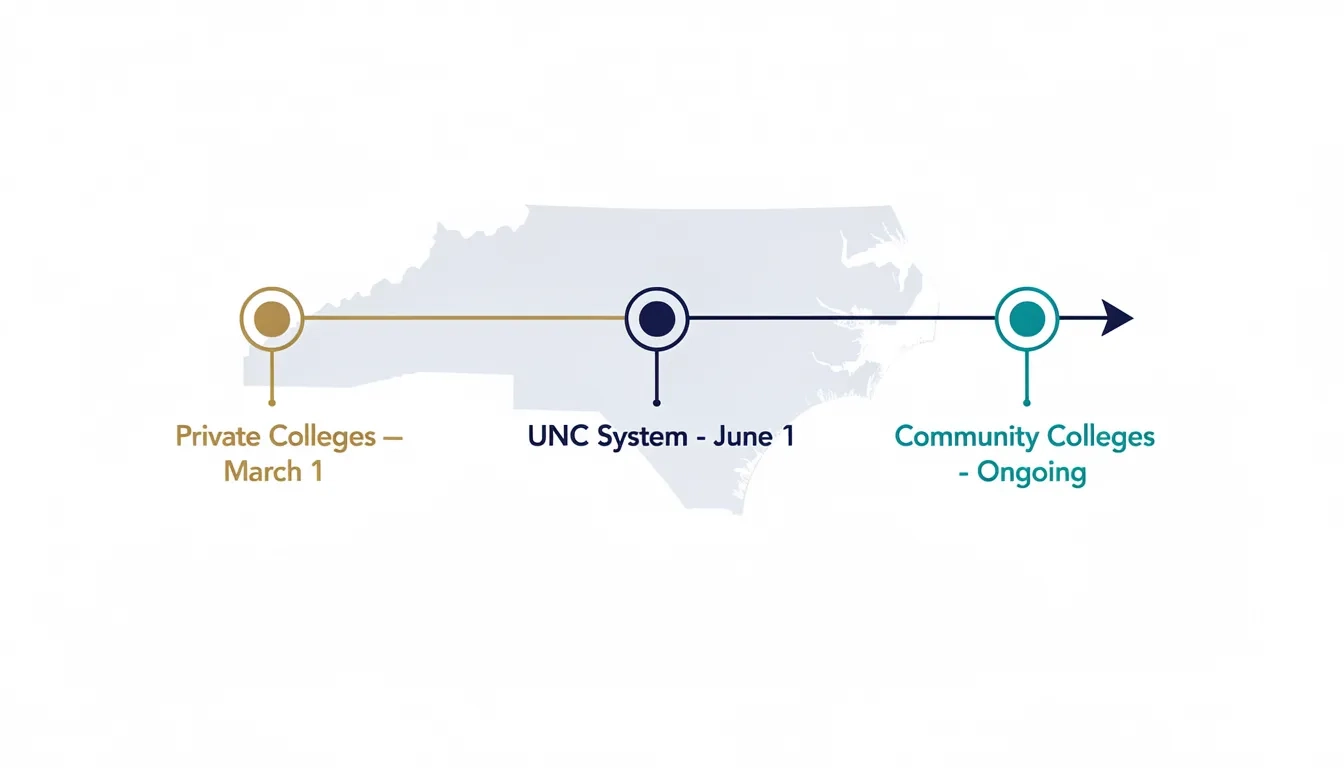
North Carolina runs a three-tier FAFSA deadline system that most high school counselors never explain clearly. If you're heading to a UNC System school, the priority deadline was June 1. Community college students have until August 15. Attending a private NC college? You should have filed back in October 2025. Three different school types, three completely different urgencies — and missing the right one can mean leaving thousands of dollars of state grant money on the table.
As of mid-June 2026, the UNC priority window has just closed. Community college students still have roughly two months. All three of NC's main grant programs are still distributing funds this cycle, but every one of them operates "until funds are exhausted."
NC's Three FAFSA Priority Deadlines
The federal FAFSA closing date (June 30, 2027, for the 2026-27 award year) is almost beside the point when you're chasing North Carolina state aid. What actually determines your shot at grant money is the institution-type priority deadline.
Private NC colleges come first. CFNC (College Foundation of North Carolina) advises filing as soon as the FAFSA opens each October. There's no single published cutoff because private schools set their own internal processing schedules, but most build aid packages in November and December for the following fall. Waiting until January instead of filing in October can realistically cost a student $3,000 to $5,000 in state grant consideration.
UNC System institutions land in the middle. The priority deadline across all 16 UNC schools was June 1, 2026. This doesn't mean your FAFSA disappears after that date — federal Pell Grants and loans are still fully accessible — but state-funded grant money starts drying up once applications pile in after the deadline.
Community colleges have the latest window. August 15, 2026 gives students more flexibility. Many community college students finalize enrollment decisions well into the summer, so the later date reflects that reality.
One thing worth flagging: none of these programs require a separate application. List a qualifying North Carolina institution on your FAFSA and consideration for state grants is automatic. No scholarship portals, no essays, no supplemental forms.
The Next NC Scholarship Explained
The Next NC Scholarship is NC's flagship aid program, and it works differently than most people expect. Instead of calculating a variable grant that shifts every year based on complex formulas, it guarantees a minimum floor.
Students at a UNC institution with an Adjusted Gross Income (AGI) below $80,000 and a Student Aid Index (SAI) of 7,500 or less are guaranteed at least $5,000 in combined federal and state aid. Community college students in the same income range get at least $3,000.
"Consideration for funding is automatic once the FAFSA is filed." — CFNC guidance covering all three NC state grant programs
That word "combined" is doing real work here. The scholarship wraps the federal Pell Grant together with state dollars to hit the guaranteed minimum. If your Pell Grant is already $4,500, the state fills in $500 to clear $5,000. If your Pell Grant is $7,395 (the 2026-27 maximum), the state contribution is smaller. The promise is predictability, not a specific state dollar amount.
The $80,000 AGI threshold surprises families who assume they earn too much for need-based aid. A household bringing in $79,000 might never think to file — but they're well within range. Families earning slightly above the threshold often qualify for other programs with more generous income limits.
Additional eligibility requirements:
- North Carolina resident (defined per the NC Residency Manual)
- Undergraduate enrolled in at least 6 credit hours
- No previous bachelor's degree
- Title IV eligible
- Must stay within semester limits (10 semesters for 4-year programs; 6 for 2-year programs)
The scholarship is not automatically renewed. Students must refile the FAFSA every October to remain in consideration the following year.
Three State Programs, Three Eligibility Nets
The Next NC Scholarship isn't the only tool in NC's financial aid toolkit. Two other programs target scenarios it doesn't cover.
The NC Need-Based Scholarship for Private College Students provides up to $7,640 per year for undergraduates attending qualifying private North Carolina institutions. The SAI ceiling here is 15,000 — double the Next NC threshold. Students who earn too much to qualify for the flagship program might still receive this one just by attending a private school.
Requirements: NC resident, at least 9 credit hours, no prior bachelor's degree, and the school must be a recognized qualifying private NC institution. Like Next NC, consideration is automatic upon FAFSA filing with the school listed.
The NC Community College Grant works alongside the Next NC Scholarship for community college students. It pays up to $2,200 per semester for full-time students (12 or more credit hours) with an Expected Family Contribution (EFC) of $8,500 or less. Part-time students enrolled in at least 6 hours can receive a partial award.
| Program | Max Award | Who It Serves | Income/Need Limit |
|---|---|---|---|
| Next NC Scholarship | $5,000/yr (UNC) or $3,000/yr (CC) minimum | UNC System + Community Colleges | SAI ≤ 7,500; AGI ≤ $80,000 |
| NC Need-Based Scholarship | Up to $7,640/yr | Private NC colleges | SAI ≤ 15,000 |
| NC Community College Grant | Up to $2,200/semester | Community Colleges | EFC ≤ $8,500 |
The practical read: private college students have the most SAI flexibility. Community college students can potentially stack both the Next NC Scholarship and the Community College Grant, which can meaningfully reduce out-of-pocket costs without taking on debt.
The "Until Funds Exhausted" Problem Is Real
Every NC state grant program carries the same warning: awards continue "until funds are exhausted." It's not just boilerplate. It's the mechanism that makes deadline timing matter.
North Carolina's FAFSA completion rate has been trending upward. EdNC reported in early 2026 that NC's completion rate was outpacing the prior year, which means more students competing for the same pool of state grant dollars.
Think of state funding less like a traditional deadline and more like a ticket window. The window stays open, but the better seats fill first. A student who files in February for a UNC school will almost certainly receive full state grant consideration. One who files in late May is cutting it close. Filing in July, after the June 1 priority date, means competing for whatever's left.
The real cost of late filing isn't lost federal aid — it's lost state grants. Pell Grants, subsidized loans, and work-study programs aren't affected by NC priority deadlines. Those remain accessible regardless of when you file. What disappears is the state-funded money that doesn't need to be repaid. That's the actual dollar cost.
For community college students reading this in June 2026: August 15 is your deadline. File this week. Not because funds will run out tomorrow, but because there's no upside to waiting.
Five Mistakes That Cost NC Students Grant Money
The "we earn too much" assumption probably costs more NC families more money than any other single error. The Next NC Scholarship's $80,000 AGI ceiling covers a wide swath of working North Carolina households. Many skip the FAFSA entirely and never discover they were eligible.
Listing no NC schools on the FAFSA. State grant consideration is triggered automatically when a qualifying NC school appears on your FAFSA. If you're applying to schools in several states and forget to include your NC option, the programs never see you. The fix is simple — add any NC school to your list before submitting — but discovering the oversight after the priority deadline means refiling too late.
Confusing the federal deadline with the NC priority deadline. The federal FAFSA remains open until June 30, 2027. NC's priority deadline for UNC schools was June 1, 2026 — more than a year earlier. Students who Google "FAFSA deadline" and find the federal date often miss state funding entirely.
Assuming renewal is automatic. It isn't. Students must refile the FAFSA every October to maintain eligibility for the following year. Missing a single annual filing can break continuity and require appealing for reinstatement.
Not checking school-specific deadlines. NC sets priority dates at the state level, but individual schools sometimes post earlier internal deadlines for institutional aid. The safest approach is to check directly with your school's financial aid office, not just the CFNC or state-level guidance.
Here's a quick decision tree for NC families:
- Attending a private NC college? File as soon as the FAFSA opens each October.
- Attending a UNC System school? File by June 1 (priority date).
- Attending a community college? File by August 15.
- Household AGI above $80,000? Still file. You may qualify for the private college program (SAI ≤ 15,000) or federal aid.
- Not sure which school you'll attend? File early and list every NC option — you can update your FAFSA school list later.
What to Do If You Missed the June 1 Deadline
The UNC System priority date closed June 1. If you're heading to a UNC school this fall and haven't filed yet, here's the honest situation.
Federal aid is fully intact. Pell Grants, subsidized loans, unsubsidized loans, work-study — none of these depend on NC's priority date. File your FAFSA now and federal consideration is unaffected.
State grant availability is uncertain, not impossible. The Next NC Scholarship may still have remaining funds at your specific school. NC doesn't publish a real-time funding tracker, so the only way to find out is to file and wait for your award package. Some students who file in June do receive state aid; it depends on when your school processes awards and how much funding remains in the pool (administered by NCSEAA, the North Carolina State Education Assistance Authority).
The one action that actually moves the needle: call your school's financial aid office directly. Each UNC institution handles award disbursement independently. A 15-minute call can clarify whether state funding is still available for late applicants and what, if anything, you can do to strengthen your case.
Community college students are still in a normal position. August 15 is your priority date, and that's a real window. File soon — not because the deadline is days away, but because "until funds exhausted" applies to your programs too.
Bottom Line
- Community college students: file your 2026-27 FAFSA now. The August 15 priority deadline isn't far off, and NC grants are first-come, first-served within the funding pool.
- UNC System students who missed June 1: file immediately regardless. Federal aid is unaffected, and state funds may still be available at your specific school.
- Private college students: your priority window opened October 2025 — if you still haven't filed, contact your school's financial aid office today.
- The Next NC Scholarship guarantees a minimum of $3,000–$5,000 for eligible students. Don't skip the FAFSA based on an assumption about family income.
- Renewal requires refiling every October. Set a calendar reminder now.
Frequently Asked Questions
Is there one FAFSA deadline that applies to all North Carolina students?
No, and this is where many students get tripped up. NC uses three different priority dates based on institution type: private colleges want the FAFSA as soon as possible after October 1 each year, UNC System schools prioritize June 1, and community colleges prioritize August 15. The federal final deadline is different from all three of these and should not be used as your planning target.
My family earns around $75,000 — do we even qualify for NC grants?
Yes, almost certainly for the Next NC Scholarship. The program covers households with an AGI up to $80,000 and an SAI of 7,500 or less, which puts a $75,000 household well within range depending on family size and deductions. Even families earning above $80,000 may qualify for the NC Need-Based Scholarship for private college students, which has an SAI ceiling of 15,000. Filing the FAFSA is the only way to find out — not filing means a guaranteed $0.
Do I need to apply separately to CFNC or NCSEAA for state grants?
No separate application is required for any of the three main NC state grant programs. The Next NC Scholarship, the NC Need-Based Scholarship for private colleges, and the NC Community College Grant all use FAFSA data exclusively. List a qualifying North Carolina institution on your FAFSA and consideration is automatic. CFNC and NCSEAA receive your information directly from the federal system.
Can a community college student receive more than one NC state grant?
Yes. Community college students can potentially receive both the Next NC Scholarship (minimum $3,000 in combined federal and state aid for eligible students) and the NC Community College Grant (up to $2,200 per semester for full-time enrollment). These programs are not mutually exclusive, though both depend on meeting their respective income and enrollment thresholds.
What happens if NC state grant funds run out before my FAFSA is processed?
Your federal aid — Pell Grants, subsidized loans, work-study — is unaffected by state funding levels. What you lose is the state-specific grant dollars that don't need to be repaid. This is why the distinction between "priority deadline" and "final deadline" matters so much. The priority date is the cutoff before which NC state funding is essentially guaranteed; after it, you're competing for whatever remains.
Is the Next NC Scholarship available to students who already have a college degree?
No. All three major NC need-based programs explicitly exclude students who already hold a bachelor's degree. They're designed for first-time undergraduates or students pursuing an initial credential. Students with a prior bachelor's degree may still qualify for federal aid programs, but NC state grants are off the table.