New math approach in California schools sparks curiosity
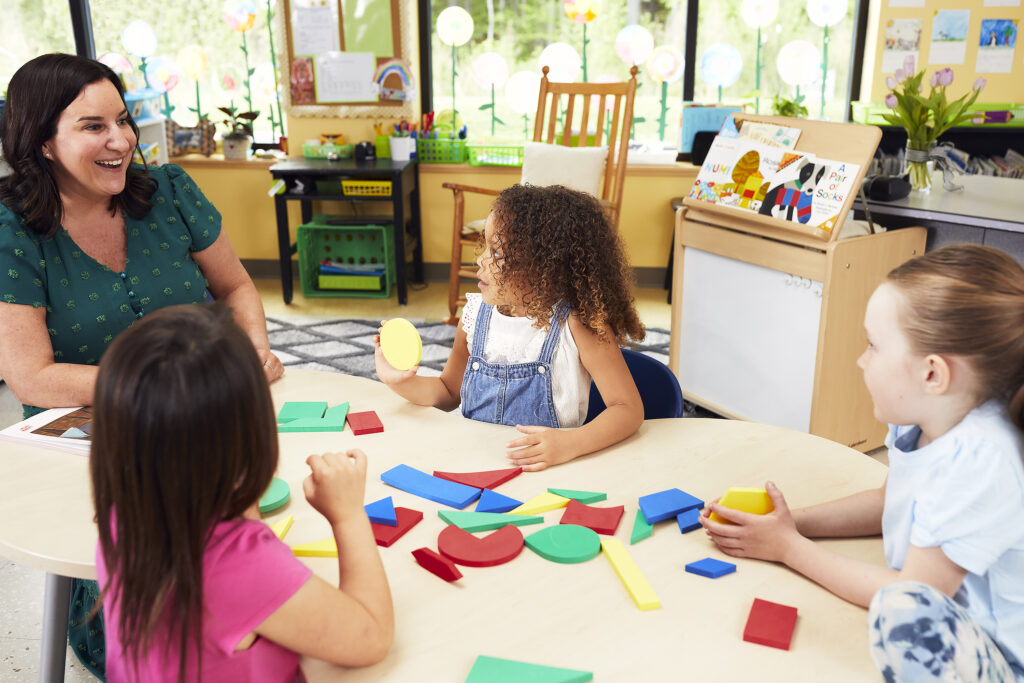
Students and their teacher use shapes as part of a math class.
Courtesy: Great Minds
As routines for the new school year get underway, many parents are looking forward to getting to know their child’s teacher and finding out what reading and writing assignments will be coming home. They may be less excited about helping with math homework.
Research shows that most Americans experience math anxiety. However, in California, parents can breathe a little easier because of upcoming changes. A new math framework in our state is designed to help students and families feel less anxious about math, improve kids’ understanding of this critical subject, and spur much-needed gains in student achievement.
The latest Nation’s Report Card results out this month show that only 1 in 5 U.S. high school seniors are proficient in math. State-level data show about a third of California fourth graders are working at the proficient level on the Nation’s Report Card in math.
The new California math framework will guide the adoption of curriculum and instructional approaches. But education leaders need to help parents understand that things will look different from what they may have seen or remember from their own school days.
I’ve been helping school districts in California and other states move toward these newer, research-based approaches to math instruction. Questions I’ve heard from parents include, “Why are my kids playing with toys and drawing in math class?” and “Why are they talking so much?”
Schools need to be prepared to answer these questions.
First, when asked about those “toys,” I explain that while they might take the form of blocks, tiles or dice, they’re not there for playtime. We now know that children develop a deeper understanding when educators use concrete objects to teach math concepts such as place value. Parents should look for these, particularly in the early grades. If they’re missing from the classroom, moms, dads and caregivers should ask why.
As for those drawings, teachers are increasingly showing students how to represent a math problem through hand-drawn mathematical models. For example, a child might draw a tape diagram, which is a rectangular bar that looks like a piece of tape divided into sections to show parts of a whole, to help them solve a word problem. Using multiple methods, in addition to traditional procedures, like algorithms and equations, helps kids become flexible thinkers, ensuring they don’t get stuck as they encounter harder math.
I have to laugh when parents ask about the decibel level in math class. Many of us remember quiet classrooms where kids sat in rows and practiced equations silently, on their own. Today, we know there is value in having kids work collaboratively and share their thinking.
Some parents may wonder how they’ll get up to speed on these new approaches. Fortunately, the new framework emphasizes the importance of engaging families. Suggestions for schools include holding “math nights” and choosing instructional resources that include math activities families can practice at home.
I have a 2-year-old. Even at her age, kids have an intuitive grasp of mathematical ideas like counting objects, sharing equally and comparing sizes. To encourage that, I sometimes break a banana into several pieces and ask which pieces are the same and which are bigger. Coco doesn’t know we’re building her understanding of fractions and ratios, but we are. We also look for shapes in everyday objects, which is a great way to practice geometric thinking.
Soon my daughter will be learning in a Newport-Mesa transitional kindergarten (TK) classroom. I’m glad she’ll be learning math in these new ways, aligned to the California framework. Districts that are early adopters of some of the recommended approaches are already seeing progress. For example, Beaumont Unified has tried to align its instruction with the framework and is reporting strong academic gains.
As parents, we don’t all need to be math experts. We just need to stay curious, stay involved, and trust that learning alongside our children is good enough. When schools and families partner, we can build a generation that not only understands math, but finds purpose, meaning and joy in it. That’s the kind of education that will shape a brighter future for all.
•••
Erica Huang lives with her family in Costa Mesa. A former teacher, school leader and instructional coach, she now supports schools in implementing high-quality instructional materials.
The opinions expressed in this commentary represent those of the author. EdSource welcomes commentaries representing diverse points of view. If you would like to submit a commentary, please review our guidelines and contact us.