Navigating college as an intellectually disabled student journalist
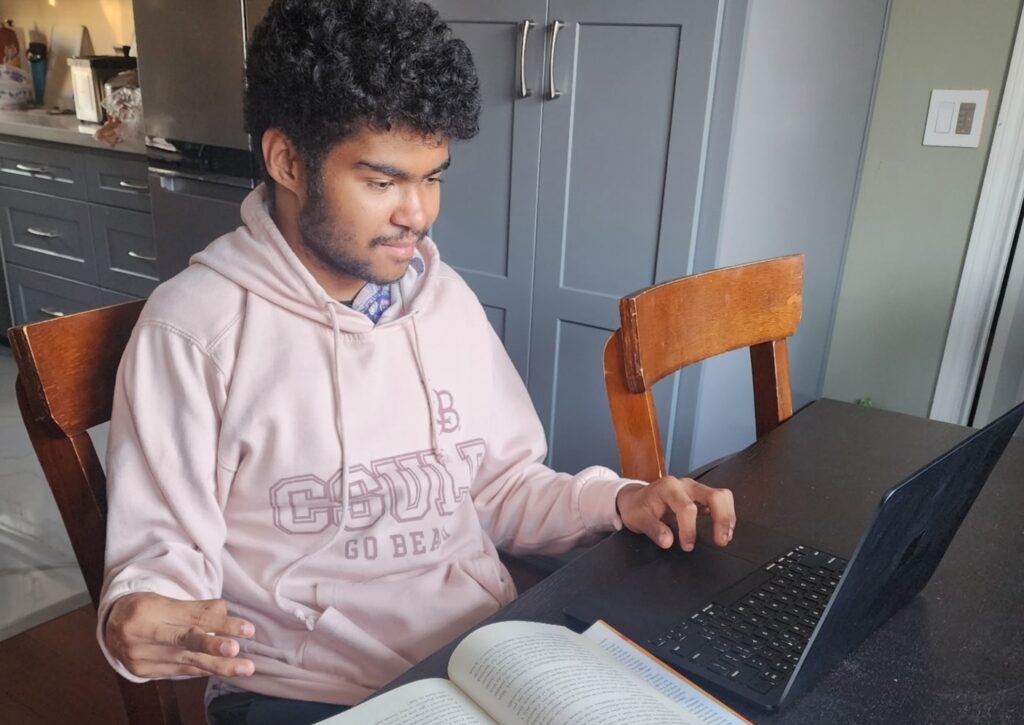
Jason Green
Courtesy of Jason Green
Recently, I was reading an article about the Vietnam War for a class, but I could not comprehend it easily like my peers. I read it again, but I still don’t understand the article. After several more attempts at rereading it, I am completely lost. This is not an isolated incident; it is my everyday life as someone with an intellectual disability.
I was born with a rare brain malformation called agenesis of the corpus callosum, which is the absence or partial absence of the part of the brain that allows communication between the left and right hemispheres. This, in turn, is the cause of my intellectual disability, making even the seemingly easiest task difficult. To add another hardship in my life, I was born with cerebral palsy, which primarily limits the mobility of the right side of my body. However, cerebral palsy is not the one that hinders my academic success.
More than 1 in 4 people in the United States have a disability, according to the Centers for Disease Control and Prevention.
I was not astonished to see that the most up-to-date data show only 20.5% of undergraduate students reported having a disability in the 2019-20 academic year.
Why?
Those with disabilities typically have to work three times harder to achieve things that usually require less strenuous effort. Too often, there is also shame that comes with having a disability, so one may not bother disclosing their condition.
I feel privileged to be in college, representing my community with this disability. I am proud of my achievements so far: making it to my senior year studying journalism at Long Beach State and being a member of the California Student Journalism Corps for EdSource.
But the journey is exhausting.
My classmates could probably write an essay in a couple of hours, while it takes me the entire day to complete it. Unironically, I feel slow.
Math? I would be the most unreliable data journalist. Working with numbers has been my greatest enemy since I started learning math. I do not hate math; I just do not understand it.
During my time in community college, I remember taking a mandatory math class. I dreaded this class. Although if I did not pass it, I would not be writing this commentary today. The class felt insurmountable. It took me five hours to complete one assignment when my professor told me it should have taken only one. The special education programs in high school, unfortunately, did not prepare me for this.
The class was finite math, which is not rigorous compared to other kinds of math classes. Every time I had to take an exam, I doubted myself; however, I passed every exam. Half of the class had dropped out by the end of the semester, but I passed with a C. This C was my A.
As a student journalist, every time I write, every word I write is daunting work. I cannot afford mistakes; accuracy is a must. However, my disability gives me the tendency to make mistakes and be inaccurate.
The problem is not that I don’t work hard enough; it’s that I become overwhelmed by usual expectations.
Interviewing sources for the Long Beach Current feels like talking to someone when just waking up. I forget my words; I am trying to remember my questions while also remembering to have follow-up questions. It is like reading a novel while running a marathon.
Interviewing, writing intensely and meeting deadlines are all standard in journalism, but if I cannot be on par with my fellow journalists, why am I pursuing journalism? Because I do not, similar to academia, see any journalists with an intellectual disability like mine. I want to show that disabled people can bring excellence to this field. Not just passion, but quality work.
One way I adapt to this field is by using an AI transcriber called Genio to take notes when I do interviews because I cannot write while asking questions. Having this resource helps me keep up with other journalists.
When I have urgent deadlines, I give myself time to prepare mentally, not to panic and take breaks in between writing, because I get mentally tired faster than the average person. I still meet my deadlines.
My intellectual disability is an emblem of tenacity and hard work.
My passion for disability goes beyond myself. I went to Washington, D.C., in July to rally near the U.S. Capitol for Medicaid, food stamps and independent living programs. I feel obligated because I experience a disability every day. There has never been a time when I was not disabled.
I want to live and push barriers.
I might as well help others along the way.
•••
Jason Green is a senior majoring in journalism at California State University, Long Beach, and a member of the EdSource California Student Journalism Corps.
The opinions expressed in this commentary represent those of the author. EdSource welcomes commentaries representing diverse points of view. If you would like to submit a commentary, please review our guidelines and contact us.