Mississippi FAFSA Deadlines and State Aid Programs: 2026 Guide
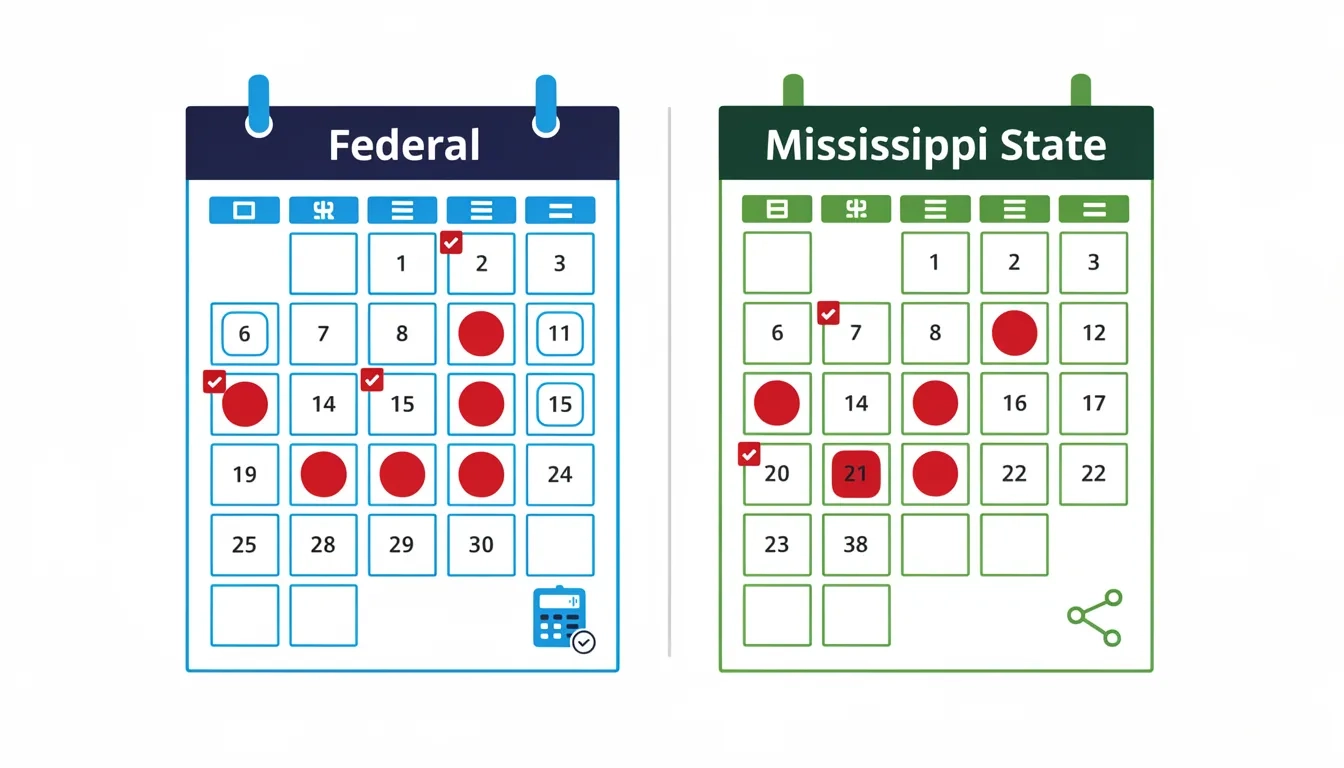
Mississippi students face a staggered deadline calendar that trips families up every year. The HELP Grant — the state's most generous need-based program — closes its application window in March, a full three months before the federal FAFSA deadline in June. Miss that spring cutoff and there is no appeals process, no grace period, no sympathetic extension. State law is explicit: deadline dates are firm, and no exceptions are made for any reason.
Two Calendars, One Very Unforgiving System
The most important thing to understand about Mississippi financial aid in 2026: the state runs on its own timeline, and it does not sync neatly with the federal one.
Federal aid — Pell Grants, Stafford Loans, Work-Study — flows through the FAFSA, which families can submit starting in late 2025 for the 2026-27 year, with a federal cutoff of June 30, 2026. Mississippi's state programs follow an entirely different schedule. Some windows close months before that federal deadline.
The second critical point: Mississippi uses its own portal called the MAAPP (Mississippi Aid Application), available at msfinancialaid.org. Filing the FAFSA alone won't get you a single state dollar. You have to submit the MAAPP separately, on its own schedule.
| Program | MAAPP Application Deadline | Supporting Docs Deadline | Requires FAFSA? |
|---|---|---|---|
| HELP Grant | March 31, 2026 | April 30, 2026 | Yes |
| MTAG | September 15, 2026 | October 15, 2026 | No |
| MESG | September 15, 2026 | October 15, 2026 | No |
| FAITH Scholarship | September 15, 2026 | October 15, 2026 | Yes |
The HELP Grant is where families get blindsided. Most people don't start thinking about financial aid for fall until April — and by then that window has been shut for weeks.
The HELP Grant: Mississippi's Need-Based Workhorse
HELP (Higher Education Legislative Plan) is the most powerful grant in the Mississippi system for students who qualify. It covers tuition and required fees in full at public institutions, and pays the average public-university rate for students attending qualifying private colleges in-state. For a full-time student at Mississippi State or the University of Southern Mississippi, that's serious money.
But HELP isn't for everyone. The eligibility requirements are specific:
- Mississippi resident for at least one year before enrollment
- Minimum 2.5 high school GPA
- At least a 20 ACT score (superscores are accepted, meaning your best sub-scores across multiple test dates can be combined)
- Completed the IHL Core Curriculum, Mississippi's required high school course sequence
- FAFSA-submitted and Pell Grant eligible, meaning household income must fall within federal financial need guidelines
That last bullet is the one people miss. HELP is means-tested. A student with a 25 ACT and a solid GPA from a high-income family will not qualify, regardless of academic record. The grant was designed specifically for academically prepared Mississippians who genuinely can't cover tuition without help.
The application process is two-step: submit the MAAPP by March 31, 2026, then get all supporting documents (including FAFSA confirmation and official transcripts) in by April 30, 2026. Both are hard stops.
HELP covers up to 8 semesters (or 12 trimesters), so a student who maintains full-time enrollment and a 2.5 GPA can ride it through a complete four-year degree. That longevity is what makes it worth treating as your highest-priority application task in late winter.
MTAG and MESG: Merit Money Without the Income Test
Mississippi's two merit-based grants don't care what your parents earn. MTAG (Mississippi Tuition Assistance Grant) and MESG (Mississippi Eminent Scholars Grant) are pure academic awards — which makes them accessible to middle-income families who earn too much for HELP but still feel the weight of tuition bills.
MTAG: The Entry-Level Merit Grant
MTAG targets solid academic performers with a lower bar than MESG:
- 2.5 cumulative GPA
- 15 or higher ACT score (superscores accepted)
- Mississippi resident for at least one year
- Not fully Pell Grant eligible (students who qualify for full federal Pell are excluded from MTAG)
The award starts modest: up to $500 per year for freshmen and sophomores, climbing to up to $1,000 per year for juniors and seniors. That won't cover housing, but it offsets a semester of textbooks or lab fees. Students who qualify for both MTAG and MESG automatically receive the higher amount.
MESG: For High Achievers
MESG sets a noticeably higher bar:
- 3.5 cumulative GPA
- 29 or higher ACT score (or SAT equivalent), OR National Merit or Achievement Finalist/Semi-Finalist status
The award: up to $2,500 per year, capped at the student's actual tuition and required fees. Both MTAG and MESG share the same September 15 application deadline and October 15 supporting document deadline — significantly more forgiving than HELP's spring cutoff.
The FAITH Scholarship: Closing the Gap for Former Foster Youth
FAITH (Fostering Access and Inspiring True Hope) is the most expansive program in dollar terms, and the least talked about. Named after State Representative Bill Kinkade, the scholarship covers a student's total cost of attendance after all other grant aid is applied. That means tuition, fees, housing, and books can all be addressed once other grants are subtracted.
The target population is specific. Applicants must:
- Be under 25 years old as of October 1 of the aid year (military service can extend this)
- Be enrolled at least part-time (6 or more credit hours) at a Mississippi postsecondary institution
- Have been in state custody, qualified residential childcare, or adoption after age 13
- Apply for an Educational and Training Voucher (ETV) if eligible
- Submit both the MAAPP by September 15 and a completed FAFSA
Unlike HELP, FAITH has no ACT score threshold for initial eligibility. You need a 2.0 cumulative GPA to maintain it, not to earn it. The bar is deliberately accessible — this program exists precisely because many foster youth enter college without the test prep opportunities other students take for granted.
If you know a young adult who aged out of the foster system in Mississippi, tell them about FAITH. Most of the people who should be receiving this scholarship have never heard of it.
The MAAPP: Gateway to Everything State
Every Mississippi state grant flows through one portal: the MAAPP at msfinancialaid.org. There's no workaround and no institutional shortcut. Schools cannot apply on your behalf.
A few things about the MAAPP process worth knowing before you start:
- You must open a new application each academic year — awards do not roll over automatically
- For HELP and FAITH, the FAFSA must be submitted first so the MAAPP can pull your federal eligibility data
- Document submission (official transcripts, ACT score reports) has a separate deadline that runs roughly 30 days after the application cutoff
- Homeschooled students have specific documentation requirements that differ from standard transcripts
Deadline dates are firm and required by state law. No exceptions are made to the application deadline for any reason. — Mississippi Office of State Financial Aid
One thing the system actually does well: if you qualify for multiple grants, you receive the higher award automatically. No need to choose between MTAG and MESG or submit separate preferences.
How to Sequence Your Applications
Starting in the wrong order costs you eligibility. Here's the sequence that captures every available dollar:
- October–December 2025 — Submit the 2026-27 FAFSA as early as possible. Earlier submission means earlier processing for income verification, which HELP depends on.
- January–March 2026 — Complete the MAAPP for the HELP Grant. Submit by March 31, 2026, even if your supporting documents aren't assembled yet.
- By April 30, 2026 — Submit all HELP supporting documents: official transcripts, FAFSA confirmation, ACT scores.
- By September 15, 2026 — Complete the MAAPP for MTAG, MESG, or FAITH. This also covers returning students renewing existing awards.
- By October 15, 2026 — Submit all supporting documents for MTAG, MESG, or FAITH applications.
Students who build this timeline into a calendar in October and revisit it monthly are the ones who actually capture all available state funding. Students who file the FAFSA in April and assume the rest handles itself routinely leave thousands on the table.
Common Mistakes That Cost Real Money
The biggest mistake: treating the FAFSA as the finish line. It's just the starting point for federal aid. State aid is a separate layer with its own form, its own portal, and its own deadlines.
Other patterns that cost students money:
- Assuming the school handles state aid applications. Colleges can guide you, but the MAAPP application is your responsibility.
- Waiting until summer to think about spring enrollment aid. HELP closed in March. By July, that window has been shut for four months.
- Missing the document deadline after submitting on time. Many students submit the MAAPP correctly, then scramble for official transcripts and miss the October 15 cutoff. Both pieces are required — application and documents.
- Not checking superscore policies. Mississippi accepts ACT superscores for HELP, MTAG, and MESG, but the scores must be officially reported through ACT, not self-reported on the application.
A student who qualifies for MESG ($2,500/year), the HELP Grant (full tuition), and federal Pell can realistically receive $23,847 or more in total annual aid at a mid-cost public institution when all three programs are stacked properly. That kind of outcome requires hitting every deadline in sequence, starting in October.
Bottom Line
- HELP Grant applicants face the tightest calendar — MAAPP by March 31, supporting documents by April 30. Put both dates in your phone right now.
- The FAFSA is required for HELP and FAITH but not for MTAG or MESG. File it early anyway — earlier processing helps with everything.
- All state grants route through the MAAPP at msfinancialaid.org. Filing the FAFSA alone leaves state money unclaimed.
- The FAITH Scholarship covers the most ground and has the lowest academic bar — if it applies to your situation, it should be the first call you make.
- Fall-semester aid planning should start the previous October. March is already late for HELP. April is too late.
Frequently Asked Questions
Can I receive both the HELP Grant and MTAG or MESG simultaneously?
Not exactly. Mississippi awards the single highest grant you qualify for among the state programs, not multiples stacked together. If you qualify for HELP and MESG, you receive HELP because it covers more ground. FAITH is different — it calculates as the gap remaining after all other aid, including state grants, is subtracted from your cost of attendance.
What is the MAAPP and how is it different from the FAFSA?
They are completely separate applications. The FAFSA (submitted at studentaid.gov) is the federal application that determines Pell Grant eligibility and federal loan access. The MAAPP (submitted at msfinancialaid.org) is Mississippi's state application, required for every Mississippi grant program covered here. You need both, filed separately, on different deadlines.
Does Mississippi accept ACT superscores for its grant programs?
Yes. HELP, MTAG, and MESG all explicitly accept ACT superscores — meaning the highest sub-scores from separate test dates can be combined into a composite equivalent. The catch: scores must be officially submitted through ACT to the MAAPP portal, not self-reported. If your superscore composite hits 20 for HELP or 29 for MESG, make sure official score reports back that up.
I missed the HELP Grant deadline. Is there any appeal process?
No. State law prohibits exceptions to application deadlines, and the Mississippi Office of State Financial Aid enforces this without exceptions. If the March 31 HELP deadline passed without your application, you'll need to reapply the following academic year. You may still be eligible for MTAG, MESG, or FAITH through the September 15 deadline if you meet those criteria.
What GPA is required to maintain state aid after the first year?
Maintenance requirements vary by program. HELP and MTAG require passing at least 12 credit hours per semester and maintaining a 2.5 cumulative GPA. MESG requires the 3.5 GPA used for initial eligibility. FAITH requires a 2.0 cumulative GPA. Falling below these thresholds can trigger suspension of the award until the requirement is met.
Is the FAITH Scholarship only available at four-year universities?
No. FAITH covers enrollment at any Mississippi postsecondary institution — including community colleges, technical schools, and certificate programs — as long as the student carries at least 6 credit hours. This makes it one of the few state programs that genuinely reaches students pursuing workforce credentials, not just traditional bachelor's degrees.
Sources
- Get2College — Mississippi Aid Programs Overview
- Mississippi College — Financial Aid Application Deadlines
- Mississippi Office of State Financial Aid — Frequently Asked Questions
- Fastweb — 2026-27 Financial Aid and FAFSA State Deadlines
- Cornell LII — FAITH Scholarship Rules and Regulations (10 Miss. Code R. 623-1.1)