Math crisis began a decade ago and has only worsened, report says
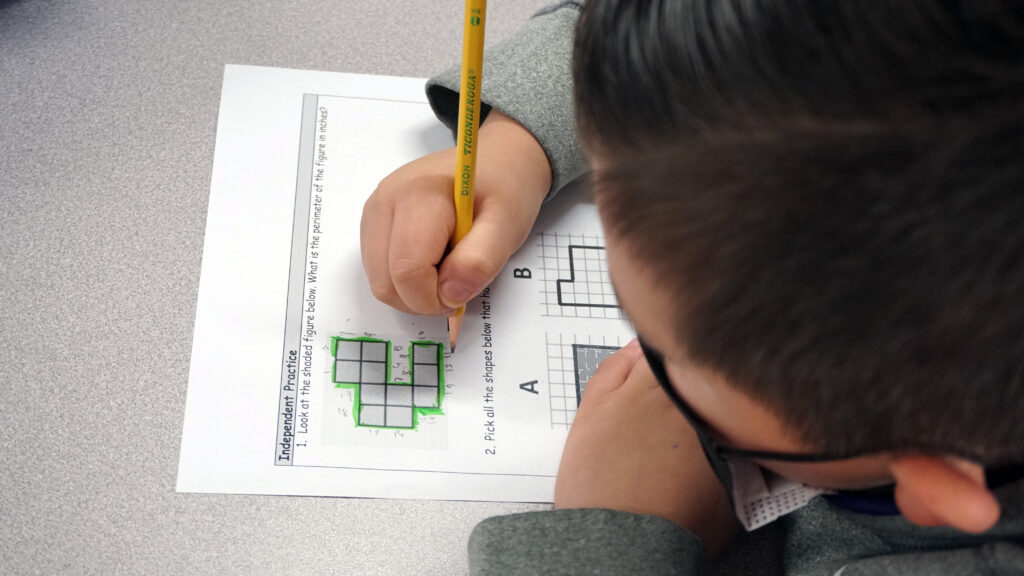
Credit: Andrew Reed / EdSource
Este artículo está disponible en español. Léelo en español.
Top Takeaways
- Eighth grade scores were improving until 2013, before stagnating, then falling in the wake of the pandemic.
- The Trump administration has ceded its authority to states on how to address sliding math scores.
- A new report says improving American math scores is complex but fixable.
American students are experiencing a math crisis marked by a decline in scores that began over a decade ago and rapidly accelerated in the wake of the pandemic.
Almost 4 in 10 eighth graders scored below basic in math on the Nation’s Report Card, leading to the lowest scores since the test began in the early 2000s. The gap between high-performing and low-performing students is higher than ever. Students who saw strong gains in math since the early 2000s — girls, low-income students, Black and Latino students, students with disabilities, and English learners — have seen their stunning progress erased.
This “alarming” problem does not seem to be on the radar of the second Trump administration, amid dramatic changes to the U.S. Department of Education, said Robin Lake, director of the Center on Reinventing Public Education, a research institute based at Arizona State University.
“A plan and a vision for solutions is not clearly happening,” said Lake. “And so we think this is a great opportunity to think about what states and districts could be doing right now.”
A new report released by the Center on Reinventing Public Education, or CRPE, on Tuesday calls attention to this topic, which Lake says has received much less attention than the national debate over how to teach reading. The report, based mostly on other preexisting research and data, says this is a complex but solvable crisis, since math performance tends to be highly responsive to what happens inside school walls — unlike other subjects such as reading.
Math is ruthlessly cumulative, the report says, where gaps in early years tend to compound years later, particularly for students from disadvantaged backgrounds. Emotions — especially anxiety — can run high among both teachers and students. Those who struggle may feel — or be made to feel by educators — that they have a fundamental weakness in math that cannot be addressed.
“My previous teachers, they weren’t exactly nice about the fact that I really, really struggle with math, and that made me struggle more at it, because I felt like if I messed up, then I would get scolded,” said an unnamed girl from California who was interviewed as a part of the Math Narrative Project conducted by independent public opinion research firm Goodwin Simon Strategic Research.
But math is an important subject that provides students with the foundation they need to be globally competitive for “jobs of the future,” Lake said, and also just to function in the modern world. American eighth graders are ranked behind 19 countries in math, including Korea, Ireland, Hungary and Malta.
The report lays out what it sees as the causes of the crisis. Some are short term, such as the pandemic, weakened expectations for students and a dwindling supply of qualified math teachers. Other causes are long term, such as the ideological math wars and the rigidity of the way students are advanced through different levels of math.
The report declares that a truce is necessary in the so-called math wars. Traditionalists emphasize math facts and direct instruction of procedures, while progressives focus on conceptual understanding and real-world problem-solving. Neither is wrong, the report’s authors say.
“Both sides have an element of truth, but also both sides tend to distort and discount any elements from the other side that actually would make up an effective balanced approach is what we’ve seen,” said Chelsea Waite, senior researcher at the center.
California underwent its own state-level version of math wars when it rewrote the most recent California Mathematics Framework, which districts are encouraged but not required to follow.
One of the most controversial points in the debate over the framework was how to fairly but equitably place students in math. Students are often placed on advanced, basic or remedial tracks at a young age, but schools pushing back on the inequities of tracking have debated whether everyone — or no one — should be pushed into eighth grade algebra. This is a fraught question since the level of math a student takes in middle school affects their opportunities in high school and college.
The report says schools should avoid this kind of high-stakes tracking of students. Real-time data can find students who need intervention before falling behind or who are ready to accelerate and should be advanced, Waite said. She said Alabama, one of the bright spots in the report, where students have made gains, used data to target interventions.
Having skilled teachers is key to learning, and students attending high-needs, high-poverty schools tend to have newer, less experienced teachers, or worse, an unfilled vacancy filled by substitute teachers.
“We just don’t have a teacher, and we just keep having subs. We literally teach ourselves,” said an unnamed Latino female student in California, according to the Math Narrative Project.
The number of credentials fell sharply in the wake of the pandemic, but there were signs of improvement this year. There tends to be a shortage of teachers credentialed in math, as well as science and special education.
The public doesn’t seem to be aware of how dire the crisis is. Schools are giving students inflated grades in the wake of the pandemic, but states are not doing a good job giving parents a reality check, the report said.
“States are obscuring the problem that students are experiencing,” Waite said.
The California School Dashboard earned a D grade for its transparency in a previous report by the Center on Reinventing Public Education.
Turning the tide on math performance will require bold goals and strong investments from states and strong public support, Lake said.
“Community organization, community action is gonna be important, and we all have an important role to play in making sure that we can get moving on this,” she said.