LAUSD’s charter wars: More than meets eye
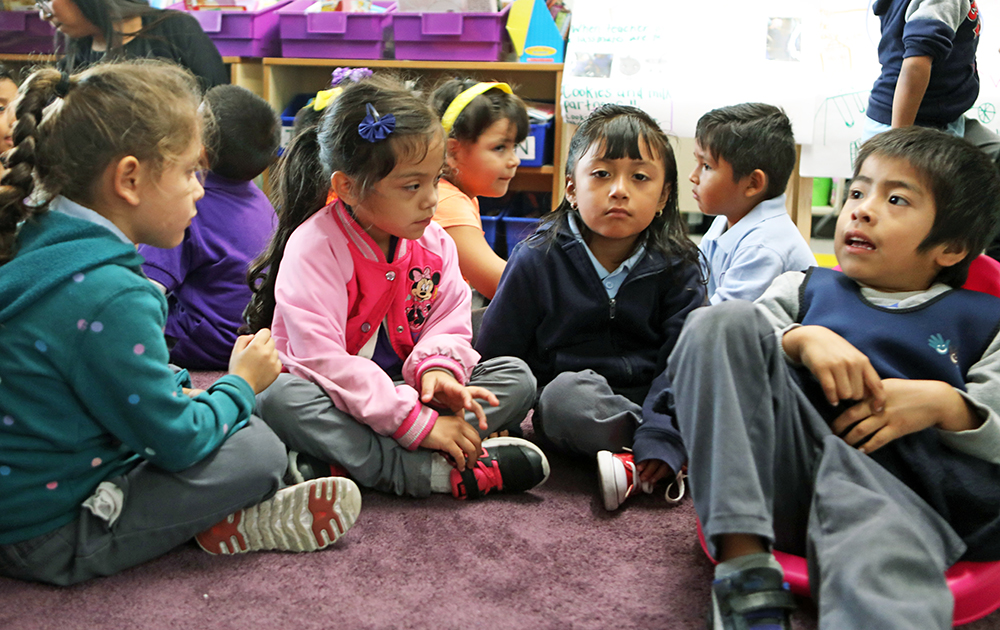
Kindergarten students at Aspire Inskeep Academy in South Los Angeles gather in groups during a reading lesson.
CREDIT: FERMIN LEAL/EDSOURCE TODAY
An LA County judge recently ruled that the LA Unified school board (LAUSD) violated state law by excluding independent charter schools from buildings with special programs, making about a third of the district’s schools off-limits to charters.
The district’s claim to need the space is ironic. Charter schools were established two decades ago partly as a way to find new classroom spaces to ease LAUSD’s overcrowding. Losing almost half its enrollment since then makes the argument that charters’ co-location will crowd out important programs ring a bit hollow.
I have conducted research on and interviewed participants in the Great LA Charter School War for more than 10 years. My work culminated in a book called “Race/Class Conflict and Urban Financial Threat,” which examines forces driving policy disputes in American cities. What struck me most forcefully about school politics in Los Angeles is not fights over control of space but the deeper issue of the wasted time, energy, resources and dedication that characterizes this war.
Civilians — district residents — are mostly uninvolved. One child might attend a charter school while their sibling attends a traditional public school; both students might switch to the other type of school as they get older. Parents care about the quality of their child’s teacher and transportation to school, not about governance structure.
But the combatants are different.
UTLA (United Teachers of Los Angeles) portrays independent charter schools as corporate raiders privatizing, commodifying and seeking to destroy our sacred public education system. It wants them to be constrained or eliminated — hence rules to minimize co-location.
Critics paint LAUSD and the teachers union as bloated bureaucracies that cannot innovate, invite polarizing controversy, and are concerned about job security, salaries, and benefits more than student outcomes. Advocates want charter schools to be able to grow — hence the legal challenge to rules about co-location.
Why such vitriol? For decades, Los Angeles’ educators struggled over desegregation, equitable funding, inadequate student achievement. But, as I learned, the more recent charter school conflict isn’t about race, class, teaching philosophies, or even educational outcomes. It’s about money.
Numbers tell the story.
LAUSD enrollment has fallen from roughly 740,000 in 2002-20 to a little over 400,000 in 2024-25, and it is expected to decline more. But over the same period, teacher and staff salaries have rightfully increased, pension obligations have grown, and fixed costs remain. Incoming money is declining; outgoing money is rising. In 2023, FitchRatings downgraded LAUSD, warning of “future structural budgetary imbalances” requiring “ongoing policy adjustments.” As political scientist Christopher Berry told The Economist, “Places that shrink are screwed.”
But about 110,000 additional students remain within the district — attending independent charter schools. They carry with them some of those dollars lost to mainstream schools, since California provides the same baseline funding for all public school students. LAUSD wants those 110,000 resource-bearing students back, while charter schools cherish their semi-independence and seek to attract even more traditional school students.
What makes this conflict particularly tragic is how similar these adversaries are. Almost four-fifths of traditional LAUSD students are Latino, and 85% are socioeconomically disadvantaged. Almost four-fifths of independent charter school students are Latino, and 80%t are socioeconomically disadvantaged. The two systems also have similar proportions of English learners and students with disabilities.
Just as important, they have almost identical commitments around education. UTLA pledges to overcome “the deep equity and justice challenges arising from our profoundly racist, intensely unequal society,” while independent charter schools, as one of my interview subjects put it, “come at the question of ‘how you improve education’ “ in terms of “racial justice — [how do you] open up access, ensure equity?”
These battles, exemplifying what some people call the narcissism of small differences, are extraordinarily expensive. Recent school board elections, in which barely one-tenth of eligible voters participated, saw $15 million to $18 million dollars in campaign spending for a few seats. (Most U.S. school board races operate with four-figure budgets.)
Unlike the usual contention around schooling in big American cities, knowledgeable Angelenos in more than 40 interviews insisted that “the race conversation, and frankly the class conversation, has not been a huge part of the reform conversation here. It’s about money.” With enrollment declines, the looming prospect of school closures pains communities; no one wants to contemplate teacher and staff layoffs, larger and more straitened classes, or pension squeezes. So they argue instead about co-location, conditions for chartering a new school, or other tangential concerns.
What can be done?
Solutions are possible— increased state funding, disciplined and shared decisions about deploying buildings and expertise, even coordination or division of labor around teaching strategies and content.
The Center on Reinventing Public Education identified school districts in which traditional and charter school teachers collaborated in developing online educational programs during the Covid shutdowns. Education professor Sarah Cordes has found that proximity can be beneficial: parents and students in traditional schools in New York City that were near to or co-located with charter schools engaged more with their school, developed higher expectations, and found their school to be cleaner and safer, compared with parents and students in schools farther from charters. Traditional school students near charters improved their performance in math and English.
LAUSD can do the same sorts of things.
•••
Jennifer L. Hochschild is a professor of public policy at the Harvard Kennedy School. She is the author of multiple books on race, class, immigration and justice, some of which examine these issues in the context of education.
The opinions expressed in this commentary represent those of the author. EdSource welcomes commentaries representing diverse points of view. If you would like to submit a commentary, please review our guidelines and contact us.