Landing my first internship was a lesson in perseverance
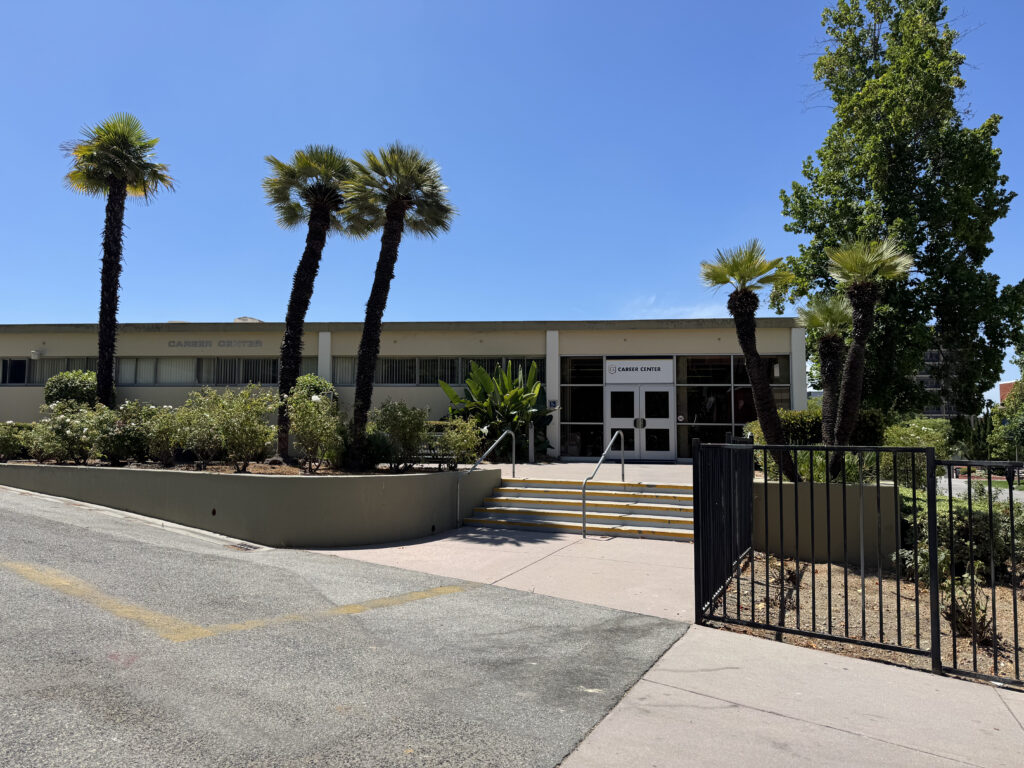
Career Center at CSU Los Angeles.
Queena Duong
When I started at Cal State Los Angeles four years ago as a first-generation college student, I knew nothing about getting an internship.
The seemingly endless work of sending out resumes, cover letters, letters of recommendation and various writing samples was something I had never encountered.
According to a 2023 alumni survey from the Cal State L.A. Institutional Effectiveness Office, 63% of undergraduate students didn’t complete internships. A 2023 Gallup poll stated that 30% of students did not obtain an internship due to the difficulty of getting one. For instance, 17% of students said that the internships required them to relocate, and they were unable to do so.
My email inbox used to be flooded with internship opportunities from the political science department chair, Taylor Dark. I would apply for these opportunities, but I disregarded them since I wanted to be paid for the work I would do.
However, many of the unpaid internships I saw on the career platform Handshake would require students to relocate to different cities in the state or Washington, D.C.
I applied for internships to work for Sen. Josh Hawley, R-Missouri, and Rep. Judy Chu, D-California, in D.C. in early February and March. I never received a response from either office, and the rejection stung deeply.
The Hechinger Report stated that internships are a coveted part of the college experience but are hard to obtain due to the limited supply and competition from around the country.
In my senior year of college, I learned that I was missing one elective course required to complete my journalism degree and graduate. When I looked at my Golden Eagle Territory portal to register, I couldn’t find a course to take since the class times didn’t align with my schedule.
I reached out to my journalism adviser, Julie Patel Liss, and she offered solutions. The first suggestion was to retake the community news class, but because I had already taken it twice to fulfill a previous elective requirement, that would not work.
She then suggested that I secure an internship and use the Television, Film, & Media Studies’ internship course as my upper-division journalism elective.
Thankfully, Liss connected me with editors from EdSource who were very enthusiastic, and after an interview, I was hopeful it would all work out.
Not long after, I received an email from the EdSource editor I had been speaking with: “I am very happy to say that each of you have made the grade and have been accepted into the Spring 2025 program of the California Student Journalism Corps.”
That meant I would have the internship I needed to graduate. I felt relieved, excited and overjoyed.
Before I knew it, I was assigned to a tough editor, who informed me that I had competed against 40 other interns. It wasn’t like college, where I could simply turn in stories for the sake of passing. We were given five stories to work on, and we could not give excuses for not being able to find sources. When I thought my piece was good, my editor would tear it to shreds during our weekly staff meetings.
This experience showed me that persistence is key in getting an internship, as well as the importance of asking professors for help, who often have contacts within the industries of interest. In the end, the internship provided me with a taste of the professional job market, and it proved to me that I have what it takes to handle the demanding tasks.
•••
Queena Duong is a fourth-year political science major and a journalism minor at California State University, Los Angeles. She is the digital editor for the school newspaper, University Times, and a member of EdSource’s California Student Journalism Corps.
The opinions expressed in this commentary represent those of the author. EdSource welcomes commentaries representing diverse points of view. If you would like to submit a commentary, please review our guidelines and contact us.