IDEA’s uncertain future: A call to protect student rights
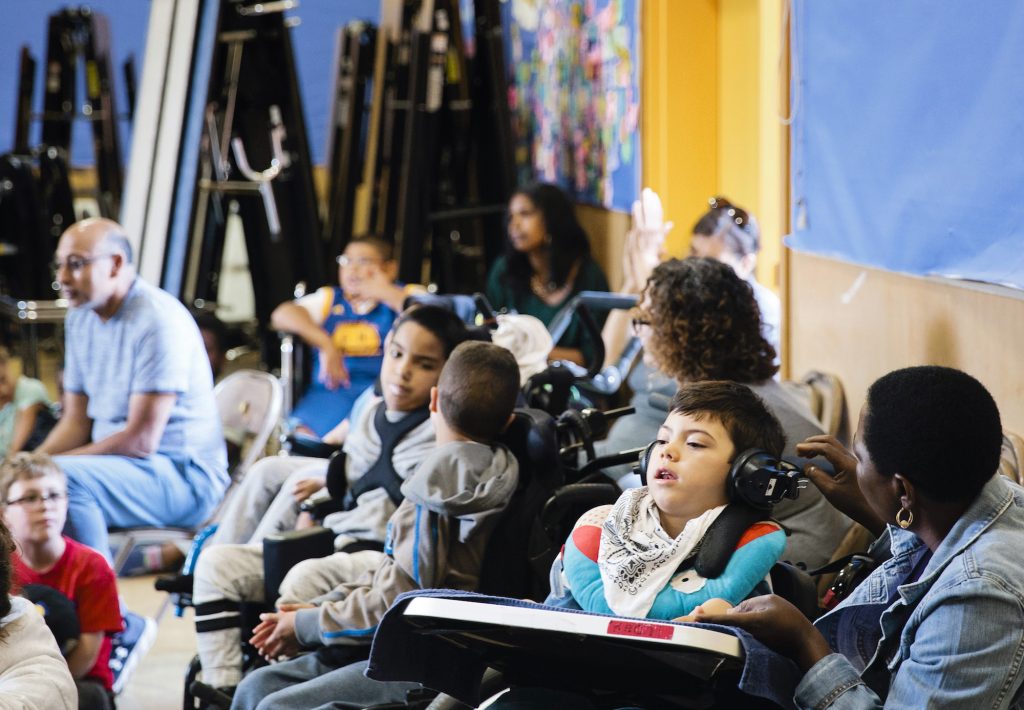
Credit: Alison Yin / EdSource (2017)
Students with disabilities are in the crosshairs of the attacks on public education. In light of the uncertain future of the Individuals with Disabilities Education Act (IDEA) — the federal law that serves and protects students with disabilities — parents, educators and policymakers must step up to safeguard protections for our most vulnerable students.
The law reaches 7.6 million children nationwide. Nearly 15% of all students age 3 to 21 received services through IDEA. It serves as a lifeline for an increasing number of students and their families.
IDEA originated in parental voice and a push for governmental accountability. Unlike most legislation, which is advanced by professional associations and lobbyists, it was driven by an organized, nonpartisan movement of parents of children with disabilities.
Their concerns were built into IDEA’s expectations so that their children’s civil rights and educational opportunities would be protected in every district and state.
When IDEA became law in 1975, the intent was for the federal government to cover 40% of the average per-pupil expenditure for special education. Instead, federal funding only covers approximately 14.7% of these costs, resulting in a financial shortfall estimated at $24 billion that states and school districts must cover. This is why some call it an unfunded mandate. It is also why the potential for fewer resources in the near future is so concerning.
Students’ rights and opportunities are currently protected under law, but it is unclear if that will continue.
The Trump administration’s 2026 budget plan calls for Congress to consolidate seven of IDEA’s grant programs into one allocation. There are no assurances that the services provided by these programs will be safeguarded. It also indicates that funding should not be provided to states and districts that “flout parental rights.”
Meanwhile, there may be other, more sweeping changes afoot. For example, Project 2025 urges the use of federal special education funding for private education alternatives that parents would choose.
There is also growing concern about what would happen if IDEA were reimagined as a block grant program. The narrative goes something like this: With block grants, the same level of funding would go to the states. Each state would make its own decisions on how best to use the funds. Without federal interference, the thinking goes, each state would do a better job of educating students with disabilities.
But the rhetoric on block grants is often different from what actually happens.
In practical terms, those who have decision-making power over federal funds are often reluctant to give it up. As a result, block grants to states and districts often come with strings attached or regulations. Further, when programs are consolidated into block grants, it characteristically results in reduced levels of funding overall.
With 50 states all having different levels of administrative capacity, protections for students with disabilities and their families would vary considerably.
There are human stories behind the numbers. Consider a few of the choices that lie ahead for educational leaders and parents:
- Where should limited resources be spent? Let’s say a local district has seen the percentage of students who qualify for special education double from 10 years ago. The district is now faced with deciding which regular programs to cut to cover the costs of special education services.
- Who receives tutoring? Mateo is a special education student in the fifth grade who is struggling with math. His parents requested an Individualized Education Program (IEP), and the IEP team decides the school should provide Mateo with additional one-on-one instruction. The district must meet Mateo’s needs by law but is already struggling financially. Thus, the tutor from the football team is assigned to Mateo. Consequently, 30 members of the football team have their tutoring reduced from three days per week to one.
A movement created IDEA, and safeguarding IDEA requires more than technocratic policy modifications. There is an urgent need to reconstitute that movement to protect the law; the uncertain future of IDEA is affecting both children’s lives and leadership decisions.
California can lead these efforts — starting at the statewide level and then advocating in coalition with other states. Parents, along with policymakers and practitioners, need to come together and engage in constructive dialogue around:
- Defining our expectations for meeting the needs of special education students. If the federal oversight role is going to change, states will need to be explicit in identifying the expectations of what services districts need to provide to their most vulnerable students and how they will be supported in doing so.
- Determining the funding model needed to ensure that special education students receive meaningful educational opportunities and have their civil rights protected under the law. Federal administration of IDEA has a 50-year track record of ensuring fairness in resource distribution and providing legal protections. If it is replaced by 50 different state versions of program administration, the states will then need to determine what changes in state funding formulas are needed for districts to meet federal program requirements under the law.
- Demonstrating the impact of IDEA and recapturing the policy narrative. It is time to recapture the ceded ground in terms of the public’s perception of the value of special education programs. Special education has had a markedly positive, long-term impact on students in such areas as academic gains for students with disabilities, student independence, life skills, and many others. Further, many parents access services such as speech and occupational therapy without realizing that they are part of IDEA. Communicating these impacts is key to recapturing the narrative.
- Helping district leaders avoid circumstances wherein different groups of parents are pitted against each other for resources. States, both individually and collectively, need to think through the policy requirements for ensuring that district budgets are adequate for meeting the needs of students with fairness and impact. If service reductions and staff layoffs are anticipated, districts need time to prepare and must know what state or other subsidies would be available.
These concerns cut to the core of how we will serve students with disabilities. We urgently need organized policy action to protect IDEA.
•••
William J. Slotnik is the founder and CEO emeritus of the Community Training and Assistance Center (CTAC) in Boston. CTAC is a national nonprofit that aims to drive and support educational innovation and community development.
Robert Pecot, Ed.D., is the superintendent of the Tracy Unified School District in Tracy, which serves about 16,000 students, and professor at Stanislaus State University and Reach University.
The opinions expressed in this commentary represent those of the authors. EdSource welcomes commentaries representing diverse points of view. If you would like to submit a commentary, please review our guidelines and contact us.