I felt like a fake Filipino until my ethnic studies courses helped me reconnect with my roots
Jenna Ramiscal, San Diego State student.
Christie Yeung
I have always felt like an impostor in the Filipino community.
At Seafood City, a Filipino grocery store, cashiers spoke to me in Tagalog, and I’d instantly freeze up. After a moment of silence, I had no choice but to awkwardly laugh and admit I couldn’t understand.
When my friends talked about teleseryes, Philippine television dramas, I had to explain that I couldn’t watch those shows because my parents didn’t want to pay for The Filipino Channel. And whenever people would ask me where my parents were from, I would embarrass myself by mispronouncing their hometowns of Pangasinan and Baclaran.
However, it’s not only my fault that the world doesn’t find me Filipino enough.
The truth is, my parents spoke little about their lives in the Philippines. My dad only spoke English at home and refused to teach me a word of Tagalog. Six-year-old me still tried to watch “Tagalog 101” videos on YouTube in an attempt to prove that I could learn the language.
However, my dad was quick to tell me that I was wasting my time — that learning his mother tongue wouldn’t benefit me. My parents firmly believed that leaving behind our cultural roots and assimilating into Western culture would set me up for success.
At some point, I grew tired of fighting back and accepted that ignoring my Filipino heritage was for the best.
But the desire to learn more about my Filipino heritage resurfaced when I took a required ethnic studies class at San Diego State University, ASIAN 102A, focusing on Asian American perspectives on politics and power.
Ethnic studies courses are meant to fulfill the ethnic studies requirement implemented across the 23 California State University campuses. According to the CSU’s website, every student must take an ethnic studies course about Native Americans, African Americans, Asian Americans or Latino Americans to earn a bachelor’s degree.
The California higher education system serves a student population that is 45% people of color, according to the Education Data Initiative. This amounts to nearly 9 million students of color — some who, like me, had never even heard of ethnic studies.
But none of those statistics were in my head the first day I walked into my ASIAN 102A class. There were around 70 students scattered in seats across the room, and unsurprisingly, the majority appeared to be of Asian heritage.
It soon became clear that the course wasn’t a typical history class centered on stories about westward expansion or Christopher Columbus. Instead, this class challenged my view of history, forcing me to think of power and politics from the perspectives of marginalized communities.
Lecture after lecture, I learned about Larry Itliong, the Delano Grape Strikes, the Watsonville Riots and the Tydings-McDuffie Act. I found myself understanding the movements, struggles and constant fight for justice led by Filipino immigrants. My professor called these instances of “resistance, survivance and thrivance.”
My professor insisted that everyone attend a cultural event to confront these concepts firsthand. I found an eskrima workshop held at the SDSU Asian Pacific Islander Desi American Resource Center. Eskrima, also known as arnis, is an indigenous martial art in the Philippines that uses sticks, knives and empty-handed techniques.
At the workshop, an SDSU alumna spoke about how she used eskrima as a way to reconnect with her Filipino roots. Eskrima was her way of fighting against erasure and finding a space where her Filipino identity could survive and thrive.
I realized I could be doing the same thing. Instead of erasing my own identity, I could explore and rediscover what it means to be Filipino.
That required ethnic studies class blossomed into a personal journey to explore the complexities of my roots, so much so that I have since declared a minor in Asian American Studies and joined the Asian American Journalists Association.
I’ve also gone against my dad’s wishes and taken two semesters of Filipino language classes.
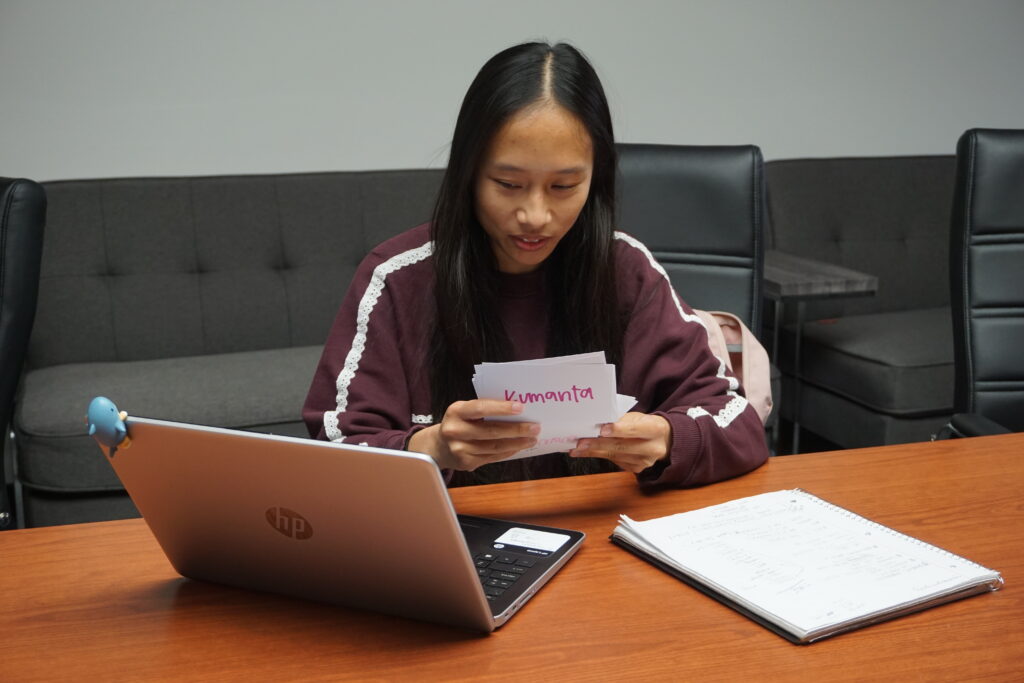
He initially told me that I’d regret it, but now he helps me review stacks of flashcards with Filipino vocabulary words scribbled on them.
I’m thankful that ethnic studies has helped me embrace my Filipino identity. But beyond that, it has made my college academic experience even richer, and I hope other students experience this type of cultural discovery.
Although the curriculum faces attacks from the Trump administration, I don’t see ethnic studies as “anti-American” or “radical indoctrination.” This field is meant to add a new layer to the voices that tell their stories — it allows students of color to see themselves reflected in the past, present and future.
It is because of ethnic studies that my 6-year-old self’s dreams of learning Tagalog with my dad have come true. With every new word and piece of history that I learn, I realize this is only the beginning of uncovering what my Filipino identity holds.
•••
Jenna Ramiscal is a student at San Diego State University majoring in journalism with a minor in Asian American Studies and a member of EdSource’s California Student Journalism Corps.
The opinions expressed in this commentary represent those of the author. EdSource welcomes commentaries representing diverse points of view. If you would like to submit a commentary, please review our guidelines and contact us.