How CSU can truly be a postsecondary engine for economic mobility
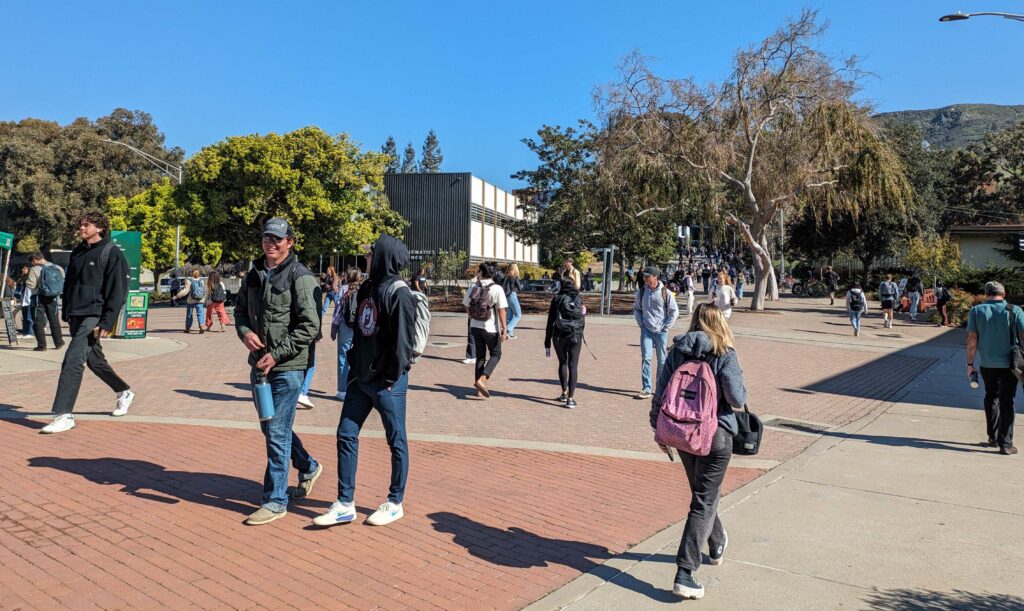
California Polytechnic State University, San Luis Obispo
Credit: Ashley Bolter / EdSource
Something’s got to change in postsecondary education, and the new strategic plan released this fall by California State University (CSU) Chancellor Mildred Garcia lays out an equity-driven approach that could move this vital public system in the right direction.
Even with its public trust shaken throughout the nation, postsecondary education remains the best opportunity for economic mobility. CSU’s new Student Success Framework properly lays out a vision of flexibility, inclusion, affordability and purpose, which will give today’s diverse learners much of what they need to succeed.
Still, CSU’s plan can’t be another 10-year cycle of well-intentioned initiatives. It has to be a moment of truth about what’s working — and what isn’t. That truth requires the California State University system to hold up a mirror and see itself as it actually is — not the idealized version it wants to project, not the UC it sometimes tries to emulate, but as the CSU that exists today serving the learners it was designed to serve. Only in this way can it become the CSU that California needs.
I talk to many people who want to start discussions about addressing gaps or flaws in postsecondary education with legislation, regulation or policy initiatives. But words are easy. Culture is the challenge. That’s the real work ahead for the CSU system. Because when we really look in the mirror, we must admit some hard truths.
First, there’s nothing “wrong” with the students CSU serves, so blaming their needs on their socio-economic status or age is unacceptable. The problem is how CSU views these learners, a large percentage of whom are working Californians. I hear it all the time: that CSU and community colleges serve the most “under-resourced” students, that low graduation rates are inevitable because students work or attend part time. But that’s just the story we tell ourselves to avoid changing the system.
CSU students are not broken. They are balancing school, work and family around the systems the state of California built. Learners don’t need to be fixed. Learning does.
The new Student Success Framework gets the fundamentals right: Every student should:
- Have clear, guided academic and career pathways.
- Experience inclusive, intentional teaching and advising.
- Have access to real-world learning and a streamlined digital experience.
These are powerful commitments that speak to today’s learners, including the more than 6 million Californians under 65 who have some college but no credential. The institutions that make education more personal, accessible, relevant and affordable for everyone — from the high school graduate to the parent who works full time to support a family — will be the ones learners choose.
Upcoming virtual roundtable | Dec. 11 at 12 p.m.
Is a college degree still the best path forward?
Many wonder whether college adequately prepares graduates for the workforce, with more people exploring alternatives like apprenticeships, certificate programs, and skills-based training.
Some question whether those with a college degree actually fare better than high school graduates who pursue other pathways.
This free virtual roundtable will explore what these shifts mean for California’s colleges and universities — some of the largest public systems in the world and long touted as powerful drivers of socioeconomic mobility.
Learn more and register
But to make this plan real and meet learners where they are, CSU must move beyond intention. Building data systems, fully embracing the state’s Cradle-to-Career effort, committing to scaling online learning, and increasing cultural awareness and public trust can prove that student success is more than a slogan.
The CSU was established with a clear mission: to provide affordable, high-quality education that drives economic mobility for working and middle-class Californians. That mission is not something to work around. It’s something to own, CSU, so own it.
The College Futures Foundation’s recent 4-Year California Mobility Index revealed that CSU really delivers on economic mobility, for the most part. In one measure, some campuses serve 80% Pell Grant-eligible students, like Cal State Los Angeles, while others serve just 18%, like Cal Poly San Luis Obispo. That showed that a commitment to mission is not embraced across the CSU system, which is something the system must change with its new framework.
What gives me hope are the learners themselves. They have more agency than ever, and know they have a choice. They’re clear about what they want: flexibility, relevance and value. They’re voting with their feet. They’ll go where their needs are met, with or without us.
And they want the chance. A September Gallup survey of Californians without a college degree revealed that while they overwhelmingly value a postsecondary degree or credential, many struggle to attain one due to the difficulties of balancing education with work or personal responsibilities.
If CSU wants to lead California into the future, it must earnestly lean into its promising new framework and finally build to serve the students of today, and stop relying on the outdated assumptions it keeps reverting to. That means listening, adapting and leaping beyond the status quo. The mirror doesn’t lie. The future of California’s learners, and the CSU itself, depends on having the courage to face that reflection and change from within.
•••
Eloy Ortiz Oakley is president and CEO of College Futures Foundation, whose mission is based on the belief in the power of postsecondary opportunity to advance economic mobility for underserved Californians.
EdSource receives funding from many foundations, including The College Futures Foundation. EdSource maintains sole editorial control over the content of its coverage.
The opinions expressed in this commentary represent those of the author. EdSource welcomes commentaries representing diverse points of view. If you would like to submit a commentary, please review our guidelines and contact us.