Grants for Nursing Students: The Programs Actually Worth Your Time
There's a strange dynamic in nursing school financial aid right now. The U.S. faces a documented, worsening shortage of registered nurses — the American Association of Colleges of Nursing (AACN) has flagged projected shortfalls in the hundreds of thousands by 2030 — and that shortage has turned nursing students into an asset worth funding. Federal agencies, state programs, and private organizations are actively competing to pay for your education. The catch, sometimes, is where you work afterward.
This guide cuts through the noise and focuses on what actually matters: where the real grant money is, what strings come attached, and how to position yourself to get it.
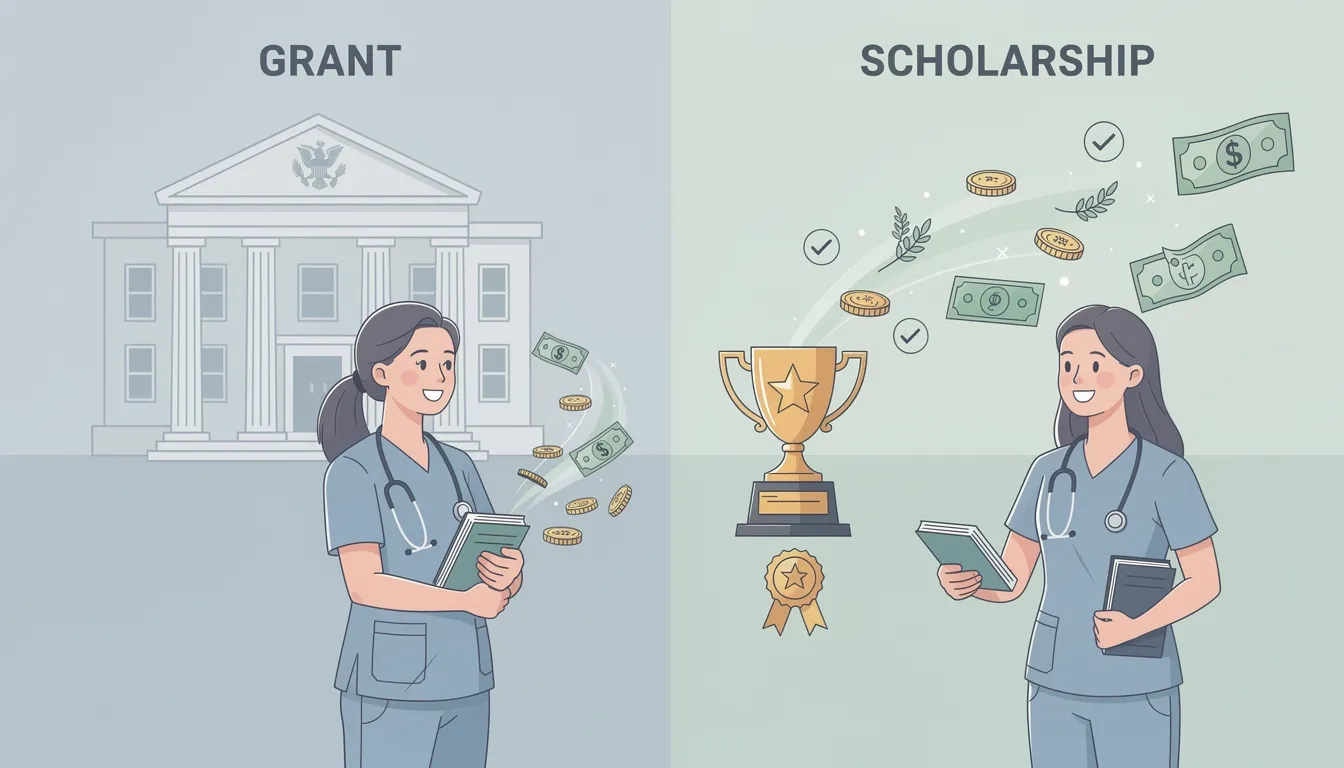
Grants vs. Scholarships: Why the Difference Actually Matters
Most students treat "grants" and "scholarships" as the same word. They're not — and understanding the distinction will change how you approach your search.
Scholarships are typically one-time or renewable awards based on merit, need, or identity (major, demographic group, school affiliation). No repayment, no service requirement.
Grants in nursing often come with a service obligation. You receive funding now; you work somewhere specific afterward. Miss the commitment and you may owe money back — sometimes at interest rates higher than a standard loan. The federal Nurse Corps Scholarship Program is the clearest example of this structure.
A nursing grant with a service obligation is not "free money." It's deferred compensation for work you haven't done yet. That's not a criticism — for many students it's an excellent deal. But go in with clear eyes.
Neither structure is inherently better. A $10,000 scholarship you can use anywhere beats a $40,000 grant that locks you into a rural facility you'd never choose otherwise. Know your situation before you apply.
Federal Programs: Where the Largest Awards Live
The Nurse Corps Scholarship Program
The biggest federal grant for nursing students is run by HRSA's Bureau of Health Workforce. The Nurse Corps Scholarship Program covers full tuition, required fees, other reasonable educational costs, and pays a monthly living stipend of $1,599 during the academic year. In exchange, you commit to working at a Critical Shortage Facility (CSF) — typically a health center in a medically underserved area — after graduation.
The service commitment scales with how many years of funding you receive. One or two years of funding means a two-year service obligation; three or more years means three years. The 2026-2027 application cycle opened in early 2026, with all applicants notified by September 30.
Eligibility is straightforward but firm:
- U.S. citizen, national, or lawful permanent resident
- Enrolled or accepted at an accredited U.S. nursing program
- Program must lead to an RN license (ADN, BSN, diploma) or a nurse practitioner credential
The program also covers accelerated BSN tracks, which is worth knowing because those students often have higher financial pressure from the compressed timeline.
The Nursing Workforce Diversity Program
Less talked about, but worth knowing: HRSA funds a separate program called the Nursing Workforce Diversity (NWD) Program. This one doesn't go directly to students — it goes to schools and nursing programs that then create scholarships, stipends, and supportive services for students from disadvantaged backgrounds, including racial and ethnic minorities underrepresented in nursing.
Hispanic or Latino individuals make up roughly 19% of the U.S. population but only 7% of registered nurses, according to a 2022 nursing workforce survey. The NWD program exists specifically to close gaps like that one. If your school has received NWD funding (ask your financial aid office directly), you may have access to awards that never get broadly advertised.
Department of Labor Nursing Expansion Grants
The Department of Labor has also run a Nursing Expansion Grant Program aimed at diversifying the nursing workforce through training opportunities for underrepresented and underserved communities. These grants flow to educational institutions and workforce development organizations, so again — ask your school whether they've received one and what student-facing funding it created.
State-Level Grants: Smaller Applicant Pools, Better Odds
State nursing grants are systematically underused because students don't think to look beyond federal and national programs. That's the opportunity.
California's Bachelor of Science Nursing Scholarship Program (BSNP) awards up to $10,000 per student in exchange for a 12-month service obligation. It's administered through the California Grants Portal and open to BSN students specifically — not associate degree or graduate programs.
Illinois runs a Nursing Education Scholarship (NES) through the Illinois Student Assistance Commission (ISAC). The 2025-26 awards are $9,117 for part-time students and $18,574 for full-time. The application deadline for the 2026-27 cycle was April 30, 2026. Unlike the federal Nurse Corps program, this one doesn't require rural or underserved placement — it simply asks that recipients practice nursing in Illinois after graduation.
The pattern here is consistent across states: trade money now for in-state practice afterward. Whether that's a good deal depends entirely on whether you planned to stay anyway.
| State Program | Max Award | Service Requirement | Degree Level |
|---|---|---|---|
| CA BSNP | $10,000 | 12 months in-state | BSN only |
| IL NES | $18,574 (full-time) | Practice in Illinois | ADN, BSN |
| Various state programs | Varies | Varies | ADN through MSN |
Check your state's higher education agency and health department. Most states with documented nursing shortages — which is most states — have some version of this program.
Professional Association Grants
The FNSNA: The Largest Student-Focused Nursing Fund
The Foundation of the National Student Nurses' Association (FNSNA) has been funding nursing students since 1969 and distributes more than $500,000 annually. Individual awards go up to $10,000 per academic year.
Eligibility requires current enrollment in a state-approved nursing program (ADN, BSN, diploma, direct-entry master's, LPN-to-RN, or RN-to-BSN completion tracks). No service obligation. Selection is based on academic achievement, financial need, and involvement in nursing student organizations and community health activities.
The 2026 application cycle closed January 9, 2026 — which tells you to mark September on your calendar for when the next cycle opens, since applications typically become available in fall for the following academic year.
NLN Nursing Education Scholarship Award
The National League for Nursing offers an $8,000 award for master's and doctoral nursing students who have completed at least one full year of their program. The hook: you're committing to a career in nursing education (faculty, not clinical practice). With a well-documented faculty shortage running parallel to the clinical shortage, this is a genuinely underused program — most students aren't thinking about teaching when they're in the thick of coursework.
Tylenol Future Care Scholarship
Johnson & Johnson's Tylenol Future Care Scholarship awards $5,000 to 25 students and $10,000 to 10 students annually. That's a very narrow winner's circle (35 total), but the average award across all recipients works out to roughly $7,143, and the application is not dramatically more demanding than other programs. Worth the hour it takes to apply.
Grants and Scholarships for Underrepresented Students
This is probably the most fragmented and underutilized category in nursing financial aid. The programs exist; they just require more targeted searching.
The National Black Nurses Association (NBNA) runs two scholarship programs with March 15 deadlines:
- Dr. Lauranne Sams Scholarship: $1,000 for NBNA members enrolled in BSN or higher programs
- NBNA Board of Directors Scholarship: $1,500, requires at least one full academic year remaining
Both require NBNA membership (which itself has a cost), demonstrated financial need, and community service documentation. For a Black nursing student already engaged with the professional community, these are low-friction applications.
The Black Nurses Rock (BNR) Scholarship runs on a January 15 deadline and requires official BNR membership. Amounts vary, but the competitive pool is smaller than national programs.
There are also military-adjacent programs worth considering. AFROTC nursing scholarships cover up to $18,000 for undergraduate nursing students who are U.S. citizens enrolled full-time. The service commitment is military — a meaningful trade-off, but one that comes with additional benefits beyond the scholarship itself.
A Framework for Deciding Which Programs to Pursue
Not every grant makes sense for every student. Here's a simple filter:
- If you'd work in an underserved area anyway — apply to the Nurse Corps first. The $1,599/month stipend plus full tuition is hard to beat.
- If you're staying in your state — find your state's service-linked scholarship. California and Illinois are two examples; nearly every state has one.
- If you're mid-program with no service strings wanted — FNSNA is your best bet for unrestricted, student-focused funding.
- If you're considering faculty — the NLN award at $8,000 has remarkably low competition relative to the dollar amount.
- If you belong to an underrepresented group — professional associations (NBNA, the National Association of Hispanic Nurses) have targeted programs that most students from outside those communities never see.
Application Strategy: What Actually Moves the Needle
The honest truth is that most nursing grant applications look alike. GPA, financial need, a personal statement, a faculty letter. You can't change your GPA now, and financial need is what it is.
What separates competitive applications is specificity. A personal statement that says "I want to help underserved communities" loses to one that says "I spent 847 hours over three summers volunteering at the Lake County Free Clinic, where I saw firsthand how a single RN case manager could reduce ER recidivism for uninsured diabetic patients." Document your hours. Name the places. Quantify the impact where you can.
Apply to state programs before national ones. The applicant pools are smaller, the awards are often comparable, and students systematically overlook them in favor of the more visible national competitions. That's the elephant in the room with nursing financial aid research — the highest-value opportunities by expected-value math are often the state and regional programs that get a fraction of the attention.
Start building your applications in the fall semester. Many deadlines cluster in January through April, and the quality difference between an essay written in November versus one written the night before January 9th is not subtle.
Bottom Line
- Federal first: The Nurse Corps Scholarship Program is the highest-dollar award available to nursing students, but it comes with a service commitment to underserved facilities. If that matches your career goals, apply the moment the cycle opens.
- Check your state: California, Illinois, and most other states have service-linked nursing scholarships with smaller applicant pools than national programs. Your financial aid office may not proactively mention them — ask directly.
- FNSNA for no-strings funding: If you want a significant unrestricted grant, the Foundation of the National Student Nurses' Association distributes $500,000+ annually at up to $10,000 per student. Fall is when to start your application.
- Match your identity to targeted programs: NBNA, National Association of Hispanic Nurses, and similar organizations have scholarships with narrower competition pools. Membership is often required — factor in that cost and time investment.
- Document everything: Hours volunteered, facilities served, patient populations encountered. The applications asking for this information will reward you for having it ready.
Frequently Asked Questions
Do nursing grants have to be repaid if I don't finish the program?
Yes, in most cases — especially service-linked federal grants like the Nurse Corps Scholarship. If you withdraw from the program or fail to complete your service commitment, you typically owe the full amount back, sometimes with interest. The exact repayment terms are spelled out in the program's service contract. Read it before signing.
Can I apply for multiple nursing grants at the same time?
Generally yes. Most programs don't prohibit receiving multiple awards simultaneously, though some require you to disclose other funding sources. Stacking a state nursing scholarship with an FNSNA award, for example, is typically allowed. When in doubt, contact the program administrator and ask directly.
Is the FNSNA scholarship the same as the NSNA scholarship?
These are related but distinct. The Foundation of the National Student Nurses' Association (FNSNA) is the funding arm that administers scholarships; the NSNA itself is the membership organization. You don't need to be an NSNA member to apply for FNSNA scholarships, though membership in nursing student organizations is a selection criterion that strengthens your application.
What's the difference between a Critical Shortage Facility and a regular hospital for Nurse Corps purposes?
Critical Shortage Facilities are specific HRSA-designated sites — typically Federally Qualified Health Centers (FQHCs), rural health clinics, and certain public hospitals in medically underserved areas. Not every hospital qualifies. If you're considering the Nurse Corps program, HRSA maintains an approved site list you should search before committing, so you know what kind of practice environment you're agreeing to.
Are there nursing grants specifically for part-time students?
Yes. Illinois's Nursing Education Scholarship explicitly differentiates award amounts between full-time ($18,574) and part-time ($9,117) students. The FNSNA also accepts applications from part-time students in eligible programs. Federal programs like Nurse Corps generally expect full-time enrollment, so read eligibility requirements carefully if you're balancing work and school.
My GPA isn't strong. Are there grants where academic performance isn't the main criterion?
Service-linked federal grants like the Nurse Corps Scholarship weight financial need and service commitment over GPA. State-level programs vary. If you're in the NBNA or similar professional organizations, some association scholarships prioritize community engagement and financial need. Focus your energy on programs where the criteria align with your actual strengths rather than trying to compete on GPA against students with stronger academic records.