Graduation reality: When your dream job is slow to arrive
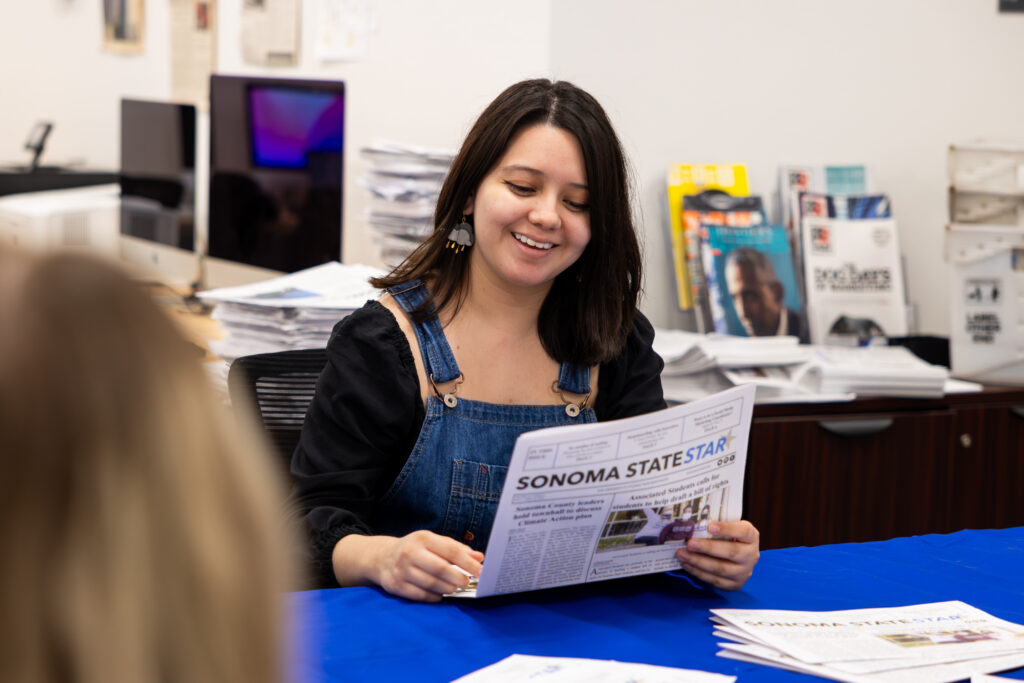
Ally Valiente in the Sonoma State Star newsroom.
Credit: Dennae Taylor
If you’d asked me last summer where I saw myself after college graduation, I would have said I pictured myself working at a local newspaper, typing at my computer with notes scattered across my cubicle as I wrote the latest story. My degree and my tenure as the editor-in-chief for my university’s newspaper, the Sonoma State Star, gave me that confidence.
The reality is a bit different. While I am fortunate to spend my summer continuing my internship with EdSource, my primary job and source of income comes from working as a barista at my local coffee shop.
That’s not to say I am ashamed of working a retail job. In fact, I’m grateful to have a job in this economy.
Currently, the rate of unemployment among graduates between the ages of 22 and 27 is nearing 6%, above the national unemployment rate of 4.2%.
Potentially more than half of college graduates end up working in jobs that do not fully utilize their degrees. According to The Wall Street Journal, “Roughly half of college graduates end up in jobs where their degrees aren’t needed, and that underemployment has lasting implications for workers’ earnings and career paths.”
“People always ask me when I’m going to get a ‘real job,’” said Claire Cruse, a UC Santa Cruz graduate. “To me, (working as a barista) is a real job. Any job is a real job, and I wish people my age, and any age, would understand that.”
Cruse graduated with a major in linguistics in 2023 and currently works three jobs — as a barista for Peet’s Coffee, a swim instructor and an assistant for her mother’s law firm.
“It’s OK (for recent graduates) to panic, but it’s also OK to step back, pause and breathe. It’ll all work out,” Cruse said.
She believes that the current job market was part of why she had been hesitant in pursuing a career in linguistics.
“I’m scared of it. Entry-level jobs require multiple years of experience. How does that make any sense?”
A study published by the National Library of Medicine in 2022 noted that recent graduates were experiencing more anxiety and stress in a post-Covid-19 job market. The study recommends developing “intervention strategies” to reduce job-seeking anxiety, along with providing more focused career planning “to improve the positive attitude towards desired job selection.”
As a result, graduates — specifically those in their early to mid-20s — have experienced weaker mental health status and self-identity. It has also led to chronic problems of insomnia, depression and a lack of motivation.
In an effort to navigate a challenging job market, many graduates are pursuing opportunities outside their chosen fields of study. They’re employed in careers that require college degrees, but not necessarily the ones they have.
Olivia Keeler graduated from Sonoma State University in 2024 with a bachelor’s degree in communication and media studies. At Sonoma State, Keeler dedicated her time to being editor-in-chief of the Sonoma State Star, as well as on air for KSRO 1350 AM, Sonoma County’s talk and local news radio station.
Although Keeler continues to be passionate about journalism, she ultimately decided to pursue a career in marketing. She was going to attend a graduate school program this past fall, but when she was offered a position in marketing, she couldn’t pass it up.
“Journalism was a key focus of mine … (it’s) something that I’ll always be passionate about and possibly something I’ll pick up again one day. But marketing is a field I see longevity and incredible value in,” Keeler said. “Gratefulness isn’t enough to describe my pivot into the marketing world right after graduation.”
To combat the rising anxiety and stress many graduates face, the California State University system is launching a new initiative, tentatively called the Beyond Completion Project 2025, which aims to measure and improve the system’s effectiveness at placing graduates into fulfilling careers in their chosen field or into graduate school.
According to an outline of the initiative, Beyond Completion Project 2025 aims to ensure that all students, regardless of their background, have the opportunity to graduate in a timely manner and contribute to California’s workforce.
Although it is not the permanent solution to a growing problem, it is about time that this issue was addressed, and it is a step in the right direction. It’s OK if it takes months, maybe even years, to land the job you want. It’s OK to change your mind about what you want to do after graduation.
“Explore paths you didn’t exactly plan for yourself. Your degree doesn’t put you in a box, and the job market has proved to reward people that can build dynamic skills. Stay flexible, patient and hopeful,” Keeler said.
As for me, I’m still trying to figure it all out. And that’s alright. I simply need to remember that I am not behind, just moving at my own timeline.
•••
Ally Valiente is a recent graduate in communications/media studies and English from Sonoma State University and a member of EdSource’s California Student Journalism Corps.
The opinions expressed in this commentary represent those of the author. EdSource welcomes commentaries representing diverse points of view. If you would like to submit a commentary, please review our guidelines and contact us.