How to Get Residency for In-State Tuition (And Actually Qualify)
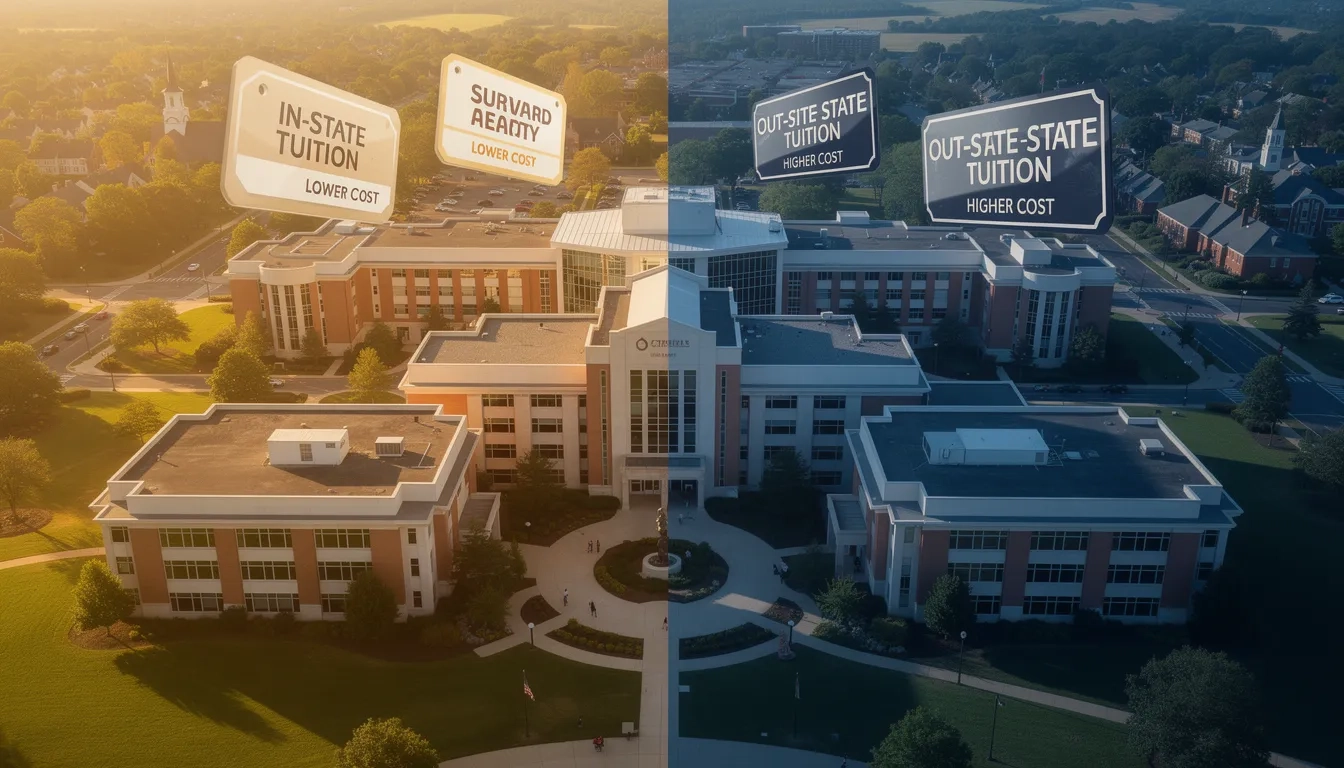
The gap between in-state and out-of-state tuition at public universities isn't a rounding error. According to 2025 data from the Education Data Initiative, the average out-of-state tuition at a four-year public university runs $28,297 per year. The average in-state rate? $9,750. That's an $18,547 annual gap, or over $74,000 across four years — before room, board, or textbooks enter the picture.
Most students accept out-of-state status as a fixed fact. For a meaningful number of people, it isn't.
Why States Charge Non-Residents So Much
Public universities receive subsidies from state tax revenue. Families who've paid into that system for years get the discounted rate. Out-of-state students haven't, so they're billed closer to the actual cost of instruction.
The underlying logic is defensible — the price difference is still brutal. You're paying the real cost, not the taxpayer-supported one.
This is also why universities guard residency classification carefully. They know families are motivated to claim it. They've built years of case law and internal policy to close gaps. Getting residency isn't impossible, but it takes more than signing a lease.
Domicile vs. Physical Presence: The Gap Most Guides Ignore
Here's what most explainers get wrong. You don't just need to live in a state. You need to be domiciled there.
Domicile is a legal concept. It means the place you intend to make your permanent home. You can only have one domicile at a time. A summer internship doesn't establish it. Living in a dorm doesn't either.
"Residency establishment should not have commenced around the time the student applied for admission." — FinAid.org, summarizing how most university residency offices evaluate claims
That sentence is doing a lot of work. If you moved to a state specifically to enroll at a cheaper in-state rate, most admissions offices will see through it. What they're looking for is someone who relocated for a genuine, non-educational reason — a job, family, a partner — and who happens to be attending school there.
Intent is the variable that's hardest to fake and easiest to document honestly. The difference between an approved and rejected petition usually comes down to the timeline of your move and what drove it.
Dependent vs. Independent Students: Two Different Games
This is the biggest fork in the road, and many families don't realize how different the two situations are until it's too late.
If you're a dependent student — meaning your parents claim you on taxes or provide more than half your financial support — your residency follows your parents'. Period. If your family lives in Ohio and you're attending the University of Colorado, you're an out-of-state student. It doesn't matter that you've spent three years in Boulder.
The only real path for dependent students is having a parent actually relocate to the state. Some families do plan around this, particularly when one parent can work remotely. Whether it pencils out financially depends on moving costs, any income disruption, and how many years remain until graduation.
If you're an independent student, the options open up. But "independent" is harder to establish than most people assume.
States don't take your word for it. They want evidence of genuine financial self-sufficiency — no significant parental support, no out-of-state loans from family. And they want time. Most states require 12 consecutive months of in-state residency as an independent adult before your first day of classes. California and Arizona push that to 24 months. Alaska requires a full two years. Arkansas sits at the other end: six months. Minnesota specifies a calendar year rather than just 12 months, which changes when the clock effectively starts.
The Documentation That Actually Moves the Needle
When you petition for residency or reclassification, not all documents carry equal weight. Residency officers distinguish between primary evidence (things that directly prove where you live and work) and supporting evidence (things that reinforce the picture but don't stand alone).
| Document Type | Category | Weight |
|---|---|---|
| State/federal tax return with in-state address | Primary | High |
| Full-time permanent employment in-state | Primary | High |
| Home purchase (mortgage or deed) | Primary | High |
| State driver's license (surrendered out-of-state one) | Primary | High |
| Voter registration | Primary | High |
| Apartment lease | Secondary | Medium |
| Vehicle registration | Secondary | Medium |
| Utility bills | Secondary | Medium |
| Local bank account | Secondary | Low–Medium |
| Library card | Supporting | Low |
The FinAid.org guidance recommends having at least two government-issued documents dated 12 or more months before your first day of classes, with at least one from the primary category.
One underrated move: filing a Declaration of Domicile with the county clerk in your new state. It's a legal document declaring where you intend to establish permanent residence. Not every state has this mechanism, but where it exists, residency offices treat it seriously. Think of it as planting your flag — officially, on paper, with a notary stamp.
The more your documentation shows someone who has genuinely planted roots in the state, the stronger your case. A driver's license alone won't do it. A driver's license plus a W-2 from an in-state employer plus a year of tax returns? That's a different story.
Exceptions That Actually Let You Skip the Wait
Several categories of students can bypass the standard 12-month waiting period.
Military and veterans get the most favorable treatment by far. Federal law under the Veterans Access, Choice, and Accountability Act (the Choice Act) requires public colleges to provide in-state tuition to veterans and eligible dependents using GI Bill benefits, regardless of how recently they moved to the state. Active-duty service members stationed in-state, along with their spouses and dependents, typically qualify immediately.
Employment relocation is another legitimate bypass. States including Alabama, Colorado, and Georgia waive durational requirements when a parent relocates specifically for full-time permanent employment. If you accept a job offer and start working in-state before enrolling, that timeline supports your claim.
Marriage to a state resident resets the clock in many states. Worth knowing if it applies to your situation.
Other categories worth researching for your specific state:
- Children of first responders killed or permanently disabled in the line of duty
- Orphans or former foster youth who attended high school in the state
- Students with dependent children of their own
- State government employees and teachers in select states
Reciprocity Programs: Cheaper Tuition Without Relocating
If moving isn't realistic, regional reciprocity programs deserve a serious look. These are agreements between neighboring states to offer residents discounted or in-state rates at each other's public universities.
The four major programs:
- Midwest Student Exchange Program (MSEP): Covers Illinois, Indiana, Kansas, Michigan, Minnesota, Missouri, Nebraska, North Dakota, and Wisconsin. Participating schools charge no more than 150% of their in-state rate to eligible students from member states.
- New England Regional Student Program (NERSP): Managed by the New England Board of Higher Education. Offers reduced rates when your home state doesn't offer your intended major at a public institution.
- Western Interstate Commission for Higher Education (WICHE): Covers 16 Western states. Includes an undergraduate exchange and a Western Regional Graduate Program with in-state rate access at many flagship schools.
- Southern Regional Education Board Academic Common Market (SREB ACM): Serves 16 Southern states, focused on graduate and specialized programs unavailable in the student's home state.
If you're in the West and haven't checked WICHE availability for your intended major at schools like the University of Arizona or Oregon State, that's worth doing before paying an application fee. These programs cover a lot of ground and go underused simply because families don't know they exist.
Getting Reclassified After You've Already Enrolled
Some students start as out-of-state, establish genuine residency during college, then apply for reclassification. This path works — but it's harder than it sounds, and varies dramatically by institution.
California's UC system is the toughest case. The UC Office of the President states explicitly that "virtually all nonresident undergraduates with nonresident parents remain nonresidents" throughout undergrad. Graduate students and financially independent students have a real path: 366 days of continuous California presence plus documented intent. Dependent undergrads face a near-closed door.
Other states are more flexible. The general reclassification process:
- Check your school's reclassification deadline — usually the semester before the rate you want takes effect
- Gather primary documentation proving 12+ months of residency with clear intent markers
- Submit a formal petition to the registrar's office
- Appeal in writing if denied, with additional supporting documentation
The most common mistake is waiting. Students who establish genuine residency at the start of sophomore year but don't apply until senior year leave real money on the table. Even one year of in-state rates at a school like Michigan or Vermont is worth the paperwork.
Patterns That Get Petitions Rejected
Residency officers have seen every angle. A few that consistently fail:
- Using a grandparent's or family friend's address without actually living there
- Moving to the state the summer before enrollment with no other established ties
- Claiming independence while parents still pay rent, tuition, or living expenses
- Getting an in-state driver's license while filing federal taxes with an out-of-state address
These tactics are transparent, and getting caught isn't just a rejection. Some universities back-bill students for the full out-of-state tuition difference going back to enrollment — which can reach six figures at a school like UVA or Michigan.
The honest path is the only one worth taking. For students who genuinely relocate, build real ties, and document everything from the start, it holds up.
Bottom Line
- Run the numbers first. The average four-year gap between in-state and out-of-state tuition at public universities exceeds $74,000. That's worth planning around seriously.
- Dependent students need a parent to move. There's no workaround — the state tracks parental domicile, not just where the student lives.
- Independent students: start documenting on day one. File your taxes with the in-state address, get the driver's license, register to vote, and ideally secure employment. Don't wait until you need the reclassification.
- Check reciprocity programs before ruling out a school. WICHE, MSEP, SREB, and NERSP collectively cover most of the country and can deliver near-in-state rates without relocating.
- Military and veterans: the Choice Act has you covered. In-state tuition access is a federal right for GI Bill users, regardless of how recently you arrived.
The students who save the most aren't gaming the system. They're the ones who plan a year or two out, make a real move, and document everything from the start.
Frequently Asked Questions
Does living in the dorms for a year count toward residency?
No. Time spent in campus housing typically doesn't count because the primary reason for being there is education, not establishing a permanent home. Most states explicitly exclude dormitory residency from the calculation, and residency offices know to look for this.
Can I appeal if my reclassification petition is denied?
Yes. Gather additional documentation — especially anything showing you established in-state ties for reasons unrelated to tuition savings. Most universities have a formal appeals process through the registrar or a residency review committee. A well-documented written appeal reverses more denials than people expect.
Does getting an in-state driver's license automatically qualify me for in-state tuition?
No, and this is one of the most common misconceptions. A driver's license is supporting evidence, not proof of residency on its own. Qualifying requires both physical presence and demonstrated intent to remain permanently — which typically means tax filings, employment records, and a documented pattern of behavior showing the state is your actual home base.
Do undocumented students qualify for in-state tuition?
It depends on the state. As of 2026, at least 21 states — including California, Texas, and New York — allow undocumented students who attended high school in-state to qualify for in-state tuition. Requirements vary, so checking directly with the institution's admissions office is the right first step.
Is there a path to near-in-state tuition without moving?
Yes. Regional reciprocity programs like WICHE, MSEP, SREB Academic Common Market, and the New England Regional Student Program can provide in-state or heavily discounted rates at out-of-state public schools. Eligibility often depends on whether your intended major is unavailable at your home state's public institutions.
How does the GI Bill specifically affect tuition classification?
Veterans using Post-9/11 GI Bill (Chapter 33) or Chapter 30 benefits are entitled to in-state tuition at any public college in the state where they enroll, regardless of how recently they moved there. This is federal law under the Veterans Access, Choice, and Accountability Act of 2014. Eligible dependents of veterans often qualify as well — check with the school's veterans services office for the specific paperwork required.
Sources
- In-State Tuition and State Residency Requirements - FinAid
- Average In-State vs. Out-of-State Tuition - Education Data Initiative
- State Residency Requirements for In-State Tuition - SavingForCollege
- How to Establish Residency - University of California Office of the President
- State & Regional College Tuition Discounts - NASFAA
- Residency Requirements FAQ - Colorado Department of Higher Education