First look at 2026-27 state budget: Schools and community colleges are fine — for the moment
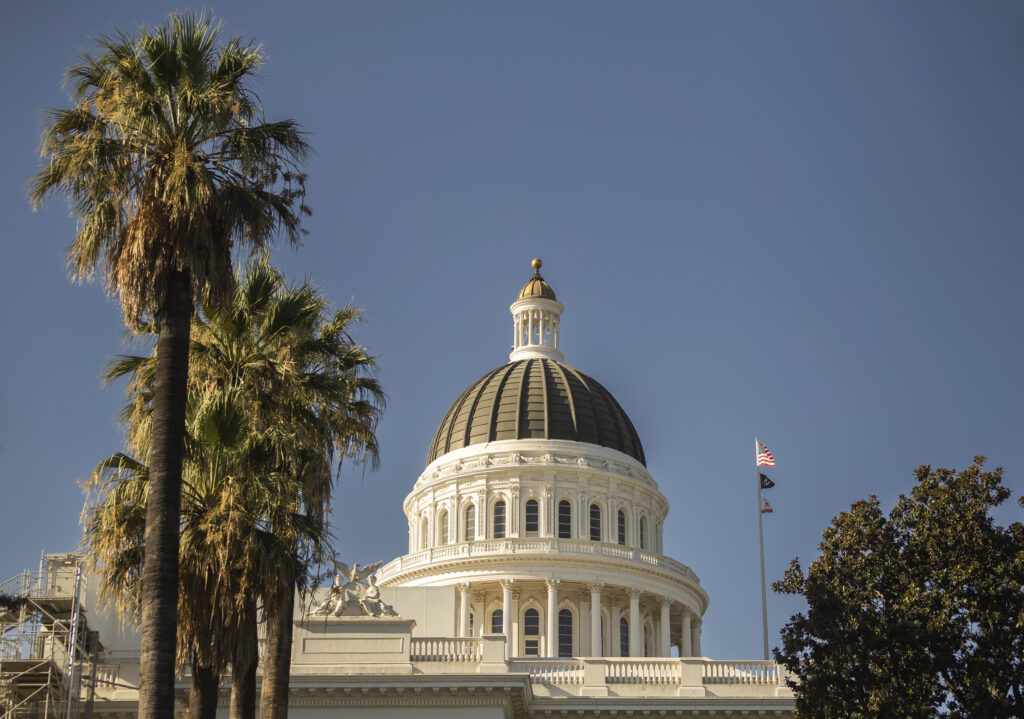
The California State Capitol in Sacramento.
Credit: Rahul Lal/Sipa USA/Sipa via AP Images
Top Takeaways
- Soaring AI stock values and lavish employee pay feed a volatile tax structure.
- Schools and community colleges will get the bulk of the unanticipated growth in revenue.
- The state’s structural deficit will mushroom without more revenue or spending cuts.
Surging tax revenue from Silicon Valley’s big bet on artificial intelligence will produce greater-than-expected funding for schools and community colleges in California in the short run. But how long will the AI investment boom last?
That’s the billion-dollar question that the Legislative Analyst’s Office asks in its forecast of the 2026-27 state budget that it released Wednesday. Its answer: Caution — it probably won’t last for long.
In its annual November budget analysis, the independent and nonpartisan LAO projects that funding for schools and community colleges will grow by $7.4 billion, which is 2.2% more than the Legislature estimated when it passed the current 2025-26 budget in June.
But the surge in income tax revenue from AI employees’ “extraordinary salaries” and soaring stock prices of a handful of AI-related firms like Google, Meta and Nvidia will slow, maybe by next summer, with sobering prospects for the larger state budget, Legislative Analyst Gabriel Petek said during a press conference. And the forecast assumes there won’t be what some economists are projecting — a recession, which would leave the state budget with tens of billions of dollars in less revenue, the LAO said.
“With so much exuberance surrounding AI, it now appears time to take seriously the notion that the stock market has become overheated,” the LAO wrote.
The LAO’s forecast is the starting line for a seven-month stretch leading to the passage of the state budget by June 15. By Jan. 10, Gov. Gavin Newsom will release the first draft of his final state budget as governor; it will benefit from two more months of revenue reports. His revised budget in mid-May will likely differ significantly from his January budget and the LAO’s revenue projection.
The level of education funding will be set by Proposition 98, the three-decade-old formula that determines the portion of the state’s General Fund that’s committed to schools and community colleges. Usually, it’s roughly 40%. But schools and community colleges get first dibs on new money when the state is in arrears on its obligations to education. And that will be the case next year, when it will receive closer to two-thirds of the $11 billion in additional projected revenue for the General Fund. It will include $1.9 billion that the Newsom administration did not fully pay from the 2024-25 estimated guaranteed minimum funding from Prop. 98.
Meeting the Prop. 98 obligations will leave less new funding for other areas covered by the General Fund, including California State University and the University of California, along with child care and preschool programs not funded by Prop. 98.
After covering an estimated 2.51% statutory cost-of-living increase for the Local Control Funding Formula and other programs, districts and community colleges will have about $7 billion in one-time money from higher-than-expected revenues from 2024-25 and the current fiscal year. The LAO estimates the minimum Prop. 98 guarantee will be $117.8 billion, an increase of $3.2 billion (2.8%) from the previously enacted budget.
Eliminating state late payments to districts, known as deferrals, and partially replenishing a depleted Prop. 98 rainy day fund would leave little for new programs. “Most education leaders agree that investing in the funding formula would be a priority over new one-time, categorical programs,” said Derick Lennox, senior director of governmental relations and legal affairs with the California County Superintendents.
There will also be discussions about which of the programs that Newsom created with one-time money, including creating community schools and hiring literacy coaches for elementary schools, should be funded moving forward, Lennox said.
Most districts and community colleges will nonetheless face fiscal pressures from higher costs on expenses not covered by cost-of-living adjustments (COLA), including health benefits, declining enrollment, and continued high chronic student absences. State funding is based on student attendance, which in turn is tied to enrollment.
Districts are likely to see direct cuts of hundreds of millions of dollars in federal funding for homeless and migratory students and English learners, teacher recruitment and training grants, mental health clinicians, and money for tutors and counselors through programs like AmeriCorps. The state would see $1.3 billion in increased costs and fewer beneficiaries for Medi-Cal and supplemental nutrition known as CalFresh under rule changes in the pending federal budget.
The LAO tamped down expectations that the state would have money to backfill losses in federal funding without reducing existing programs or raising taxes or fees. ”That, I think, will be a particularly difficult conversation for the Legislature this year,” Chief Deputy Analyst Carolyn Chu said during the press conference.
The state’s projected $13 billion structural deficit, which it attributed to constitutional spending requirements, including Prop. 98, will grow $5 billion more to $18 billion in 2026-27, then double to $35 billion a year later, LAO said. “If our estimates hold, the Legislature will face a fourth consecutive year of budget problems—all during a period of overall revenue growth. As it stands,” the LAO wrote. “California’s budget is undeniably less prepared for downturns.”