Fallout from shutdown could be lengthy, school leaders say
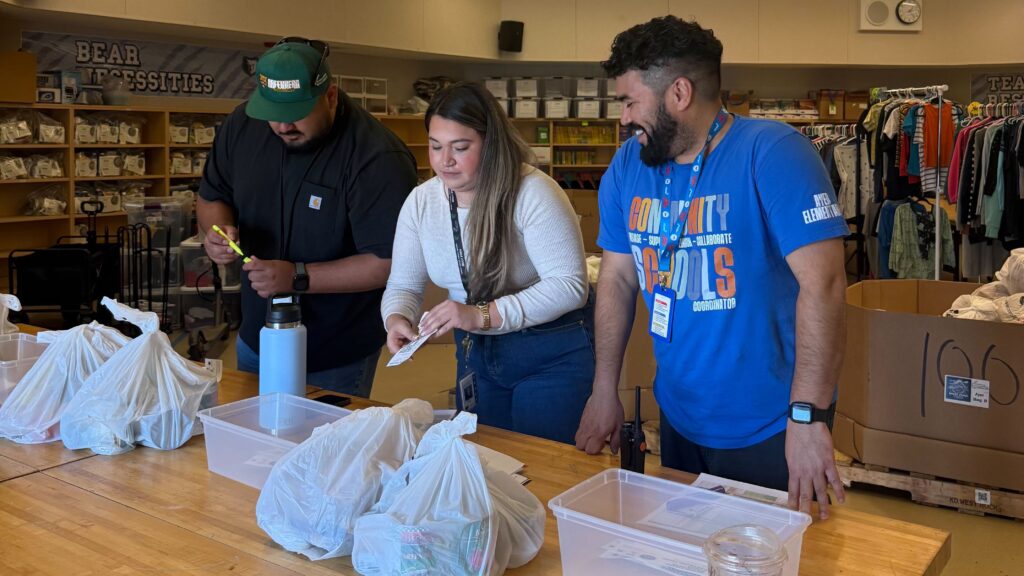
Manuel Rocha Salazar, Emily Rivas and Sal Lucatero, Fresno Unified community school coordinators, pass out meal bags at Ayer Elementary School on Friday, Nov. 7, 2025.
Courtesy of Fresno Unified Community Schools
With the government shutdown over, school communities will grapple in the coming weeks with the upheaval and uncertainty the 43-day shutdown caused.
Students from preschool to college were affected by the loss of the Supplemental Nutrition Assistance Program (SNAP), the federal program that helps feed low-income families. In addition, schools were left without guidance for helping students with disabilities, homeless students, and children of migrant farmworkers after many U.S. Department of Education employees were laid off.
Even as the shutdown ends, it is unclear how long it will take for funding to flow and for employees to resume their usual activities.
“I don’t think anything goes back to normal after such a long shutdown,” said Barbara Duffield, executive director of SchoolHouse Connection, a national homeless advocacy organization. “You can imagine if you were out of work for many days, you wouldn’t just come back in and everything would be just as you left it.”
Schools are still scrambling to get food to families for the nearly 2 million children statewide who rely on SNAP benefits, known in California as CalFresh.
There was so much need during the shutdown that pantries and food distribution sites ran out of food at some community colleges and school districts, including Kings Canyon Unified and Fresno Unified.
“We had really nothing on the shelves to offer families,” said Stephanie Villaseñor, a Kings Canyon Unified social worker who oversees the pantries. “It was just diced tomatoes, some pizza sauce and a little bit of pasta, and nothing really that you could make a very nutrient-dense meal.”
Fresno families who reached out to Ayer Elementary, one of 29 community schools that act as a neighborhood hub with wraparound services for families, worried about not having food for their families over the weekend, according to Sal Lucatero, the community school coordinator.
Even now that the government shutdown has ended, the work of helping families continues, Lucatero said.
“We know that there’s going to be a lot of rebuilding from food pantries that were depleted of all of their food, like ours,” Lucatero said.
Los Angeles Unified, which serves about 400,000 students and some 545,000 meals each school day, has seen the average daily meal increase to 550,660, reflecting “the growing needs of our families during the ongoing federal shutdown and related impacts to SNAP benefits,” the district said in a statement.
The nonprofit Oakland Public Education Fund raised $23,000 as of Wednesday to stock school food pantries, send home groceries, and provide snacks for students.
Ali Medina, the organization’s CEO, said even if the shutdown ends, some CalFresh recipients may receive less for food assistance under the new federal spending bill signed by President Donald Trump on July 4.
“It’s really chaotic messaging and moving really fast. We know that California started funding SNAP cards, but then a day later, the White House said, ‘Don’t fund them,’” Medina said. “We’re trying to make sure we have resources to deploy to families when schools say they need them, because there’s no certainty about what’s happening at the federal level.”
The legislation to end the shutdown would also temporarily restore federal education employees who were laid off, but only until Jan. 30, the next deadline for Congress to fund the government. Some members of Congress, including Rep. Jimmy Panetta, D-Monterey, are advocating to make reinstatement permanent for federal education employees who administer homeless and foster student programs.
Educators and advocates are concerned that if Congress fails to reach an agreement on funding bills, there could be another shutdown.
In addition, they are closely watching those funding bills. Both the House and Senate bills maintain current funding for homeless students, Duffield said, but the House bill would cut programs for English learners, students in the migrant education program, and students in foster care.
“There’s a lot at stake in what happens between now and Jan. 30,” Duffield said.