FAFSA Changes Under the One Big Beautiful Bill Act
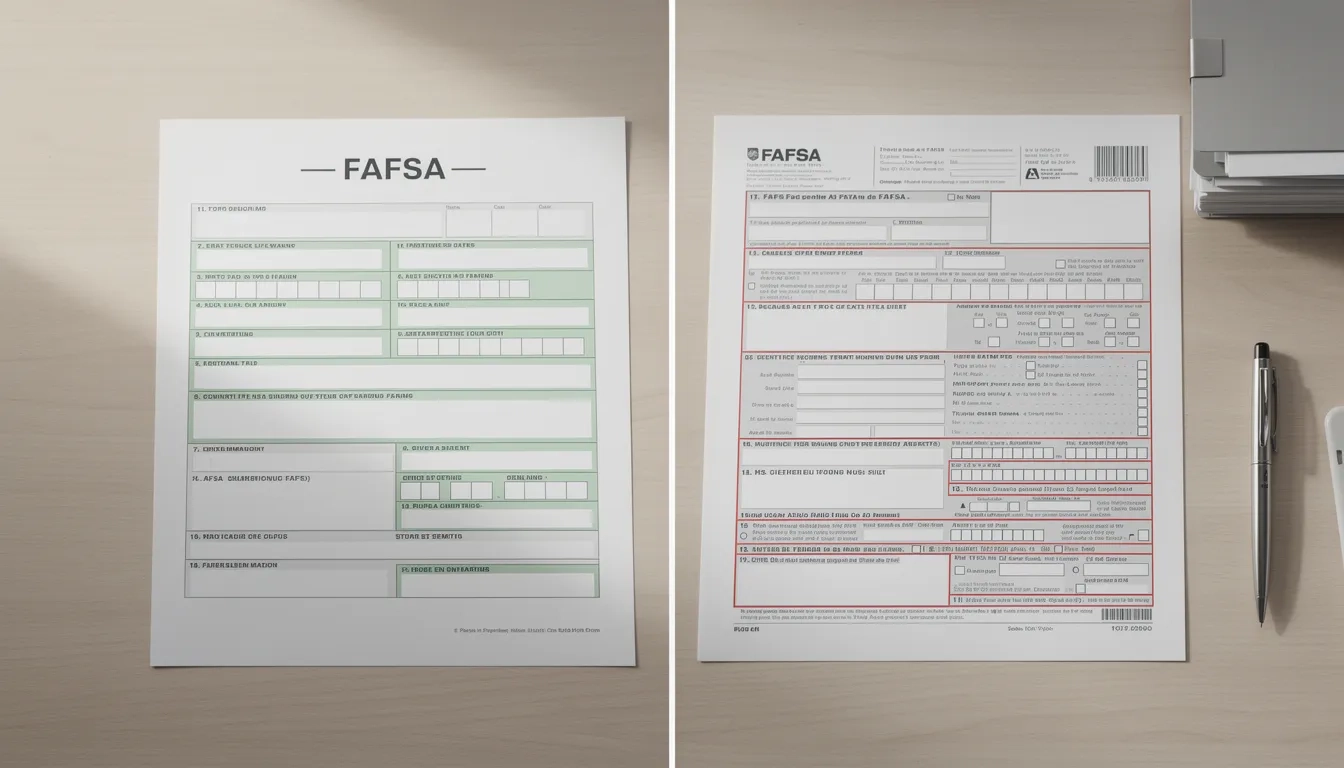
On July 4, 2025, President Trump signed the One Big Beautiful Bill Act into law. The timing was deliberate, the name was memorable, and buried past the headline tax provisions was one of the largest overhauls of federal student aid since the Higher Education Act. If you're a student, parent, or financial aid counselor navigating FAFSA for the 2026-27 school year, the rules changed. Substantially.
Not everything in the bill hurts students. Farm families and small business owners got real relief. Vocational students finally gained access to Pell Grants. But graduate students carrying large debt loads, families hovering near the middle-income Pell threshold, and anyone banking on income-driven forgiveness are facing a harder road. Here's what actually changed.
What Changed on the FAFSA Form Itself
The form moved in two directions at once.
Family business and farm assets no longer count toward your FAFSA calculations. Starting with the 2026-27 cycle, families don't need to report the net worth of a farm where the family resides, a family-owned business employing fewer than 100 full-time workers, or a family-owned commercial fishing operation. This was a long-standing frustration. A third-generation dairy farmer with land valued at $700,000 on paper couldn't exactly liquidate the operation to pay tuition, yet that asset inflated their Student Aid Index and cut their eligibility. The calculation now acknowledges that productive assets aren't liquid cash.
The practical move for farm and small business families: re-run a FAFSA estimate with these exclusions. Your SAI may drop enough to open eligibility you didn't expect.
Foreign income now counts toward Pell calculations. This is the opposite direction, and it catches a lot of expat families off guard. Under prior rules, income sheltered from taxes via the IRS foreign earned income exclusion (which in 2025 allowed Americans working abroad to exclude roughly $126,500 in overseas earnings from federal income tax) also got excluded from financial aid calculations. OBBBA closes that gap. That excluded income gets added back to AGI when the Education Department calculates Pell eligibility. If your family claims the exclusion, that door has now closed on the aid side too.
Pell Grants: New Walls, One New Door
Two new restrictions and one genuine expansion took effect July 1, 2026.
The SAI ceiling is the most impactful new restriction. Students whose Student Aid Index reaches $14,790 or higher — exactly twice the current maximum Pell award of $7,395 — are no longer eligible for any Pell Grant. Before OBBBA, a family with SAI of $15,000 still qualified for a small grant. According to Federal Student Aid guidance published on FSA Partners in 2026, this cutoff applies immediately to the 2026-27 award year.
Stacking Pell on top of full scholarships is over. If a student's scholarships and institutional waivers already cover the full cost of attendance, no Pell Grant can be layered on top. This targeted a specific group: highly recruited students at competitive schools who received merit-based full rides but still collected federal grants. FSA guidance makes it explicit:
"Students meeting or exceeding their full Cost of Attendance with scholarship/waiver aid will not be eligible for any amount of Pell Grant."
The expansion is real, though, and it matters for a group that was historically locked out. Vocational and workforce program students — including adults who already hold bachelor's degrees and are pursuing trade credentials — can now receive Pell Grants. A laid-off worker retraining for HVAC certification or a healthcare aide completing a licensed nursing program now qualifies for funding they never had access to before. One operational wrinkle flagged by Washington State University's financial aid office: administrators must manually activate a new "Enrolled in Eligible Workforce Program" field in their systems before the recalculated eligibility registers. If you're in a qualifying program and not seeing Pell, ask whether your school has set that indicator.
There's also a subtler aid calculation shift. As Fastweb reported, need-based aid now uses the national median cost for each type of program rather than the individual school's actual cost. Students at institutions priced above the national median for their program may see lower need-based packages than they would have under the old formula.
Federal Student Loan Caps Are Finally Real
For decades, federal student loans had annual limits but no lifetime ceiling that applied consistently across program types. That changed July 1, 2026.
$257,500 is the new combined lifetime cap across all federal student loans — undergraduate, graduate, and professional added together. The program-level limits break down like this:
| Student Type | Annual Limit | Aggregate Limit |
|---|---|---|
| Graduate, non-professional | $20,500 | $100,000 |
| Professional (law, medicine, dentistry, pharmacy, veterinary) | $50,000 | $200,000 |
| Parent PLUS (per child) | $20,000 | $65,000 |
| All federal loans combined | N/A | $257,500 |
Undergraduate annual limits were left unchanged.
Grad PLUS is discontinued for new borrowers. Anyone starting graduate or professional school after July 1, 2026 has no access to Grad PLUS loans at all. Students who had already borrowed Grad PLUS before that date can continue for up to three years or program completion, whichever comes first.
The math problem this creates is real for high-cost professional programs. A student entering law school in fall 2026 at a school charging $60,000/year in tuition will burn through a large portion of the $200,000 professional aggregate before finishing — factor in living expenses and you reach the ceiling faster. Once federal limits are exhausted, the alternatives are private loans at market rates (which have been running 8-12%) or stopping. Neither is an easy answer.
Loan proration is also new. New borrowers enrolled less than full-time have their federal loan amounts reduced proportionally to their credit load. Minimum half-time enrollment is required to borrow at all.
The End of Income-Driven Repayment for New Borrowers
New borrowers — anyone who takes their first federal loan on or after July 1, 2026 — have exactly two repayment options.
Option one: Standard Repayment Plan. Fixed terms of 10, 15, 20, or 25 years based on total debt. Predictable, but payment amounts can run steep for large balances early in a career.
Option two: the Repayment Assistance Plan (RAP). This is the new income-tied option. Payments are 1-10% of adjusted gross income, with a $10/month minimum and a $50-per-dependent reduction. The term is 30 years. Negative amortization is prohibited, so your balance can't compound upward while you're making minimum payments.
Every existing income-driven repayment plan — SAVE, PAYE, IBR, ICR — is closed to new borrowers. For existing borrowers with pre-July 2026 loans, the deadline to make a repayment plan choice is July 1, 2028. Miss that and you get auto-assigned to RAP. This matters more than it sounds: if you're on IBR with a 20-year forgiveness timeline, drifting into RAP's 30-year structure adds a decade of payments and significant additional interest you hadn't planned for.
Forbearance also shrinks under the new rules. For loans originated after July 1, 2027, forbearance caps at nine months in any two-year period (down from 12). Economic hardship and unemployment deferments are eliminated entirely for those newer loans. The design logic is that RAP's $10 floor makes extended forbearance redundant. Whether that holds during a serious economic downturn is a reasonable question nobody has answered yet.
One genuine improvement: defaulted borrowers can now rehabilitate a loan twice. The previous limit was once.
Gainful Employment Expands to All Schools
Before OBBBA, gainful employment rules — which measured whether program graduates could actually afford their debt — applied almost exclusively to for-profit institutions. The new law extends it everywhere.
"Gainful Employment for All" evaluates outcomes four years after program completion. For bachelor's programs, graduates must out-earn workers with only a high school diploma. For graduate programs, they must out-earn bachelor's degree holders. Failing in two of three consecutive years means loss of federal loan access. Private universities and public flagship schools face this accountability standard for the first time.
This is the right call. The argument that selective nonprofit institutions deserved an automatic exemption from earnings accountability was always more about institutional reputation than student outcomes. A credential from a well-known school that leaves graduates earning $38,000 a year on $80,000 in debt is not meaningfully better for the borrower just because of where it came from.
The Endowment Tax Gets Sharper
One change that affects students indirectly: OBBBA restructured the endowment tax on wealthy private universities from a flat 1.4% to a tiered system.
| Endowment per FTE Student | Tax Rate |
|---|---|
| $500,000 – $749,999 | 1.4% |
| $750,000 – $1,999,999 | 4% |
| $2,000,000 and above | 8% |
Harvard, MIT, Princeton, and Yale all hold endowments well above $2 million per student. NAICU noted in its OBBBA FAQ that the total Pell shortfall funding allocated alongside the bill exceeded $10.5 billion — which signals Congress was aware the Pell restrictions would create a funding gap that needed addressing. Whether elite institutions respond to the higher endowment tax by adjusting their own aid policies or cutting elsewhere won't be clear for a few years. Worth watching.
Bottom Line
The One Big Beautiful Bill Act is a net loss for graduate students borrowing at high levels, families just above the middle-income Pell cutoff, and anyone who was counting on income-driven forgiveness timelines that no longer exist for new borrowers. It's a genuine win for farm and small business families, vocational students, and defaulted borrowers who get a second shot at rehabilitation.
Here's what to actually do before the 2026-27 award year:
- Check your SAI against $14,790. Log into studentaid.gov and use the FAFSA estimator. If you're at or above that threshold, Pell eligibility may be gone for next year.
- Graduate students: map your borrowing now. Add existing undergraduate debt to your projected graduate borrowing. Check where you land against the $257,500 lifetime cap and your specific program aggregate.
- Don't sleepwalk into RAP. If you have pre-July 2026 loans on an IDR plan, July 1, 2028 auto-assigns you to RAP's 30-year structure if you do nothing. Evaluate before that deadline.
- Vocational program students: confirm Pell eligibility with your aid office. Schools must manually activate the workforce enrollment indicator. Don't assume — ask.
- Farm and small business families: re-run the FAFSA estimate. Asset exclusions could shift your SAI and open up aid you weren't expecting.
Frequently Asked Questions
When do these FAFSA changes actually take effect?
Most changes are effective July 1, 2026, applying to the 2026-27 award year. The FAFSA form itself was updated in September 2025 to capture the new asset exclusions and workforce program fields. Federal Student Aid's processing systems were updated April 26, 2026. A second round of changes — covering forbearance limits and the elimination of hardship deferments — applies to loans originated after July 1, 2027.
I currently have federal student loans. Does the OBBBA affect my existing debt?
Borrowers with loans originated before July 1, 2026 keep their current loan limits and can remain on existing repayment plans for now. The critical date is July 1, 2028: that's when you must actively choose a repayment plan or get auto-assigned to RAP. Students already using Grad PLUS before the cutoff date can continue borrowing for three years or program completion, whichever comes first.
Is it true that a full scholarship disqualifies me from Pell?
Yes, but only when scholarships and waivers cover your entire cost of attendance. If your scholarship covers tuition but not room and board, your full cost of attendance isn't met, and you may still qualify for Pell. The restriction targets students whose aid package eliminates all remaining financial need — a real group, but a specific one.
What is the Repayment Assistance Plan and how does it compare to older IDR plans?
RAP is the only income-tied repayment option for new borrowers starting after July 1, 2026. Payments run 1-10% of AGI with a $10 floor and a $50-per-dependent reduction. The main drawback compared to PAYE or SAVE is the 30-year term — older plans offered forgiveness after 20 years for undergraduate borrowers. Total interest paid under RAP will generally exceed what would have accumulated on a shorter IDR plan.
Who actually benefits from the OBBBA financial aid changes?
Farm and small business families benefit from the asset exclusions, potentially seeing significant drops in their SAI. Vocational students with existing bachelor's degrees gain Pell access they never had before. Defaulted borrowers get a second crack at loan rehabilitation, up from one chance. And the prohibition on negative amortization in RAP prevents the balance-growth trap that burned some borrowers under the old SAVE plan.
What options do graduate students have when they exceed the new federal loan caps?
Once federal limits are exhausted, the realistic options are private student loans (at market rates significantly higher than federal rates), institutional loans offered directly by the school, external fellowships and grants, or employer tuition assistance for working professionals. Private loans carry no income-based repayment protections and no path to federal forgiveness. This is the scenario where comparing programs by total net cost — not just sticker price or rankings — matters more than it ever has.
Sources
- One Big Beautiful Bill Act FAFSA Processing Updates – Federal Student Aid Partners
- One Big Beautiful Bill Act: 2026-27 Changes to Federal Financial Aid – Washington State University
- How the Big Beautiful Bill Reshapes College Costs, Financial Aid, and Student Debt – Fastweb
- Frequently Asked Questions About the One Big Beautiful Bill Act – NAICU